





































































































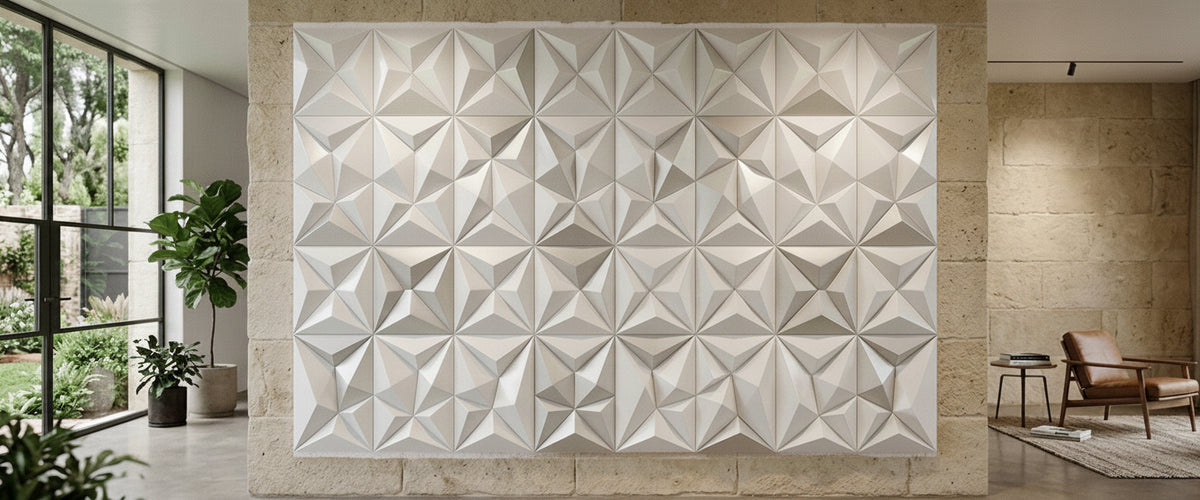

A flat pattern printed on canvas can look sharp in a photo and dead on the wall. That gap is exactly why 3D geometric wall art keeps pulling designers and collectors back to real relief, faceted panels, and metalwork that catches light instead of pretending to. A geometric piece behaves like architecture. Get the depth, spacing, and viewing distance right and it reorganizes a whole room. Get them wrong and you have an expensive texture nobody looks at twice.
Looking for the full range in this category? Browse our Wood Art collection for every available finish, size, and configuration of 3D geometric wall art.
Below is how our studio actually thinks about these commissions, from the first sketch to the day it goes on the wall. Not theory. The questions we ask, the mistakes we have watched buyers make, and the decisions that quietly decide whether the finished piece sings.

3D Geometric Wall Art at a Glance
Depth is the whole point. Relief height and facet angle control how the piece changes as you walk past it.
Viewing distance drives scale. A design tuned for 10 ft (3 m) can fall apart at 30 ft (9 m), and vice versa.
Material sets the mood. Wood warms, mirrored metal energizes, bronze and steel add weight and permanence.
Bespoke beats off-the-shelf at scale. Above roughly 6 ft (1.8 m) wide, panel joins and mounting need real engineering.
Budget depends on inputs. Material, size, complexity, finish, and installation all move the number; ask for a tailored quote rather than trusting a flat price.

What Sculptors Weigh Up Before Taking On a Commission
The first thing we want is not a style. It is a wall, a light source, and a distance. Before anyone talks about triangles or hexagons, we need to know how far back the main viewer stands, whether the light rakes across the surface or hits it flat, and what the piece has to hold its own against. A 20 ft (6 m) atrium wall and a snug study demand completely different geometry, even if the client loves the same reference image. Good 3D geometric wall art starts with those facts, not a mood board.
Light matters more than most buyers expect. Raking light, coming in at a low angle across the surface, is what makes a geometric relief read as sculpture rather than decoration. Shadows deepen the facets and the piece gains real presence. Flat frontal light flattens everything, so if a wall only ever gets even ceiling wash, we lean into deeper relief or reflective finishes to create the contrast the room won't.
We also ask the unglamorous questions early. What is behind the wall? Stud, brick, concrete, or glass changes the entire mounting strategy. A heavy bronze relief needs fixings anchored into something that can carry the load, and we would rather design for that on day one than improvise on install day. Most 3D geometric wall art fails at the fixing stage, not the design stage.

Craft Decisions That Change the Result (and the Price)
Three levers do most of the work on any piece of 3D geometric wall art: material, relief depth, and finish. Each one shifts both the look and the cost, so it helps to understand what you are actually choosing.
Material. For wood wall art geometric pieces, timber gives you warmth and a grain that reads beautifully in domestic spaces, though it wants a stable indoor climate. Mirrored geometric wall art in polished stainless steel does the opposite job; it throws light and color from the room back at you, so the piece never looks the same twice across a day. Bronze and Corten bring mass and patina that suit larger, more permanent installations, indoors or out. Where the composition calls for crisp contemporary color rather than metallic weight, a painted composite panel such as the Prisma White Geometric Panel 3D Wall Art lets the geometry and hue do the heavy lifting; the same form in the Prisma Blue Geometric Panel 3D Wall Art pushes the effect toward a bolder, more saturated register if the wall can carry it.
Relief depth. Shallow relief, say under an inch (25 mm), reads as texture. Deep relief, several inches of variation, reads as sculpture and casts real shadow. Deeper facets mean more material, more machining or hand-finishing, and heavier panels that need stronger mounting. That is where the cost of 3D geometric wall art climbs, and it is usually money well spent when the piece has to command a big wall.
Finish. A matte painted surface hides fingerprints and softens light. A mirror polish demands flawless underlying metalwork because it shows every imperfection. Powder coating, patina, brushed steel, and clear lacquer each carry different maintenance and different price implications. There is no single right answer; there is only the right answer for your wall and how you live with it.

Why Some Designs Read Right at 10 ft and Wrong at 30
This is the mistake we correct most often with 3D geometric wall art. A buyer falls for a design with tight, intricate facets, then hangs it on a wall people mostly see from across a large room. At distance, that fine detail collapses into visual noise. The eye can't resolve it, so the whole thing turns gray and busy.
The fix is to match facet size to viewing distance. Close-range pieces in a hallway or above a console can carry delicate, layered geometry because people pass within a few feet. A double-height living room or a commercial lobby needs bolder forms, wider planes, and stronger tonal contrast so the composition still holds from 30 ft (9 m) back.
Scale of individual modules matters as much as overall size. We often build a large geometric field from repeated units, and the size of each unit is a deliberate choice tied to distance, not a manufacturing default. If you are browsing the 3D wall art collection, look at the module size relative to the room in each shot, not just the total footprint.
Our Studio Process: Maquette, Sample, Fabrication, Install
Bespoke 3D geometric wall art runs through four stages, and skipping any of them is where projects go sideways.
Maquette. We build a scaled model or detailed digital render so you can see how the geometry behaves in three dimensions before committing. A pattern that looks balanced flat can feel lopsided once it has depth.
Sample. For finish-critical pieces, especially mirrored or patinated metal, we produce a physical sample of the actual material and finish. Screen color lies. A brushed steel sample in your own light tells the truth.
Fabrication. The piece is cut, formed, and finished in the studio. Large works are engineered as panels with concealed joins so the composition reads as one field, not a grid of seams.
Install. We plan the mounting system around the wall substrate and the panel weight. For heavy relief we design hidden French cleats or bracket systems rated well above the load, because a geometric piece that shifts even slightly ruins the alignment that makes it work.
One recent lesson worth sharing: on a wide reflective commission, we underestimated how much a client's warm evening lighting would pull the color of the whole panel. The daytime sample looked cool and architectural; at night it read amber. We now sample under the client's actual bulbs whenever reflection is central to the design. Small detail, big difference.
How to Make Geometric Wall Art Yourself, and When to Commission
Plenty of people ask how to make geometric wood wall art at home, and for a modest accent piece it is a genuinely satisfying project. The honest version: plan the pattern on paper first, cut clean modules with consistent angles, stain or paint before assembly so edges look sharp, and mount to a hidden backing board rather than fixing each piece to the wall. Precision at the cutting stage is everything; sloppy angles show instantly in raked light.
Where DIY stops making sense is scale and permanence. Once a piece of 3D geometric wall art needs to span a stairwell, survive outdoors, or carry the weight of bronze or steel, the engineering and finishing move beyond a weekend build. That is the point to commission. A studio like Giant Sculptures exists precisely for the large, structural, long-life end of the spectrum, where a wall becomes a single considered surface rather than a craft project. If you want the warmth of timber at that scale, our wood wall art range shows how far the material can be pushed with proper fabrication behind it.
Honest Red Flags to Ask About Before You Commit
Good questions protect your money. Ask any maker of 3D geometric wall art the following before signing off.
How is it mounted, and what is my wall made of? Vague answers here are a warning sign. Weight and substrate should be discussed early, not at delivery.
Will I see the joins? On large panels, ask exactly how sections meet and whether the seam falls on a natural line in the geometry.
Have you sampled the finish in my lighting? For mirrored or patinated work especially, insist on this.
Indoor or outdoor rated? Timber and many coatings are indoor only. If it is going in an outdoor courtyard, the material and fixings must suit weather and UV. The American Institute for Conservation is a useful reference on how different materials age and what environmental stress does to them over time.
What does aftercare look like? A reputable maker will tell you how to clean it and what to avoid without hesitation.
Geometric relief is one of the most forgiving styles to live with and one of the least forgiving to make. The margins are tight, the alignment is unforgiving, and the difference between 3D geometric wall art that reads as art and a piece that reads as wallpaper comes down to decisions made long before anything is cut. Get those right, on your wall, in your light, and a faceted geometric field can hold a room for decades.
For wider placement ideas, 3d Printed Wall Art: What Sculptors Weigh up Before Saying Yes is useful companion reading before finalising the setting and sightlines for your 3D geometric wall art.