






















































































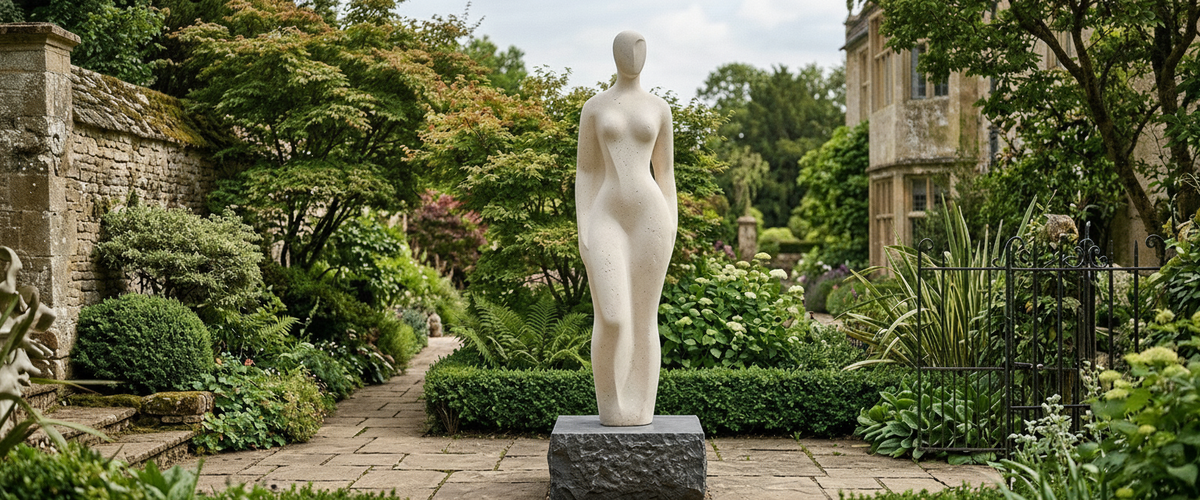

A large stone sculpture garden piece is decided long before anyone touches a chisel. Get the size, the stone and the sightlines right on paper, and the finished work looks inevitable. Get them wrong, and no amount of surface polish saves it. That gap between a piece that anchors a garden and one that just sits there is mostly craft judgment, and most of that judgment happens in the first two weeks of a large stone sculpture garden commission.
Looking for the full range in this category? Browse our Large Garden Statues collection for every available finish, size, and configuration.
We field a lot of questions from buyers who have already picked a spot and want to know what fills it. The honest answer is that the spot dictates far more than people expect: the fall of the land, the backdrop, how far away the viewer usually stands. Here is how a serious studio actually thinks a large stone sculpture garden through.

Key Takeaways for a Large Stone Sculpture Garden
- Scale is set by viewing distance, not room. A form that reads at 10 ft (3 m) can look thin at 30 ft (9 m).
- Stone choice drives cost, weathering and detail. Marble, limestone and granite behave very differently over decades.
- The base and foundation are part of the sculpture, not an afterthought. Weight lives here.
- A maquette and a stone sample should come before fabrication. Skipping them is the most expensive shortcut in the process.
- Budget depends on material, scale, complexity, engineering, installation and finishing. Ask for a tailored quote rather than trusting a flat figure.

What Sculptors Weigh Before Taking the Commission
The first conversation is rarely about the subject. It is about site. Where does the large stone sculpture garden piece live, and where do people see it from? A sculpture on axis with a long lawn needs a different silhouette than one tucked into a courtyard where you only ever meet it at close range.
We look at the backdrop early. Pale limestone reads beautifully against dark yew or a brick wall, and can vanish against a bright rendered facade or a wide open sky. We check the light: which way the garden faces, when the sculpture catches direct sun, and how deep the shadows fall across carved detail at midday versus late afternoon. Stone that looks flat at noon can come alive by late afternoon because the relief finally has raking light to work with.
Then there is the ground itself. A large stone sculpture for garden placement is a serious point load. A carved granite figure can run to several tons, and that weight has to travel through the base into a foundation that will not shift after the first hard winter. If the answer to "what is under this lawn" is a shrug, the engineering conversation starts before the design one.

Craft Decisions That Change the Result (and the Price)
Material is the biggest lever for any large stone sculpture garden. Marble carves to fine, crisp detail and holds a luminous surface, which is why it has been the choice for figurative work since antiquity, but it is more vulnerable to acid rain and freeze-thaw than people assume. The Getty's conservation guidance on outdoor marble is blunt about how surface loss accelerates once weathering starts (Getty Conservation Institute). Limestone weathers to a soft, characterful patina and suits classical and contemporary work alike. Granite is the workhorse for exposed sites: hard, dense and close to indestructible, at the cost of fine detail and a lot more carving time.
Finish is the second lever. A polished surface reflects light and reads as refined and modern. A honed or bush-hammered face holds shadow and looks older, quieter, more geological. The same block can feel like two different sculptures depending on how the last inch of surface is treated, and that final stage is labor-heavy, so it shows up in the quote.
Not every garden commission ends in solid stone. Plenty of buyers want the presence of carved rock with the movement bronze allows. Where the design needs mass at the base but energy in the form, a cast animal on a carved plinth such as Monumental Charging Bull Bronze Sculpture (Stone Base) - 200cm makes more sense than committing months of carving to a single block. The stone grounds the piece visually and gives it the weight a lawn setting needs, while the bronze carries the detail.

Why Some Pieces Read Right at 10 ft and Wrong at 30
This is the mistake we see most on a large stone sculpture garden project. A buyer falls for a form at studio distance, roughly the length of a large room, then installs it at the end of a long garden and wonders why it looks apologetic. Scale is relative to viewing distance, and distance eats detail.
At 10 ft, subtle modeling, a turned wrist, the texture of drapery, all of it registers. Push the same piece to 30 ft (9 m) and those subtleties disappear. What survives at distance is silhouette and mass. That is why monumental work is often simplified and slightly exaggerated: the carver is compensating for everything the eye loses on the way across the lawn.
A life-size figure is roughly 5 to 6 ft tall (1.5 to 1.8 m), which suits an intimate setting where people pass close. For a large stone sculpture garden that has to hold a big open space, we usually push well past life-size, sometimes to 8 or 10 ft (2.4 to 3 m), so the piece keeps its authority from the terrace. When an animal form has to command a driveway or long approach, a piece whose pose reads in outline before any surface registers, such as Life-Size Traditional Standing Horse Bronze Sculpture (Verdigris Legs, Stone Base) - 180cm, holds its place from distance in a way that fussier, detail-dependent forms cannot.
Water complicates scale in a useful way. A fountain draws the eye and the ear, so it can hold a large space at a slightly smaller physical size than a static large stone sculpture garden centerpiece. Our garden fountains and water features are worth looking at if the site has a natural focal point where sound would earn its place; movement and reflection do some of the work that sheer mass would otherwise have to.
The Studio Process: Maquette, Sample, Fabrication, Install
A proper large stone sculpture garden commission moves through clear stages, and each one exists to catch a problem while it is still cheap to fix.
- Maquette. A scale model, usually a fraction of the final size, that lets everyone judge proportion, pose and silhouette in three dimensions. Photographs lie about volume; a maquette does not. This is where you kill a bad idea for the price of a model rather than a block of marble.
- Stone sample and finish test. We show the actual material and the actual finish before committing the full block. Marble varies batch to batch in vein and color, and a honed sample in daylight tells you more than any swatch.
- Fabrication. Roughing out, then progressively finer carving, then the final surface. On a monumental piece this is measured in weeks or months, not days, and it is the least glamorous, most skilled part of the whole thing.
- Foundation and install. Engineered footing, lifting plan, access route, crane or gantry if needed. We have shipped worldwide, and the recurring surprise on install day is access: a beautiful garden with a 30-inch (76 cm) side gate is a genuine logistics problem for a two-ton block, and it is far better solved on paper than at the curb.
Giant Sculptures runs a bespoke large stone sculpture garden commission through this sequence precisely because the expensive mistakes cluster at the start and the end, not in the middle. The carving is the visible work. The siting and the foundation are what let it survive a decade of weather without leaning.
Honest Red Flags Buyers Should Ask About
A few questions separate a studio that has done this from one that is guessing. Ask them before you commit to a large stone sculpture garden.
- "Where exactly is the stone from, and how has it weathered outdoors?" Vague sourcing is a warning. Reputable suppliers can tell you the quarry region and how that material behaves in freeze-thaw.
- "What is the foundation spec for my ground conditions?" If nobody asks about your soil, drainage or frost line, the install is being winged.
- "Can I see a maquette and a sample before fabrication?" A confident studio says yes without hesitation. Resistance here usually means corners are being cut.
- "How is it lifted and fixed on site?" Rigging, access and fixing should be planned, not improvised on delivery day.
- "What does long-term care look like?" Marble in a polluted or coastal setting needs a different regime than granite in a dry inland garden. The US National Park Service publishes solid guidance on cleaning and maintaining outdoor stone monuments (National Park Service).
None of this is about scaring anyone off stone. It is about making sure the large stone sculpture garden piece you commission still looks intentional in twenty years. Get the site, the scale and the material right, and a large stone sculpture garden centerpiece stops being decoration and becomes the thing the whole garden is arranged around.
For wider placement ideas, How a Large Garden Angel Gets Made: A Sculptor's Honest View is useful companion reading before finalizing the setting and sightlines.