






































































































The first question we ask about any bespoke outdoor sculpture UK commission is not "what do you want it to look like". It is "where will it stand, and who walks past it". A piece that reads beautifully in a photograph can fall flat in a garden if the sculptor ignores viewing distance, weather, and the way light moves across a surface at 7am versus 7pm. Getting that right is the difference between a sculpture people stop for and one they walk straight past.
What follows is how we think through a bespoke outdoor sculpture UK commission at Giant Sculptures, the craft decisions that quietly change both the result and the cost, and the honest questions you should put to any maker before you sign anything.

Key Takeaways Before You Commission
- Placement drives everything. Viewing distance, sight lines, and prevailing weather shape the design before aesthetics do.
- Material sets the lifespan. Bronze, stainless steel, Corten, and stone all age differently outdoors; pick for the climate, not just the look.
- Scale is not linear. A form that works at 10 ft (3 m) can read wrong at 30 ft (9 m), and vice versa.
- Process protects you. Maquette, material sample, then fabrication. Skipping stages is where a bespoke outdoor sculpture UK commission goes wrong.
- Budget depends on material, scale, complexity, engineering, and install. Ask for a tailored quote rather than a headline figure.

What a Sculptor Actually Thinks About First
Before form, we think about failure. Where will water sit? Which way does the wind load a tall, narrow piece? Will the base take a frost heave over a wet winter? A bespoke outdoor sculpture is engineering as much as art, and the pieces that survive decades are the ones designed with drainage, fixings, and thermal movement in mind from the sketch stage.
Then we think about context. A coastal garden throws salt air at a sculpture that a sheltered courtyard never sees. A UK piece bound for a windswept ridge needs a different anchoring strategy from one tucked against a wall in a warm corner. We ask for photos, sun orientation, and honest notes about how the space is used before we commit to a single line.

Craft Decisions That Change the Result and the Price
Two sculptures of the same size can cost very differently, and the reasons are rarely obvious to a first-time buyer. Wall thickness in a cast bronze affects both weight and durability. A hollow lost-wax bronze with a heavier gauge will outlast a thin, decorative pour, but it uses more metal and more foundry time.
Surface finish is another lever on any bespoke outdoor sculpture. A hand-chased, richly patinated bronze takes far more studio hours than a plain sanded surface, and patina choice changes how the piece ages. Bronze naturally forms a protective layer over time; on a low, grounded form such as the Life-Size Contemporary Resting Hippopotamus Bronze Sculpture - 100cm, a warm, deep patina reads as weight and calm, while a cooler verdigris would make the same animal feel colder and more sculptural.
Material choice sits underneath all of it. Bronze is our default for figurative and animal work because it holds fine detail and ages gracefully. Stainless steel suits clean, contemporary forms that catch light. Corten steel gives an outdoor metal sculpture a warm, weathered orange-brown surface that suits naturalistic garden settings. Stone and marble reward carving but demand different structural thinking. If you are still weighing options for a bespoke outdoor sculpture UK project, our metal sculptures collection is a useful place to see how the same subject reads across finishes.

Why Some Pieces Read Right at 10 ft and Wrong at 30
Scale is the trap buyers fall into most. A maquette on a studio table looks resolved because you view it from two feet away. Enlarge that same form to monumental height and detail that felt delicate can vanish, while a silhouette that seemed simple can dominate an entire lawn.
We design a bespoke outdoor sculpture for the actual viewing distance. A piece meant to be seen across a wide lawn, where fine surface work will not carry at range, needs a strong, readable outline; the Large Contemporary Dual Dragon Bronze Sculpture - 250cm at 250 cm (roughly 8 ft) is built around exactly that kind of legible profile. A garden statue set beside a path where people pass within arm's reach can carry intricate texture, because the eye gets close enough to reward it.
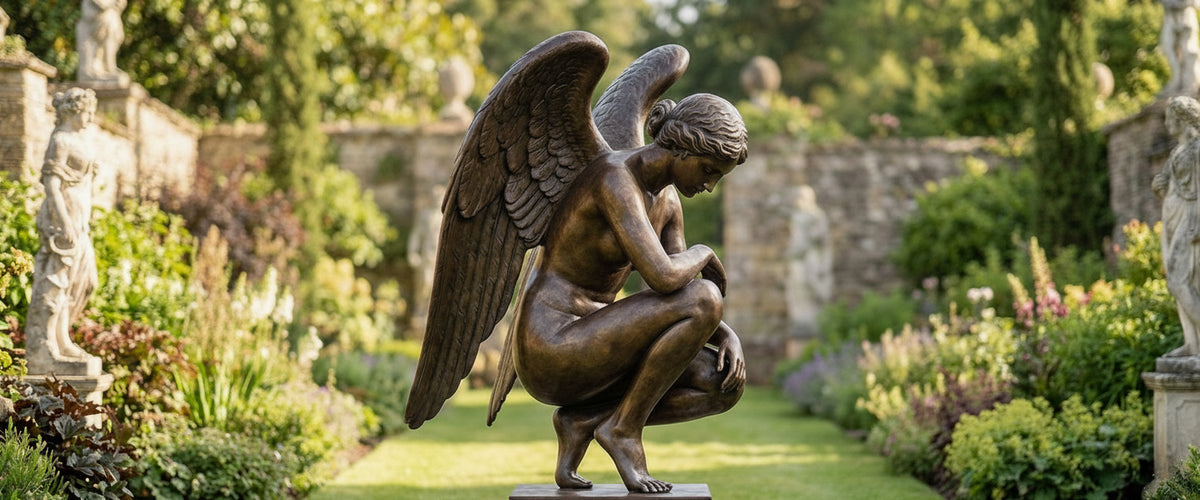
This is also why enlargement is never a simple photocopy. Proportions often need subtle adjustment as a form grows, because the human eye reads mass differently at height. Where a commission is meant to be seen from directly beneath, the Monumental Contemporary Crouching Angel Bronze Sculpture - 300cm at 300 cm (close to 10 ft) is designed so the pose still holds together when you stand below it and look up, not just when you see it head-on in a catalog.

Our Studio Process: Maquette, Sample, Fabrication, Install
A bespoke outdoor sculpture we shipped to a private garden shows why we work in stages. The client loved a horse study but wanted it larger and mid-stride rather than static. We worked through it like this:
- Maquette. A scaled model, usually in clay or a working material, so you can approve pose, proportion, and stance before any expensive metal is committed. Changes here cost hours, not thousands.
- Material sample. A finished swatch of the exact patina or surface, viewed outdoors in daylight. Patina looks completely different under studio lights versus open sky, so we insist on this step.
- Fabrication. Casting, welding, or carving, followed by finishing and the internal armature or structural core that keeps a tall piece rigid.
- Install. Foundation design, fixings, transport, and placement. A rearing form like the Large Traditional Prancing Arabian Horse Bronze Sculpture - 175cm puts real load on the base, so the plinth engineering matters as much as the casting.
Every stage gives you an approval gate. That protects your budget on a bespoke outdoor sculpture UK order and stops small misunderstandings turning into large ones in metal.
Honest Red Flags to Ask About Before You Commit
Good makers welcome hard questions. If you get vague answers to these, slow down.
- "How is it fixed and drained?" If the answer skips foundations and water management, the piece may not survive a decade outdoors.
- "What is the wall thickness or internal structure?" Thin decorative work sold as monumental sculpture is a common trap.
- "Can I see a maquette and an outdoor material sample?" A refusal to work in stages is a warning sign.
- "How will this patina age, and what upkeep does it need?" A specialist should answer without hesitation.
- "Who handles install and lifting?" A large outdoor metal sculpture is heavy; a serious supplier plans the logistics, not just the making.
You can browse finished work across our outdoor sculptures and garden statues collections to get a feel for scale, subject, and finish before you brief a bespoke outdoor sculpture UK commission. Seeing what already exists sharpens what you actually want made.
Caring for the Piece Once It Lands
Ownership is a long game. Bronze wants an occasional wash and a light protective wax; stainless steel wants cleaning to keep its reflectivity; Corten is designed to weather but should never sit in standing water. The Smithsonian's conservation guidance on outdoor bronze recommends gentle washing and periodic waxing rather than harsh chemical cleaning, which matches what we tell every client (see the Smithsonian's Museum Conservation Institute for the underlying principles). A smaller piece is easy to maintain by hand, while a monumental figure needs a scheduled check once or twice a year.
Commission a bespoke outdoor sculpture the right way and it becomes a fixed point in a garden for generations. Get the placement, material, and process right first, and the piece earns its keep every day the light changes across it.
For wider placement ideas on any bespoke outdoor sculpture UK project, Life Size Outdoor Sculpture: What Sculptors Weigh up Before They Say Yes is useful companion reading before finalising the setting and sightlines.