























































































Most life size outdoor commissions go wrong long before anyone touches metal. The wrong pose gets approved on a screen, the plinth is an afterthought, and the piece that looked confident in a maquette reads timid the moment it lands in a big garden. Getting a life size outdoor sculpture right is less about the finished object and more about the string of decisions that lead to it. That is the part buyers rarely see, so this is the view from inside the studio.
Looking for the full range in this category? Browse our Life Size & Large Statues collection for every available finish, size, and configuration.
We make and ship large-scale, bespoke work, and the questions we ask a client on day one are not the questions they expect. They ask about price. We ask about sightlines, weather, foot traffic, and how far away someone first sees the piece. Those answers shape everything that follows.

Key Takeaways for a Life Size Outdoor Commission
- Viewing distance drives scale. A figure that works at 10 feet can look wrong at 30. Where people first see it matters more than a tape measure.
- Material decides longevity. Bronze, stainless steel, and Corten each age differently outdoors; the choice affects both look and lifespan.
- The plinth is part of the sculpture. Foundation, fixing, and base height change how the whole thing reads.
- Budget follows complexity, not size alone. Pose, surface detail, engineering, and finishing move the number as much as height does.
- Process protects you. Maquette, sample finish, fabrication, then install. Skipping a stage is the most common cause of regret.

What Sculptors Actually Think About Before Taking a Life Size Outdoor Commission
The first thing we assess with any full-scale piece is whether the idea survives contact with the site. A client once wanted a standing figure at the end of a long gravel approach. Beautiful concept, wrong execution. By the time you reached the figure, you had already spent two hundred feet looking at it head-on, and a static pose felt flat by the time you arrived. We shifted to a seated composition with a turned head, so the piece rewarded the walk rather than exhausting it. Where a long approach calls for a resolved, self-contained form, a seated figure such as the Life-Size Classical Seated Figure Bronze Statue - 250cm holds interest from several angles rather than presenting one flat face.
We also think hard about weather load and mounting long before aesthetics. Wind catches a raised arm or an outstretched wing far more than people expect, and that dictates internal armature and the fixing detail at the base. A commission like this is an engineering brief wearing an art brief's clothes. If a maker is not asking about your climate, exposure, and ground conditions early, that is a gap worth noticing.

Craft Decisions That Change the Final Result (and the Price)
Two life size outdoor statues can be the same height and cost very different amounts. The variables that move the number are rarely the ones buyers guess.
Pose and undercuts. A tucked, compact figure is quicker to mold and cast than one with limbs held away from the body. Every gap between an arm and a torso is another surface to build, finish, and support. The wound-up throwing stance of the Life-Size Baseball Pitcher bronze statue carries real drama, but that extended arm and coiled leg represent hours of armature work you never see in the final bronze.
Surface detail. Feathers, drapery, fur, and fine facial modeling all add labor at the chasing and finishing stage. A smooth contemporary form and a heavily textured classical figure can share dimensions and diverge sharply on cost.
Material. Foundry bronze remains the default for figurative work because it holds detail and ages honestly. Stainless steel suits sharper, more contemporary pieces and reflects its surroundings. Corten trades crisp detail for a warm, weathered skin that many gardens now favor. Each choice sets a different maintenance and longevity path.
Because so many factors interact, we do not quote from a height alone. Budget depends on material, scale, pose complexity, engineering, installation, and finishing. The honest answer is to request a tailored quote once the concept is defined, not before.

Why Some Life Size Outdoor Pieces Read Right at 10 ft and Wrong at 30
Scale is relative to the viewer, not to a human body. "Life size" sounds precise, but it can mislead. A figure that stands a true 6 feet (about 1.8 m) feels commanding in a courtyard where you meet it up close. Drop the same figure into a wide lawn viewed from a terrace 90 feet away, and it shrinks into the planting. It reads as an ornament, not a focal point.
This is why we ask where the first, longest, and closest views happen. For an open setting, we often recommend going above life size, or raising the piece on a taller plinth so it holds the horizon. A grand animal subject such as the Life-Size Contemporary Bugling Elk Bronze Sculpture - 290cm earns its impact partly through the raised head and antlers, which give it a strong silhouette against sky and tree lines from a long way off. Silhouette does most of the heavy lifting at distance; fine detail only registers when you are close.
The reverse mistake matters too. An oversized figure crammed into an intimate garden room can feel oppressive. Getting the relationship right between piece, plinth, and eye level is where a good maker earns their fee. If you want to compare forms and finishes across figurative work, our metal sculptures collection is a useful place to see how different treatments carry at scale.

Studio Process: Maquette, Sample, Fabrication, Install
A serious commission moves through clear stages, and each one exists to catch problems while they are still cheap to fix.
- Maquette. A scaled model, usually a fraction of final size, that lets everyone agree on pose, proportion, and gesture. This is where most changes should happen. Approving a maquette you are only lukewarm about is the single most common source of later disappointment.
- Sample finish. A small cast or panel in the chosen material showing the exact patina or surface. Bronze patina in particular varies with light and background, so seeing it in your own conditions beats trusting a photo.
- Fabrication. Scaling up, molding, casting or building, then welding, chasing, and finishing. For bronze this runs through lost-wax casting; the Metropolitan Museum of Art has a clear account of why the process holds such fine detail. This is the longest phase and the one buyers should not rush.
- Install. Foundation, fixing, craning, and final placement. Access matters more than people think; we have re-planned deliveries because a driveway gate was 4 inches (about 10 cm) too narrow for the intended route.
Ask any maker to walk you through their version of these stages. A confident answer, with sign-off points you control, tells you a great deal about how the commission will run.

Honest Red Flags to Ask About Before You Commit
Some questions feel awkward to ask a studio. Ask them anyway. The good ones welcome it.
- "How is it fixed, and who signs off the foundation?" A vague answer here is the biggest warning sign. Outdoor pieces fail at the base, not the surface.
- "What does the wall thickness and armature look like?" Thin, unsupported casting saves money and creates long-term problems in wind and frost.
- "Can I see a sample of the finish in daylight?" Reluctance suggests the finish is not fully controlled.
- "What maintenance will this need in year one and year ten?" Bronze wants occasional washing and waxing; stainless needs cleaning to stay bright; Corten needs the right base detail so runoff does not stain paving.
- "Who handles install and insurance in transit?" Shipping a heavy sculpture internationally is a specialist task, not an afterthought.
Care expectations should be honest from the start. For weatherproof bronze, conservation guidance from the Smithsonian's Museum Conservation Institute supports what we tell clients: gentle regular cleaning and a maintained protective coating do far more for longevity than any single heroic restoration later.

Choosing the Right Piece for Your Setting
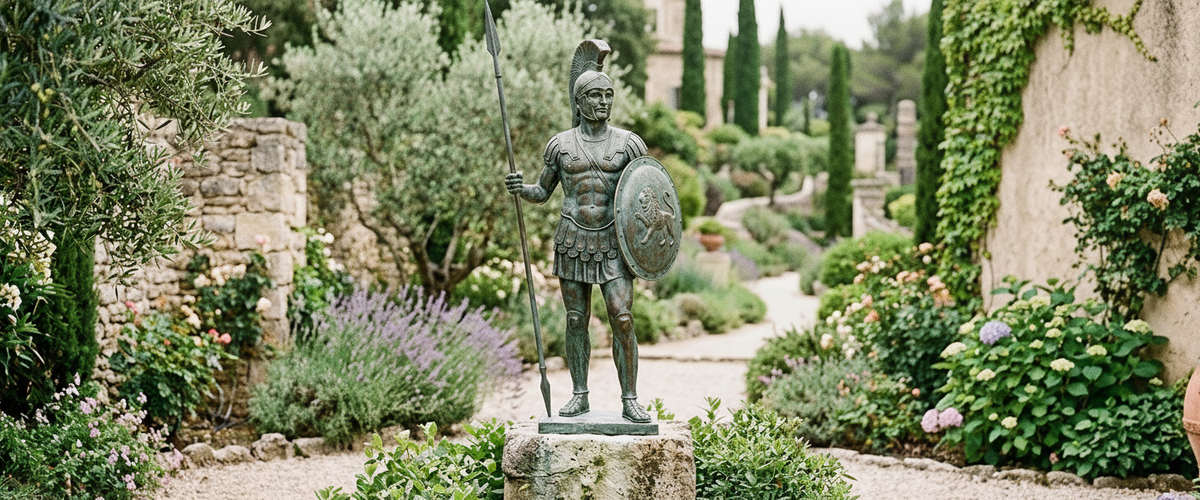
Different subjects suit different sites. Classical figures anchor formal gardens and entrances; a piece like the Life-Size Classical Greek Warrior Bronze Statue - 250cm gives a strong axial focal point at the head of a lawn or drive. Animal subjects tend to feel more at home in naturalistic planting, whether that is a bronze lion flanking steps or a grazing group across a meadow. If you are drawn to life size outdoor sheep statues or a small flock scattered across a paddock, spacing and pose variation are what stop them looking like a matched set of ornaments; real flocks never stand in tidy rows.
Whatever the subject, the goal is the same. A well-placed piece should look inevitable in its spot, as though the garden was designed around it. That only happens when scale, material, and placement are decided together, early, by people who have shipped and installed work like it before. If you are weighing a commission, tell us the site and the sightlines first. The rest of the conversation gets much easier from there.
For wider placement ideas, Life Size Bronze Statues: How to Place Them so They Actually Land is useful companion reading before finalising the setting and sightlines.