





































































































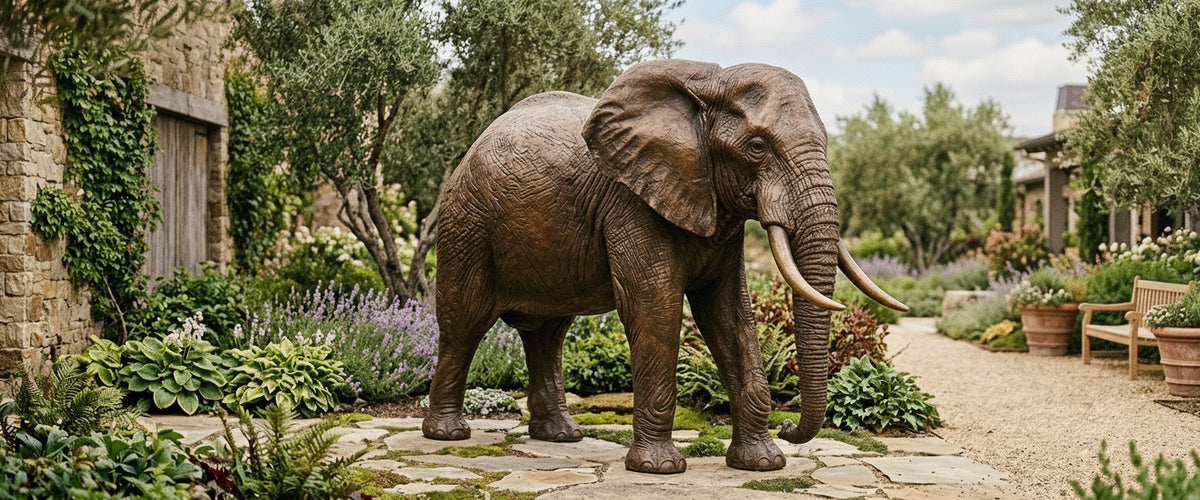

A ten-foot bronze elephant that looks commanding on a studio floor can vanish across a wide lawn, or worse, loom awkwardly at the wrong distance. Large African statues live or die on decisions made long before the first wax goes into the mold. Get scale, pose, and finishing right and the piece becomes a landmark; get them wrong and you have paid for something that reads as clumsy from every angle that matters.
Looking for the full range in this category? Browse our Large Bronze Sculptures collection for every available finish, size, and configuration.
We ship large-scale bronze work to gardens, estates, and commercial forecourts, and the same conversations come up every time. Buyers focus on height. Sculptors focus on how the form behaves in real space, at real viewing distances, under real weather. This piece walks through what actually governs the outcome of large African statues, and what to ask before you commit.

Key Takeaways for Buyers of Large African Statues
- Scale is relational, not absolute. A statue that works at 10 ft (3 m) can fail at 30 ft (9 m) because viewing distance changes how the form reads.
- Bronze is the default for a reason. It handles outdoor life, holds fine detail, and ages predictably with the right patina and care.
- Pose drives cost more than height. A walking animal with a raised trunk or lifted leg demands engineering that a static, grounded pose does not.
- Maquette first. A scaled model tells you far more about the finished piece than any drawing.
- Ask the awkward questions early. Wall thickness, armature, mounting, and lead times separate serious studios from the rest.

What Sculptors Think About Before Taking a Large African Statue Commission
The first question is never "how tall." It is "where does it live, and how do people approach it." A life-size African elephant read from a driveway 50 ft (15 m) away needs different proportion emphasis than the same animal tucked into a walled garden where you meet it at arm's length. Buyers hunting for large life size statues often start with a number in mind, but placement decides whether that number ever pays off.
Site conditions shape everything. Wind loading matters for tall or top-heavy forms. Ground bearing matters because a large bronze animal carries real weight; a life-size pair can run well into the hundreds of pounds (over 100 kg) before you count the base. Where a driveway is wide enough to hold two forms in dialogue, a matched set such as the Life-Size Pair of African Elephants Bronze Sculpture - 280cm gives you a composition rather than a single object, and the spacing between them becomes part of the design decision. Sightlines matter too, since a statue seen mostly in silhouette against sky needs a cleaner outline than one viewed against planting.
Then there is subject fidelity. When people search for African statues large enough to anchor a forecourt, they rarely ask about anatomy, yet it decides the result. African elephants differ from Asian ones in ear shape, back profile, and tusk carriage. A sculptor who knows the difference builds it into the anatomy rather than approximating a generic "big grey animal." That accuracy is what holds up under close inspection, where a rushed casting would not.

Craft Decisions That Change the Result (and the Price)
Height gets quoted first, but it rarely explains the number. Pose does. A grounded, four-square animal distributes its own weight and needs a simpler internal armature. Lift a foot, raise a trunk, or open a stance and you introduce cantilevered mass that has to be engineered, reinforced, and balanced. That work is invisible in the finished bronze and central to the invoice. This is where large African statues earn their cost.
Wall thickness is another quiet variable. Cast too thin and a large form flexes or dents; cast too heavy and you waste bronze and add cost with no benefit. Skilled foundries vary thickness across a piece, thicker at stress points, leaner across broad surfaces, so the sculpture is strong where it needs to be and no heavier than necessary.
Finishing is where two statues of identical size diverge in feel. Patina is applied with heat and chemistry, not paint, and the color you choose (warm brown, near-black, verdigris green) changes how the surface catches light outdoors. The Metropolitan Museum of Art's notes on conservation and scientific research explain how these surface treatments both color and protect the metal over time (metmuseum.org). At true monumental scale, a piece like the Life-Size Traditional African Elephant Bronze Sculpture - 350cm asks for a patina scheme that stays legible from a distance rather than one built for a tabletop bust.

Why Some Large African Statues Read Right at 10 ft and Wrong at 30
Scale is not a slider you drag up until it looks impressive. The human eye reads proportion against context, so the same statue placed at different distances behaves differently. Up close, you register texture, muscle, and the small anatomical truths. Far away, all of that collapses into outline and mass, and the piece is judged on silhouette alone. This is the trap that catches large African statues most often.
This is why a walking pose with a raised trunk can look alive at conversational range and confusing from across a field, where the gesture flattens into an ambiguous shape. Something like the Life-Size Walking African Elephant Bronze Sculpture - 280cm rewards placement where visitors move past it and the pose resolves through changing angles, rather than a single fixed long view.
Enlarging a design is not the same as scaling a photo. When you take a maquette proportion and blow it up to monumental size, features that felt balanced small can turn heavy or thin. Good studios re-judge proportion at each size, adjusting leg thickness, head mass, and base footprint so the piece feels correct at its final scale rather than mathematically consistent with the model. That re-judgment is one of the clearest differences between a considered commission and a mechanical enlargement.
Studio Process: Maquette, Sample, Fabrication, Install
A serious large African statue commission moves through predictable stages, and each one is a checkpoint you should use.
- Maquette. A scaled model, often in clay or a smaller bronze, lets you judge pose and proportion before committing to full-size work. Approve it carefully; it sets everything that follows.
- Sample and material sign-off. For bronze, this is where you confirm patina color and finish on a test surface. Seeing the actual patina outdoors, in your own light, beats any swatch on a screen.
- Fabrication. Full-size sculpting, molding, casting (usually lost-wax), then chasing and welding the sections. This is the longest stage, and honest lead times reflect it.
- Install. Base engineering, transport, and placement. Large bronzes need proper footings and often a crane or gantry. Access to the site, gate widths, ground protection, and lifting points all get planned in advance, not on the day.
The same process applies whether you are commissioning a monumental animal or a figurative bust. A smaller work such as the Life-Size Classical African Woman Bust at 80cm still runs through maquette and patina sign-off, just at a scale that makes it a natural entry point for a first bronze commission or an indoor setting. Even among life size African statues, that smaller footprint often teaches buyers what to look for before they scale up to large African statues.
Honest Red Flags to Ask About Before You Commit
Confident suppliers welcome hard questions. If any of the following draws a vague answer, slow down before you order large African statues.
- "What is the wall thickness and internal armature?" A studio that cannot describe how a large piece is reinforced has not thought about its structural life outdoors.
- "How is it mounted?" You want specifics on base plates, anchor bolts, and footing depth. Wind and weight are not afterthoughts.
- "Can I see the maquette before full production?" Skipping this stage is where costly disappointments start.
- "What patina, and how do I maintain it?" Outdoor bronze needs occasional washing and periodic waxing to keep its surface stable. The American Institute for Conservation offers sound public guidance on caring for outdoor sculpture (culturalheritage.org).
- "What are the real lead times and shipping arrangements?" Large life-size statues cross oceans in crates and need crane offload. Anyone quoting a suspiciously fast turnaround on a monumental cast is worth a second look.
Budget is the honest final question for large African statues, and the honest answer is that it depends. Material, scale, pose complexity, engineering, finishing, and installation all move the number, so a like-for-like quote on your specific piece and site matters far more than any headline figure. At Giant Sculptures we handle bespoke commissions from first sketch through install, and we would rather talk through your site and sightlines than sell you a height off a spec sheet.
Large African statues, made well, become the fixed point a garden or forecourt is organized around for decades. That longevity is earned in the decisions above, long before anyone stands back to admire the finished bronze.
For wider placement ideas, Large 3d Wall Art: How Scale, Light, and Placement Decide Its Impact is useful companion reading before finalising the setting and sightlines for your large African statues.