




















































































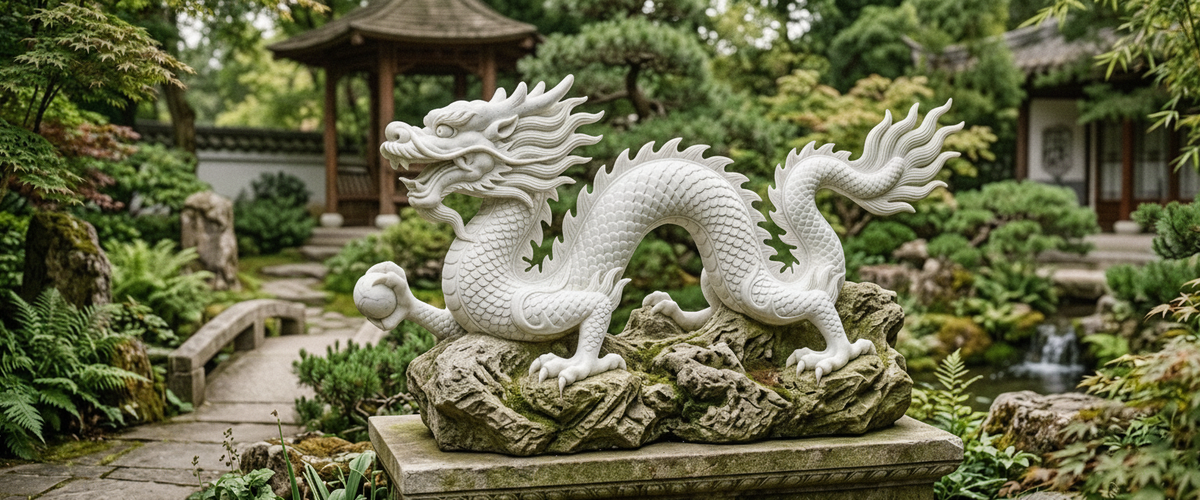

Damaged dragons tend to break in the same few places: a whisker, the tip of a horn, a claw that once curled free of the base. An outdoor garden dragon statue is one of the most detailed subjects you can put in a garden, and winter goes after detail first. Scales are small water traps. Claws are small levers. Choose the right material and site it well, and the dragon will outlast the planting around it.

Quick Answer
Deep, undercut scales hold water, and in freeze-thaw climates that water splits the surface.
Thin projections (claws, horns, whiskers) are usually the first to go. Thicker, supported forms survive.
Bronze and dense marble hold up best. Cast stone and resin age faster and less gracefully.
Raise the piece on a plinth, set it in gravel and keep it out from under tree drip lines.
On exposed or north-facing sites, commission shallower scales and heavier claws.
Undercut Scales Hold Water, and Frost Does the Rest
Carvers love deep scales because they throw strong shadows. The problem is the undercut, the small lip beneath each scale where rain collects and has nowhere to drain. Water expands by roughly nine percent as it freezes. On a dragon garden statue outdoors through a Vermont or Minnesota winter, that can happen dozens of times in a season, and each cycle pries the lip open a fraction further. Conservators treat this as a primary cause of decay; Historic England's guidance on stone conservation lists frost action among the main drivers of surface loss in porous stone.
Dense white marble absorbs far less water than sandstone or cast stone, which is why it keeps crisp edges for longer. With a mid-sized marble dragon such as the Serpentine Dragon White Marble Outdoor Sculpture, at 120cm (about 47 inches), judge the scale cuts as closely as the silhouette: study them in the photographs and ask how deep the undercuts run. On an outdoor garden dragon statue in a cold garden, crisp but shallow scales will outlast deep, shadowy ones.
Claws, Horns and Whiskers: The Thin Projections That Snap First
Any slender form that sticks out from the main mass works as a lever. A hairline crack at the root of a horn fills with water, freezes and widens. Snow piles onto an outstretched claw, then ice adds weight. A garden hose or a careless leaf blower can finish the job. A client in the Hudson Valley once sent us photographs of a cast stone dragon whose whiskers stood fully free of the head. Both were lying on the lawn by February.
We took a clear lesson from that. On every outdoor garden dragon statue we make now, we tie whiskers back into the mane or cheek, and we keep claws gripping a rock or the base rather than hanging in the air. The silhouette looks just as alive from ten feet away, and nothing is left unsupported.

Cast Stone, Resin, Bronze and Marble After Three British Seasons
Our UK base gives us a useful testing ground. British winters are wet more often than they are bitterly cold, so a piece goes through constant soaking with frequent mild freezes. After about three seasons, the pattern is consistent:
Cast stone: soft edges, gray-green staining in the scales and occasional spalling on the snout and claws. It ages quickly, which some owners like and others regret.
Resin: it will not crack from frost, but sunlight chalks and fades the surface. A light resin dragon can also tip over in high wind unless it is anchored.
Bronze: the patina deepens and greens unevenly, but even thin claws stay intact because the metal does not absorb water, so frost has nothing to pry apart. Conservators usually maintain outdoor bronze with a periodic wax coat, an approach the Getty Conservation Institute has studied for decades.
Marble: detail stays sharp. Shaded faces may take on a faint gray bloom, which a gentle wash removes.
Bronze also copes with constant water. Where a dragon is meant to stand in a pool or anchor a water feature, a cast piece such as the Large Classical Dragon-Griffin Hybrid Bronze Fountain can carry running water over fine modeling for years without the damage that would ruin cast stone.
Moss as a Finish: When Greening Over Protects a Stone Dragon
Owners who ask about outdoor garden dragon statue mold usually mean one of two things. Black mold and slimy green algae form a slick film that holds moisture against the surface, and that film is worth cleaning off with soft brushes and plain water. Never use a pressure washer. True moss on a rough cast stone or limestone dragon is a different case. Conservators are divided on it, but a thin, even layer can buffer the surface against rapid wetting and drying, and it gives an old-garden look that no patina can copy. On marble, keep moss off fine detail such as the eyes and teeth, and let it settle on the base if you like the effect.
Siting an Outdoor Garden Dragon Statue So It Drains
For an outdoor garden dragon statue, placement does more for longevity than any sealant. Set the statue on a plinth at least 12 to 18 inches (30 to 45 cm) high so it never sits in splash-back or standing water. Surround the plinth with a gravel bed rather than lawn or mulch, so rain soaks away instead of wicking upward. Keep the piece out from under tree drip lines, where concentrated drips, sap, leaf litter and bird droppings all collect in the scales.
Scale changes the engineering. For an estate lawn or the end of a long garden axis, a monumental carving such as the Cloud-Surging Dragon Marble Outdoor Sculpture, at 260cm (about 8.5 feet), needs a proper concrete foundation and planned crane access. Treat it as an installation, not a garden ornament you can move later.

Shallower Scales and Thicker Claws for Exposed Sites
For wider placement ideas, Choosing a Dragon Statue for Your Garden Starts With What It Guards is useful companion reading before finalising the setting and sightlines.
If your outdoor garden dragon statue will face north, sit on a windy ridge in Aspen or overlook a lake that freezes, the best decisions happen at the commission stage. As a bespoke sculpture studio, Giant Sculptures can adjust the carving or casting pattern: shallower scales angled to shed water, thicker claws locked into the base, horns swept back against the head and drainage channels hidden in the rockwork. You lose very little drama and gain decades of service.
Buyer Checklist Before You Commit
What is your coldest winter low, and how often does the site freeze and thaw?
Does the site face north or sit in full shade? If so, expect moss and slow drying.
Are any claws, horns or whiskers unsupported?
How deep are the scale undercuts?
Is there room for a raised plinth and a gravel collar?
Will the weight need a foundation or crane access?
Budget depends on material, scale, carving complexity, engineering, installation and finishing, so ask for a tailored quote once you know the site conditions. To see how bronze patina develops on detailed mythological figures, look through our bronze mythology statues, then send us photographs of the spot you have in mind. We will tell you plainly which dragon suits it.