






































































































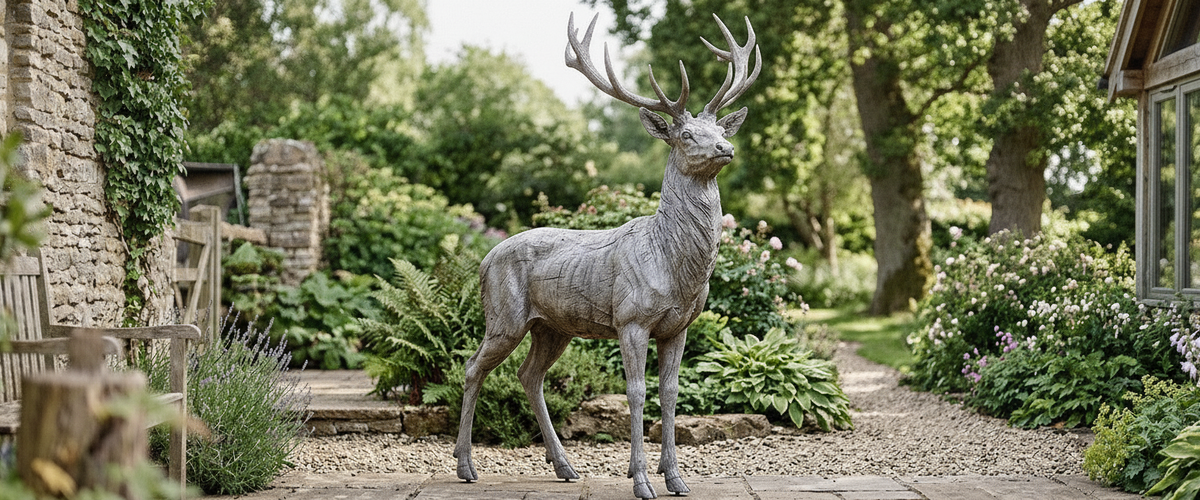

Every carved stag, hare or boar that fails outdoors fails the same way: from the feet up. Outdoor wooden animal sculptures spend their lives standing in the one place a garden never fully dries, and the timber pulls that moisture straight into the carving. Get the wood, the mounting and the ground right, and a wooden animal can weather into something better than the day it arrived. Get them wrong, and it can be soft at the ankles before its third winter.
Key takeaways
Rot starts where end grain meets wet ground: hooves, paws and resting bellies.
Air-dried oak, sweet chestnut and larch heartwood cope well in damp gardens.
Hidden stainless steel pins and a free-draining gravel bed keep the feet dry without looking staged.
Small, low animals tolerate leaf litter. Tall, heavy animals need a proper footing.
Gray silvering and surface cracks are normal. Dark, spongy feet are not.

Hooves, Paws and Bellies: Wet Ground Drinks Through End Grain First
Think of a log as a bundle of drinking straws running lengthwise. Side grain sheds water reasonably well. End grain, the cut face at the bottom of a leg, wicks it upward. On outdoor wooden animal sculptures, the legs are almost always oriented along the grain for strength, which means every hoof is a straw end pressed into wet soil or turf.
Resting poses make it worse. A lying deer or a sleeping fox puts a broad belly in contact with the ground, trapping moisture in a wide, shaded band where fungi thrive. The USDA Forest Products Laboratory's Wood Handbook sets the threshold: decay fungi need wood moisture content above roughly 20 percent, and timber in ground contact rarely dries below it.
Choosing Timber for Outdoor Wooden Animal Sculptures
Species matters more than finish. For outdoor wooden animal sculptures in a soggy garden, we steer clients toward oak, sweet chestnut and larch heartwood. American buyers can treat white oak as the natural equivalent of European oak; its plugged pores resist water uptake far better than red oak, whose open pores let water travel through the wood with little resistance.
Sweet chestnut carves cleanly and, as the Wood Database notes, its heartwood is rated durable against decay. Larch is softer and only moderately durable, but it's resinous and holds up surprisingly well in cool, wet climates when the sapwood is cut away.
Plenty of imported tropical hardwoods are genuinely durable. The problem is what typically arrives under that label: fast kiln-dried, sapwood-heavy carvings that check badly once they meet a Pacific Northwest winter or a humid Carolina summer. Dense, air-dried native heartwood, carved with the pith removed, is the safer bet.
Hidden Steel Pins and Gravel Beds
The fix for wet feet is lift, and it shouldn't be visible. On the outdoor wooden animal sculptures we commission, each leg is drilled and fitted with a stainless steel pin that drops into a concrete footing below the surface. The animal stands a finger's width above a bed of crushed gravel, around 4 to 6 inches (10 to 15 cm) deep, so water drains away instead of pooling against the hooves.
From a few steps back, the gap disappears into shadow. The stag reads as standing in the garden, not on a plinth. This matters most on irrigated ground. The classic failure is a carved oak animal set straight onto watered lawn: after two seasons the body is perfect and the front feet are soft. The sprinkler schedule does the damage, not the carver.

A Hedgehog Can Sit in Leaf Litter, but a Stag on Soft Lawn Cannot
Scale changes the rules. A small, light animal tucked under a hedge can sit in leaf litter, shift a little and be lifted to dry out. Even at statement size, a low, rounded form spreads its weight across a wide base, which is why a squat, ground-hugging figure such as the Animal Hedgehog Labubu Sculpture, 100cm settles among planting far more easily than anything balanced on four slender legs.
A life-size stag is different. Several hundred pounds balanced on four narrow hooves will sink into soft lawn, tilt and hold water at the exact points that rot first. Tall, slender-legged animals need pinned footings every time. If you want a dramatic piece without that maintenance, our bronze garden statues handle wet turf and frost with little more than an occasional wax.
Silvering and Checking Are Character: Soft, Dark Feet Are Rot
Untreated oak turns silver-gray within a year or two outdoors. Fine surface cracks, called checks, open in dry spells and close in wet ones. Neither is a defect, and many collectors prefer the weathered look to fresh honey-colored timber.
What should worry you is low down. Press a fingernail into the base of each leg. Sound wood resists. Rot feels spongy, looks darker than the rest of the carving and may show white fungal threads or give off a damp, mushroomy smell. Caught early, the soft section can be cut out by a specialist and spliced with new heartwood.
Before You Buy: Decision Criteria
Ground conditions: heavy clay, irrigated lawn or a high water table all call for pinned footings and gravel.
Pose: standing animals on narrow legs need more engineering than low, resting forms.
Species and heartwood: ask what timber is used and whether sapwood has been removed.
Drying: air-dried timber moves less once outdoors than fast kiln-dried stock.
Indoor alternative: if you love carved timber but your site is relentlessly wet, bringing the animal indoors may be the better answer; a carved, backlit panel such as Mythoria Journey Fairytale Horse Wooden LED Wall Art keeps the warmth of wood well away from the weather.
Budget for outdoor wooden animal sculptures depends on species, scale, carving complexity, mounting engineering, installation and finishing. Giant Sculptures quotes each bespoke commission individually, and we'll tell you honestly when bronze or stainless steel suits a site better than wood.

One Autumn Afternoon: The Annual Check
Rake leaves, mulch and grass clippings away from every foot.
Top up the gravel bed so it stays below the hooves, never against them.
Rock the sculpture gently and check each steel pin for movement.
Probe the base of each leg for softness or dark staining.
Brush on a penetrating oil or end-grain sealer at the feet only, and let it soak in.
Trim back any planting that shades and traps moisture around the base.
That's an hour, once a year. For outdoor wooden animal sculptures, it's the difference between a piece that silvers gracefully for decades and one that quietly gives way at the ankles. Browse our garden statues for inspiration, or talk to us about a commission built for your ground.
For wider placement ideas, Wooden Animal Sculptures: Why the Grain Decides Everything is useful companion reading before finalising the setting and sightlines.