
























































Water is the one element in a garden that never takes a day off. Stone weathers slowly, steel oxidizes on its own schedule, but bronze water fountain statues are being chemically worked on every hour the pump is running. That is not a warning against buying one. It is the reason the good ones look better at year twenty than at year two, and the reason the badly specified ones look tired by their third summer.
Most of what goes wrong is predictable. It also happens in the same few places every time.

Quick Answer: What Actually Ages a Bronze Fountain
The waterline is the fastest-changing zone on the whole piece, and it never weathers evenly.
Water hardness matters more than rainfall. Mineral-rich supply lays down a pale crust that fills fine modeling.
Pump access is a foundry decision, not a plumbing decision. Specify it before casting.
Freeze damage is the single biggest risk to the installation, and draining down takes well under an hour.
Annual care is a wash, a wax, and an honest look. Anything more aggressive usually causes damage.
The Waterline Is Where Bronze Water Fountain Statues Show Their Age
Look at any long-established fountain and you will find a band, usually two to four inches (5 to 10 cm) deep, where the patina behaves differently from everything above and below it. Constant wetting and drying, plus oxygen at the surface, drives copper corrosion products harder in that strip than anywhere else. You get greens that read almost turquoise in some spots and a dark, waxy brown in others.
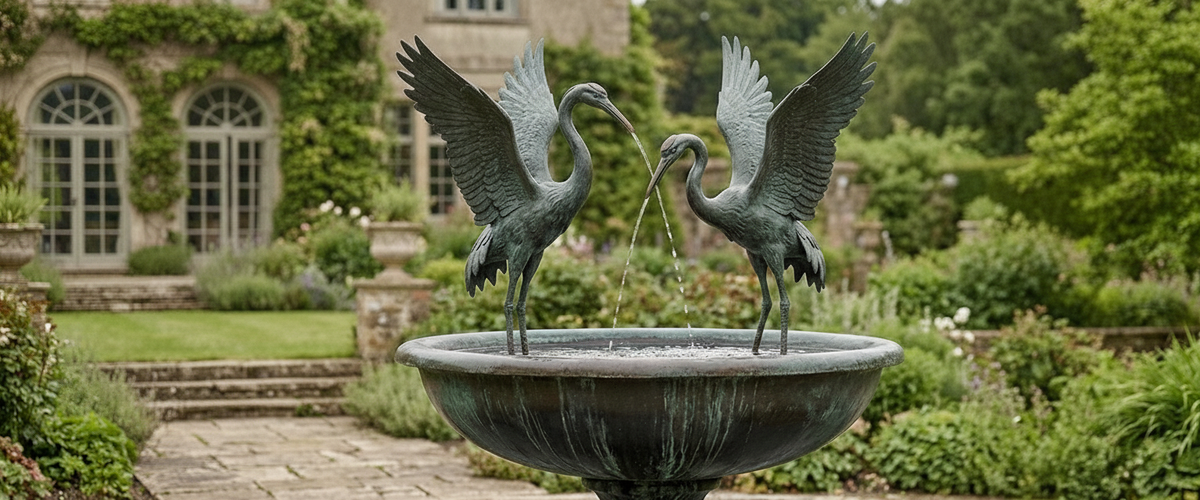
What surprises owners is the asymmetry. Green streaking rarely returns in the same pattern twice, because it follows the splash path, the prevailing wind, and whatever the pump is doing that season. A crane pair with water arcing from two beaks will stain differently on the downwind bird. With something like the Large Traditional Crane Pair Bronze Fountain - 190cm at 190cm (about 6 ft 3 in), that streaking becomes part of how the sculpture reads within a couple of years, and scrubbing it back to uniformity tends to look worse than leaving it.
The practical takeaway: decide early whether you want a piece that records its own water history, or one you will keep visually consistent. Those are two different maintenance budgets.

Hard Water and the Crust That Buries the Modeling
Green is cosmetic. White is the problem. Most bronze water fountain statues that look tired by year five are not corroded at all; they are coated. In hard-water regions the dissolved calcium and magnesium precipitate wherever water evaporates, and a fountain evaporates constantly. By the third year, a thin chalky film can sit in every undercut of a face, a feather, or a horse's mane. The form stops reading. Detail that a modeler spent weeks on flattens out under something that looks like limescale in a kettle, because chemically that is roughly what it is.
Two fixes work. Run a recirculating system topped up with softened or filtered water where you can, and remove buildup early with a mild acidic treatment applied by a conservator rather than a pressure washer. Copper alloy surfaces respond badly to abrasive attack; the Copper Development Association is clear that a stable patina is a protective layer, and stripping it restarts the corrosion clock. One client hired a pressure washer for a weekend and ended up with a bright, blotchy surface that took two seasons to settle down.
Choosing Bronze Water Fountain Statues: The Decisions That Actually Matter
Buyers usually start with the subject. We would argue the site should lead.
Water pressure and reach. Tall tiered pieces throw further than they look on paper. A tiered form on the scale of the Classical Tiered Bird Fountain Bronze Fountain - 250cm at 250cm (roughly 8 ft 2 in) needs enough basin diameter to catch wind drift, or you will be topping up the reservoir weekly.
Basin material. Bronze on stone is quiet and forgiving. Bronze on tile amplifies splash.
Viewing distance. Fine surface detail is wasted beyond around 30 feet (9 m). Where the approach is close and framed, a figurative group such as the Monumental Classical Swan and Cherub Bronze Fountain - 330cm at 330cm (about 10 ft 10 in) earns its detail on a courtyard sightline rather than across a paddock.
Sightlines at night. Uplighting a wet bronze creates glare. Cross-light from two low positions instead.
Service route. Can two people reach the pump chamber without lifting the sculpture? If the answer is no, change the design.
Budget for bronze water fountain statues moves with scale, casting complexity, plumbing engineering, base construction and installation access. We quote each commission individually rather than publishing ranges, because a 3 ft (0.9 m) self-contained bowl and a monumental multi-figure group share almost nothing except the alloy.

Specify the Pump Hatch at the Foundry, Not on Site
For wider placement ideas, How to Choose a Bronze Mermaid Statue That Earns Its Spot by the Water is useful companion reading before finalising the setting and sightlines.
The most common regret we hear about older fountains is access. Pumps fail. Impellers clog with leaf litter. Someone eventually needs to change a UV clarifier at eight in the evening in October. If the only route to the equipment is a bolted plinth panel behind a planted bed, that job becomes a small excavation.
On commissions we now draw the access hatch into the base at the pattern stage: a hinged or lift-off panel, positioned on the least-viewed elevation, with the cable route and overflow already cast in. It costs almost nothing at that point and it is close to impossible to retrofit neatly once the base is finished.
Draining Down Before the First Hard Freeze
Freezing water expands with enough force to split a soldered joint, crack a stone basin, and deform thin-walled cast sections that hold standing water. Bronze is tough, but the pipework and plinths that carry bronze water fountain statues are the weak links. In climates like Aspen, upstate New York or the Texas Panhandle, the annual drain-down is the highest-value 40 minutes you will spend on the piece.
The routine: shut off the supply, pump the basin dry, lift and store the pump indoors, blow or drain standing water from all lines, sponge out low points, then cover the basin or leave it open with a drainage gap so it cannot fill with ice. Guidance from the Canadian Conservation Institute on outdoor metal sculpture is worth reading before your first winter, particularly on protective coatings.
Listen to the Weir Before You Look at It
Mineral buildup changes sound before it changes appearance. A clean weir gives an even, broad sheet with a low continuous note. As deposits build on the lip, the sheet breaks into ribbons and the sound goes thinner and more percussive. Owners often notice the acoustic shift months before they notice the crust. Treat that change as your maintenance alarm; it is the cheapest diagnostic you have.
Wax, Wash or Leave It: An Honest Annual Calendar
Spring: flush the reservoir, clean the pump filter, rinse the sculpture with clean water and a soft brush, check jets for partial blockage.
Early summer: apply a microcrystalline wax to dry, cool metal above the waterline. Buff lightly. Skip the wet zone; wax will not hold there.
Late summer: inspect the waterline band and remove early mineral film while it is still soft.
Fall: clear leaf debris weekly. Rotting leaves acidify the water and stain the basin.
Pre-freeze: full drain-down and pump storage.
Every three to five years: book a conservator to assess the coating and any active corrosion spots.
That is the whole program for most bronze water fountain statues. Anything harsher, including household descalers, wire wool or bleach, does more harm than the marks it removes.

Re-Patinating, or Letting the Weathering Be the Artwork
Re-patinating means heat, chemicals, scaffold and a specialist on site for several days. It is worth it when corrosion is active and pitting the surface, when a previous owner has stripped or painted the metal, or when the piece sits in a formal architectural setting where uneven color reads as neglect. Grand set pieces in symmetrical layouts, where two matching flanks are meant to read as one composition, usually want that consistency.
In a loose planted garden, the opposite is true. Streaking, green pooling in the undercuts and a darkened waterline are the piece behaving as bronze should. Plenty of the fountains in our bronze fountains collection look better once the water has had a few years to write on them, and clients who resist the urge to intervene generally end up happier.
If you are weighing options across a wider scheme, compare bronze water fountain statues with static pieces in the same material. Browsing bronze garden statues and the broader garden fountains and water features range tends to clarify whether you want movement and sound at that spot, or presence and stillness. Our studio takes commissions either way, and we would rather resolve that question at sketch stage than after casting.