






































































































Frost almost never ruins a sculpture on its own. Water that got in before the frost does. That single fact reorders most outdoor sculpture maintenance tips you will read online, because it moves the important work to October, not January, and it puts the base of the piece ahead of the polished surface everyone actually looks at. A bronze hare can sit through a Colorado winter untouched and come out fine. The same hare, sitting in a shallow pool of trapped meltwater on a flat stone pad, will not.

Outdoor Sculpture Maintenance Tips at a Glance
October: walk around the piece and check drainage, fixings, joints, plinth contact and irrigation overspray.
November: wash with cool water, a soft cloth and pH-neutral soap only. No detergents, no pressure washers, no vinegar.
December: decide honestly whether to cover, move indoors, or leave standing. All three are valid; guessing is not.
February: inspect the base. Standing water, moss creep and the plinth-to-sculpture joint cause more damage than weather ever does.
April: wax bronze with two thin coats rather than one heavy one, in dry, mild conditions.
June to September: light rinses, quick visual checks, and leave the patina alone.
October: The Walk-Round That Catches Nearly Everything
If you follow only one of these outdoor sculpture maintenance tips, make it this one. Give yourself ten minutes and circle the piece slowly. Five checks catch the overwhelming majority of problems. First, does water sit anywhere on the sculpture after rain? Cupped hands, upturned leaves and hollow forms are the usual suspects. Second, are the drainage holes clear? Cast bronze figures usually have them, and leaves and spider nests block them. Third, are the fixings sound, with no rust bloom weeping from a bolt head? Fourth, is the plinth still level, or has one corner started to sink after a wet summer? Fifth, and the one people forget, where is the irrigation hitting?
We shipped a bronze piece to a garden north of Napa a few years back and the client called about a pale streak on one flank. Nothing to do with weather. A pop-up sprinkler was firing hard water at the same eight inches (20 cm) of surface twice a day. Mineral deposits did in one season what a decade of rain would not. Moving one sprinkler head solved it.
November: Wash It Properly or Do Not Wash It at All
Cleaning is where well-meant outdoor sculpture maintenance tips go wrong most often. Cool or lukewarm water, a soft cotton cloth or a natural bristle brush for textured areas, and a small amount of pH-neutral soap. That is the whole toolkit. Rinse and dry with a clean cloth so nothing dries in streaks.
What strips patina: acidic cleaners, vinegar solutions, bleach, household degreasers, scouring pads, wire brushes and pressure washers. A patina is a chemically formed surface layer, not paint, and once it is scoured back to raw metal the color will never quite match again. The Copper Development Association's guidance on copper alloys and patina behavior is a useful sanity check if you are tempted by a miracle product. On stone, the risk is different: harsh chemicals can drive salts deeper into the surface and cause spalling later. Where the stone is dense and close-grained, as on the Blessing Character Grey Granite Garden Screen - 200cm, washing is far more forgiving than it is on soft limestone, but even there, gentle beats fast.

December: Cover, Lift Indoors, or Leave It Standing
There are only three real options and each carries a trade-off. Covering works if the cover breathes and is fitted loosely; a sealed plastic sheet traps condensation against the surface and creates exactly the microclimate you were trying to avoid. Lifting indoors suits smaller cast pieces under roughly 60 pounds (27 kg) that you can move without a strap and a second person. Beyond that, moving is more likely to cause a chip than the winter is.
Leaving it standing is usually the right answer for large bronze, granite, Corten and stainless steel, provided the October checks were done. The exception is anywhere de-icing salt gets airborne. Sculptures near driveways and sidewalks in New York or Chicago take a hard chemical hit every winter, and a spring rinse becomes non-negotiable. A small cast bronze, such as the 60 cm Contemporary Sparring Rabbits Bronze Sculpture - 60cm, is light enough to shift into a sheltered terrace corner by hand; a marble lion on a rock base is staying put, and should.
February: The Base Inspection Nobody Does
Kneel down. Look at where the sculpture meets its plinth, and where the plinth meets the ground. Standing water at that joint is the single most destructive condition in outdoor sculpture maintenance, because freeze-thaw cycling opens hairline gaps a fraction at a time until something shifts. Historic England's technical advice on building materials and weathering makes the mechanism clear: repeated wetting and freezing does far more damage than cold alone.
Check for moss creeping up from the ground line, which holds moisture against stone, and for soil that has banked up against the base over the seasons. Scrape it back so air can circulate. On heavy stone pieces with a wide footprint, a two-meter sandstone elephant being the obvious case, a slight settle on one side is worth catching early. Re-leveling a base is straightforward. Repairing a cracked leg is not.
April: Two Thin Coats of Wax Beat One Heavy One
Of all the seasonal outdoor sculpture maintenance tips here, waxing is the one most often done badly. Wax on bronze is a sacrificial barrier. It is meant to be renewed, not built up. A microcrystalline wax applied in two thin coats, buffed between, gives an even film that sheds water and slows chloride attack. One heavy coat looks glossy for a couple of weeks, then clouds in the recesses and yellows where the sun hits hardest.
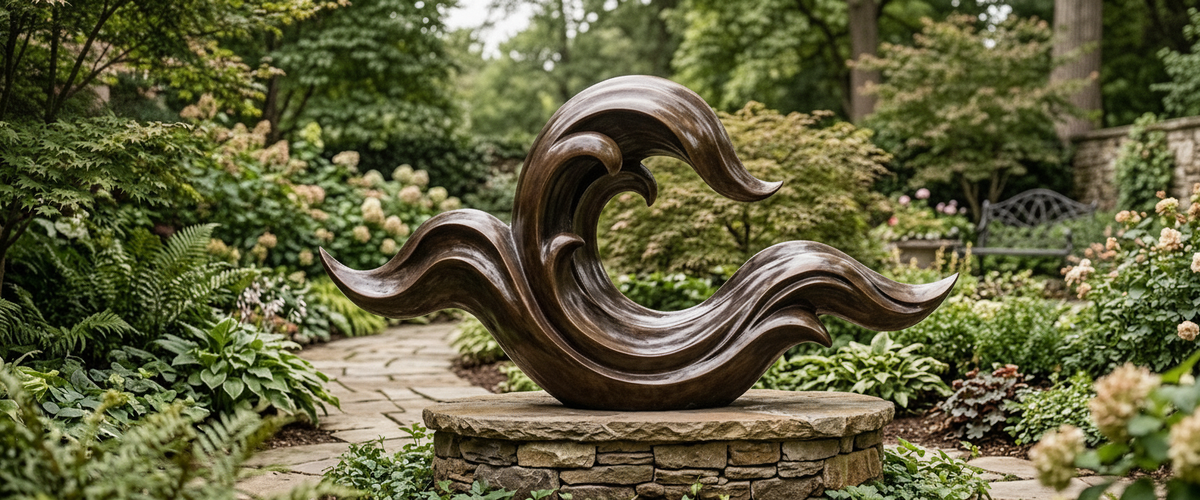
Timing matters more than frequency. Wax on a dry, mild day above roughly 50°F (10°C), on a surface that has been clean and dry for 24 hours. Waxing damp bronze seals moisture underneath. Most sheltered garden bronzes need this once a year; coastal and exposed sites often want twice. Form changes the workload as much as location does: a continuous, uninterrupted surface like the Bronze Abstract Organic Wave Sculpture Brass - 91cm waxes quickly because there is nowhere for the film to pool, while a detailed animal piece takes far longer around the undercuts, where a soft brush beats a cloth.

June to September: Keep It Light
Of all the outdoor sculpture maintenance tips here, summer's are the lightest, because warm-weather care is mostly restraint. Rinse dust and pollen off with plain water. Check nothing has been knocked out of alignment by a garden party or a landscaping crew. Watch for bird droppings on bronze and remove them within a day or two, because they are acidic enough to etch a waxed surface. On stainless steel, wipe in the direction of the grain so you do not cross-scratch the finish. On stone, resist the urge to remove every trace of lichen; some growth is stable and part of the piece maturing. If you are still building a collection, looking through our outdoor sculptures with a maintenance eye is worth doing, because form and material dictate how much of your year a piece will ask for.
Where DIY Stops and the Studio Takes Over
Everything above assumes the problem is cosmetic and stable. Call a specialist when you see green or blue-green weeping streaks that return after washing, active corrosion at a fixing point, a crack in stone that has opened rather than stayed static, or a patina that has gone patchy across a large area. Re-patination, structural pinning, armature repair and lifting anything over a few hundred pounds belong to people with the right equipment and insurance. The American Institute for Conservation maintains a directory if you need one locally.
Giant Sculptures builds and ships large-scale bespoke work worldwide, and the questions we get most often at commission stage are about longevity, not looks. That conversation is worth having before casting starts. Drainage detailing, fixing method, plinth design and material choice all get set at the design table, and they decide how much outdoor sculpture maintenance the piece needs for the next thirty years. A bronze garden statue specified with proper weep holes and a drained base will outlast an identical piece that skipped both. Cost depends on material, scale, complexity, engineering, installation and finish, so ask us for a tailored quote rather than working from an assumption.

Your Annual Outdoor Sculpture Maintenance Checklist
Pin this in the shed. It condenses the outdoor sculpture maintenance tips above into eight lines.
Clear drainage holes and hollow forms before the first frost.
Redirect any irrigation that hits the sculpture directly.
Wash once in late fall with pH-neutral soap and cool water.
Decide on winter strategy deliberately: cover, move, or leave.
Inspect the base and plinth joint in late winter for standing water and movement.
Wax bronze in spring, two thin coats, dry surface, mild day.
Rinse salt-exposed pieces as soon as the season ends.
Photograph the piece annually from the same angles so you can see slow change.
For wider placement ideas, The Pose Decides Everything in a Large Rabbit Garden Statue is useful companion reading before finalising the setting and sightlines.