







































































































Brass and travertine sell themselves in a product photo. About a month after delivery, they start pulling in different directions. If you are considering a Balizie brass table sculpture, or any piece with warm metal on pale stone, expect the two materials to age at different speeds. They also mark from different things and need different cleaners. At Giant Sculptures we work with metal and natural stone every week, usually at a much larger scale. The same rules apply on a console table as on a 10-foot (3 m) garden commission.

Key Takeaways
Lacquered brass stays bright until the lacquer wears through. Unlacquered brass darkens evenly and is easier to live with.
Travertine is mostly calcium carbonate, so acids such as lemon, wine, vinegar and many natural sprays will etch it.
Filled travertine stays cleaner. Unfilled pits read as texture but collect dust.
The stone base should carry the weight. A top-heavy piece on a busy coffee table will eventually fall.
Why a Balizie Brass Table Sculpture Looks Right on Day One
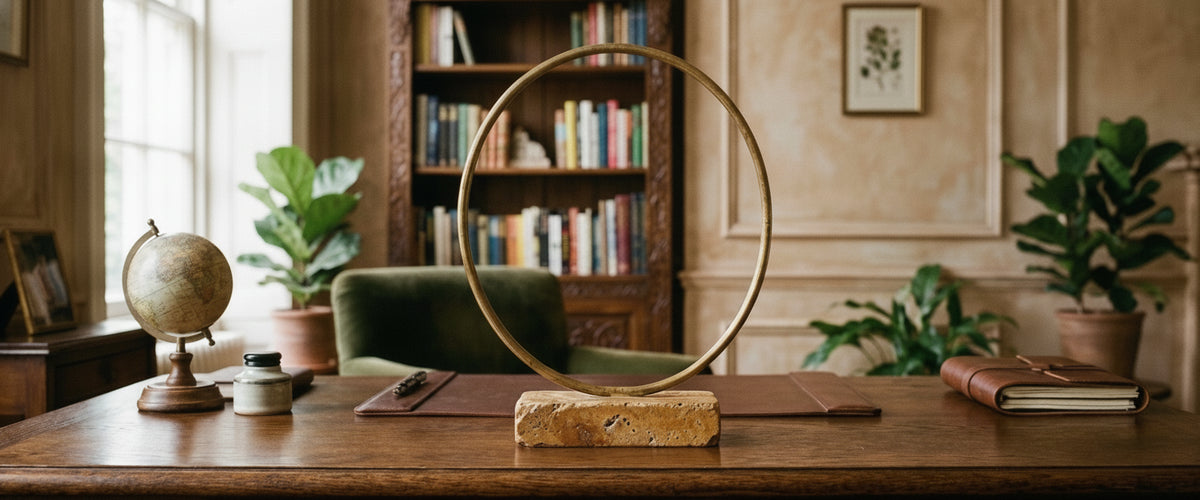
A Balizie brass table sculpture on a walnut console: warm metal and honey-toned travertine share a color temperature.
The appeal comes down to color temperature. Brass sits in the yellow-gold range, and travertine runs through honey, cream and pale walnut. Because both are warm, neither competes with the other. The stone adds matte weight and the metal adds a thin line of reflected light. That is why the Balizie brass and travertine decorative table sculpture format suits a walnut credenza in Napa as well as a white oak console in a Manhattan loft. Few decorative sculptures for a tabletop look finished with nothing styled around them, and this pairing is one of them.
That is the easy part. Here is what happens over the following years.

Lacquered or Living Brass: What Three Years Do to the Metal
Most brass table pieces leave the factory with a clear lacquer coat. It keeps the shine, and for a year or two it does the job. Over time, hands lift the piece to dust underneath, the lacquer thins at those touch points, and air reaches the metal in patches. The result is bright brass next to brown spots, which looks worse than either finish would on its own. Conservators at the Smithsonian's Museum Conservation Institute treat tarnish on copper alloys as a surface reaction rather than structural damage. That is a useful way to think about it.
Unlacquered brass, sometimes called living brass, darkens evenly to a soft toffee tone. Our studio often recommends it for that reason: the whole surface ages together. If you want the shine back, a non-abrasive brass polish restores it in a few minutes. If your Balizie brass table sculpture came lacquered, plan on having a metal finisher strip and re-lacquer it at some point.
Filled or Unfilled Travertine: Which Pits Matter
Travertine forms around mineral springs, and escaping gas leaves it full of small holes. Makers either fill those voids with resin or cement and hone the surface flat, or leave them open. Filled stone is the practical choice for anything that sits where keys and mail land. Open pits look good on vertical faces, but on a flat top they trap dust, and a cotton cloth catches on their edges. Ask the seller which version you are getting, because product photos rarely make it clear.
Rings, Spills and Coffee Cups
This part surprises most owners of a Balizie brass table sculpture: the stone marks before the brass does. Travertine is porous, so a sweating glass leaves a ring and a splash of orange juice dulls the surface within seconds. Brass just tarnishes a little faster wherever it got wet. One client in Austin sent us photos of a travertine plinth with a clean pale ring from a single glass of white wine left overnight. A poultice and a professional re-hone removed it, but neither should have been necessary.
If the piece is purely decorative, keep drinks off it. If it also needs to work as a surface, choose something built for that job: a sculptural side table such as the Holtmarsh Brown Monkey Side Table - 60cm keeps the figure below and gives a cup a proper top to land on, which is a far better arrangement than asking an ornament to act as a coaster.

Cleaners That Suit One Material and Etch the Other
Most cleaning damage to a Balizie brass table sculpture happens because the owner treats it as a single object. Brass polishes often contain mild acids, ammonia or fine abrasives, all of which etch or scratch travertine. Stone sealers won't harm the metal, but they can leave a cloudy film on brass. The Natural Stone Institute recommends pH-neutral products for calcareous stone, which rules out vinegar and most kitchen sprays.
Dust weekly with a dry microfiber cloth.
Clean the stone with a few drops of pH-neutral stone soap in water, then dry it straight away.
Before polishing the brass, mask the stone edge with painter's tape. Put the polish on the cloth, not directly on the metal.
Seal the travertine once or twice a year if it sits anywhere near liquids.
The Join and the Heavy Base That Keeps a Table Piece Upright
A threaded fixing lets the brass be retightened; a glued socket cannot.
The weak point is where the metal meets the stone. Cheaper pieces glue the brass into a drilled socket with epoxy. Better ones set a threaded rod into the stone so the metal can be tightened if it works loose. When your Balizie brass table sculpture arrives, give the brass a gentle twist. If it moves now, it will wobble later.
Next, check the proportions. Our rule of thumb is a base footprint at least a third of the overall height, with the stone carrying most of the weight. A 16-inch (40 cm) piece on a narrow plinth will fall the first time a cat or a sleeve brushes it. The same logic holds at furniture scale: a long, low form such as the Oakstone Teal Angular Coffee Table - 380cm, at roughly 12.5 feet (380 cm), keeps its mass wide and close to the floor rather than stacked on a slim support, and that is exactly the instinct to bring to a small piece on a console.

What to Check Before You Buy
Is the brass solid or plated? Solid brass is not magnetic, so a fridge magnet will tell you.
Is the brass lacquered or unlacquered?
Is the travertine filled or unfilled, and has it been sealed?
Is the metal attached with a threaded fixing or only with adhesive?
What is the base-to-height ratio, and what does the piece weigh in pounds?
Will it sit near drinks, direct sun or a heating vent?
When Sculpture Decor Should Be Made to Measure
Ready-made sculptures for home decor work well at tabletop scale. A commission makes more sense when you want a piece sized to a particular console, stone that matches your floor, or metalwork that can handle a busy family home. Giant Sculptures makes bespoke work in bronze, stainless steel, engineered metalwork and natural stone. Our functional sculpture and art furniture collection shows how we balance a sculptural object with everyday use. Budget depends on material, scale, complexity, engineering, installation and finishing. Send us photos and measurements of the space and we will come back with a tailored quote.
For wider placement ideas, How to Make Resin Art That Survives a Coffee Table is useful companion reading before finalising the setting and sightlines.