






































































































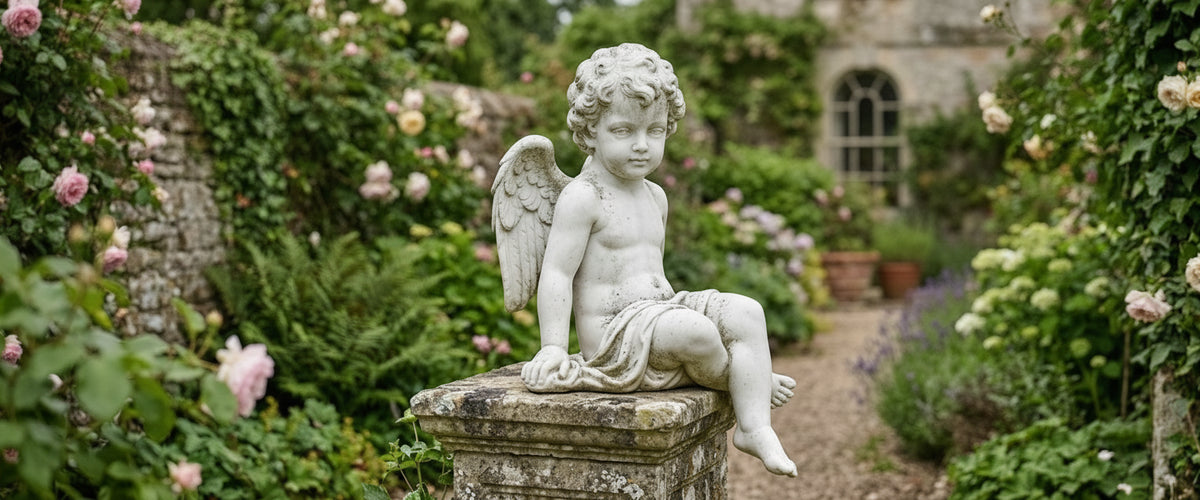

Most people who buy a stone cherub garden statue spend the first year worrying that it looks wrong. It is too white and too crisp, and it looks plainly new beside an old boxwood hedge. Give it time. Stone ages on its own schedule. The cherubs that look most at home in a Hamptons border or a Napa courtyard usually belong to owners who resisted the urge to hurry them along.
Quick answer:
Year one is about patience. The bright, fresh surface of a new stone cherub garden statue fades with rain and air. Scrubbing does not help.
Carved marble weathers slowly and evenly. Cast stone is more porous and can flake at thin points.
Frost hits fingers, wing tips and curls first, so design and placement matter more than any coating.
Real lichen is selective. Factory aging coats the whole figure at once.
Repair structural cracks and live with softened edges.

Year One: Why a New Stone Cherub Garden Statue Looks Too Clean
A freshly carved stone cherub garden statue leaves the workshop with a surface that has been worked by hand through progressively finer abrasives until the marble reads as one even tone. Outdoors, that finish starts to change within weeks. Rain carries pollen, soil and fine dust into the pores. The surface loses its showroom brightness, and the shaded side begins to cool in color before the sunny side does.
After the first winter, owners often ask whether they should paint on a buttermilk wash to speed up the moss. Our advice is to wait one more season. By the following autumn, the north-facing side of a cherub in a damp garden will often have picked up a soft gray-green bloom on its own, while the south face stays pale. That uneven, directional aging is exactly what a fake finish cannot reproduce. Do not pressure-wash a new piece to "reset" it either. The National Park Service guidance on cleaning masonry is blunt about the damage high-pressure water and harsh chemicals can do to historic stone surfaces.
Carved Stone and Cast Stone Weather Differently From the First Frost
Carved stone is cut from a single quarried block, so the grain and density run consistently from surface to core. Cast stone is crushed aggregate bound with cement and poured into a mold. It often has a denser outer skin over a more open interior. When that skin chips on a cast stone cherub garden statue, it can expose a core of a different color and texture, and the damage reads as damage.
Carved marble ages more evenly. Over many years its surface slowly dissolves, and the crystals loosen into a faintly granular texture conservators call sugaring. Because the material is the same all the way through, a weathered petal still matches a weathered cheek. That consistency matters most on figures with fine ornament: on a crowned design such as the Blossom Crown Cherub, carved at 39 inches (100 cm), the flowers and the face are the same marble, so the whole figure softens together rather than shedding a surface layer.

Freeze-Thaw Finds the Thin Points First
Water expands by roughly nine percent when it freezes. In stone, that means pressure inside the pores every time the temperature crosses the freezing line. Thin projections have the most surface for their volume, so they soak up water and freeze through first. On a stone cherub garden statue, that means fingers, wing tips, toes and the tight curls of the hair.
Placement does more than any product here. Raise the figure on a plinth so it never sits in standing water. Keep it out of sprinkler arcs and away from roof drip lines. In hard-freeze climates like Aspen or upstate New York, use a breathable winter cover, never plastic sheeting, which traps condensation against the stone. When choosing a design, look at how far the wings and limbs stand away from the body. For a small bed or a cold, exposed corner, a gathered seated pose such as the Seated Cherub Angel, at 24 inches (60 cm), generally leaves frost fewer exposed edges than a standing figure with outstretched arms and open wings.
Real Lichen Versus Factory Aging
Lichen is slow and fussy. It settles in hollows, folds and recesses where moisture lingers, and it favors the shaded side. Many of the crusty species that colonize stone grow only a millimeter or two a year, as the British Lichen Society explains, which is why a properly weathered stone cherub garden statue takes years rather than months.
Factory aging works the other way. Acid washes, tinted waxes and sprayed "moss" coat everything evenly, including the high points that nature keeps clean. The giveaway is green on the tip of the nose or the crown of the head. Some dipped finishes also seal the surface and trap moisture behind them. We prefer to supply each stone cherub statue for the garden clean and let the planting do the work. If a client wants a head start for a new landscape, we can hand-apply a restrained patina to the recesses as part of a bespoke commission.

Softened Edges Are a Record of Years
A vintage stone cherub garden statue with rounded cheeks and blurred curls has not failed. That softness is what decades of rain look like on stone. To tell patina from active decay, press a fingertip lightly against the surface. If it feels firm and simply rounded, leave it alone. If grains come away or the surface powders, the stone is breaking down and needs a conservator's assessment, not a garden-center sealant.
When to Repair a Chipped Cherub, and When to Leave It
Repair anything structural on a stone cherub garden statue. That means cracks through the wing roots, ankles or neck, loose fixing pins, and any break that lets water run into the core. Those get worse each winter, and a falling wing is a safety issue. Use reversible methods, matched stone fills and stainless steel pins. Old iron pins rust and expand, and that alone has split countless garden figures. Never patch marble with cement mortar.
Leave small chips on curls, worn toes or a weathered nose on an older piece. If your site is truly harsh and you want fine detail to stay crisp, bronze is the more forgiving material. For a larger focal point where open, delicate elements are the whole appeal, a bronze group such as the Large Classical Cherubs Under Parasol, at 67 inches (170 cm), holds its edges through winters that would wear a carved stone parasol down. Our bronze angel and cherub statues sit naturally alongside the stone options if you are weighing the two materials.

Checklist: Choosing a Stone Cherub Garden Statue That Ages Well
Ask whether the piece is carved from solid stone or cast. If it is cast, ask about the core.
Check how far wings, fingers and curls project from the body.
Plan a plinth and drainage before delivery, not after.
Choose the shaded side of the garden if you want lichen sooner.
Avoid glossy sealers and pre-applied "antique" coatings.
Agree on a repair approach, with stainless pins, before you ever need one.
Budget for installation as well as the figure. Cost depends on material, scale, carving complexity, engineering and finishing, so request a tailored quote.
A stone cherub garden statue is a long-term purchase. Choose it for the material and silhouette, place it with care, then let the weather finish the job. Giant Sculptures carves and ships bespoke figures worldwide. Explore our garden statues, or talk to us about a commission sized and detailed for the climate it will live in.
For wider placement ideas, Cherub Statues for Garden Spaces: Which Ones Keep Their Faces? is useful companion reading before finalizing the setting and sightlines.