





































































































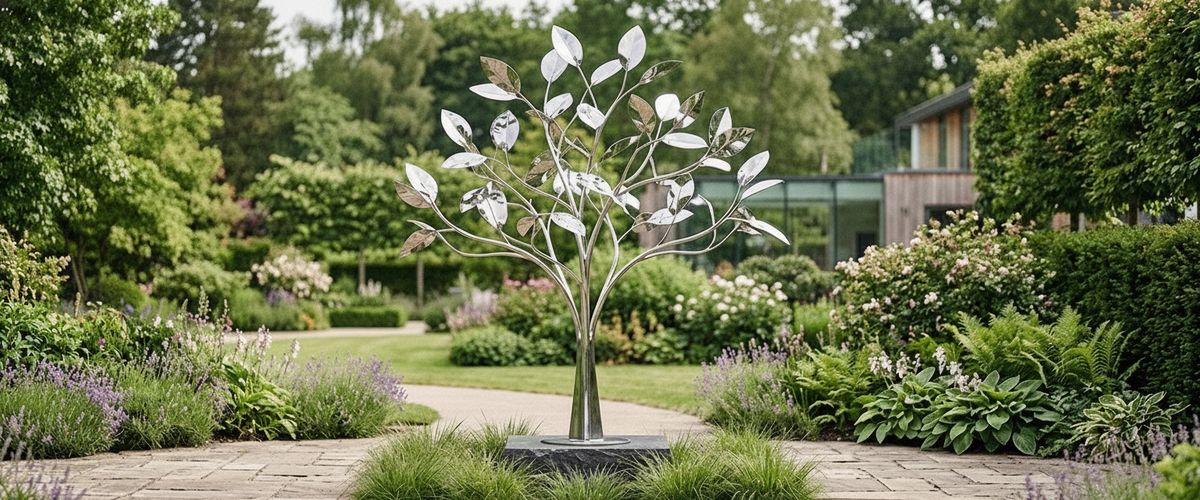

Most metal tree sculptures fail at the moment they should land hardest: the first glimpse from across the lawn or through the lobby doors. Up close, the welds are clean and the branches are lovely. From thirty feet (about 9 m), the whole thing collapses into a gray scribble. After years of building and shipping large-scale metalwork, our studio has reached one blunt conclusion. A metal tree sculpture succeeds or fails on the spaces between the metal.

At a Glance
Prune the branching. Three or four orders of limbs read at distance. Six or seven read as tangle.
Protect the gaps. Open pockets in the canopy keep the outline legible against sky or wall.
Size leaves for the viewer's distance, not for the hand holding them.
On a wall hanging, choose the wall color first and the metal finish second.
Check low winter sun, when shadows can double the apparent branch count.
Judge the maquette from the real viewing distance, never at arm's length.
An Overbranched Metal Tree Turns to Scribble at Thirty Feet
Real trees branch fractally, and the temptation is to copy that faithfully. The eye does not cooperate. Past a certain distance it stops resolving thin secondary limbs and blends them into a haze, so the extra welding adds visual noise and no information.
We see this on our own bench more often than we would like. A courtyard maquette can look superb up close and, photographed from the lobby doors, look like steel wool. Cutting roughly a third of the secondary limbs and thickening the primaries is often all it takes to give the tree posture. A period street lamp makes the point: a six-arm lamp post reads cleanly across a plaza because each arm is a thick, deliberate gesture. A good metal tree sculpture should borrow that confidence.

Sky Through the Canopy Carries the Silhouette
When we sketch a tree, we shade the gaps rather than the branches. Those holes are what let a viewer recognize the crown as a crown. Close them up and the outline turns into a blob; leave them open and even a stylized form reads instantly as a tree.
For a terrace or lawn where the view beyond should stay part of the picture, an open-crowned piece such as the Blossom Tree contemporary steel sculpture makes more sense than a dense, fully leafed canopy. A garden, a pool or a stretch of sky stays visible through the crown, which is exactly why that kind of tree holds its shape outdoors. For coastal sites, specify a marine-grade stainless; the British Stainless Steel Association publishes clear guidance on grade selection for salt exposure.
Fewer, Larger Leaves Read as Foliage
Hundreds of tiny laser-cut leaves shimmer nicely in a showroom. Outdoors they read as noise, trap debris and multiply the welds that have to survive decades of wind load. Fewer, larger leaves give the eye something to hold and group into masses, the way we actually perceive foliage from a distance.
Material changes the calculation. Polished stainless leaves reflect the sky and appear lighter than they are. Bronze leaves are heavier and warmer, so they want more air around them. Corten darkens as it weathers, which pushes the canopy toward silhouette; plan the gaps more generously.
Metal Tree Sculpture Wall Hanging: The Wall Color Does Half the Work
A metal tree sculpture wall hanging has no sky behind it. The wall is the sky. Gold branches on warm white can vanish in afternoon light, while the same piece against charcoal, deep green or oxblood jumps forward. Fine gilded linework, as in the Ethereal Frames golden tree suspended wall art, wants a darker, matte ground if it is to read from across a room; on pale plaster the same gold tends to dissolve.
Any metal sculpture wall hanging also benefits from standoffs that hold it an inch or two (2.5 to 5 cm) off the surface. That gap creates a crisp shadow line that thickens thin limbs visually. Look through our hanging sculptures with your paint chart in hand.

Winter Light Adds Branches You Never Welded
Low winter sun throws long shadows, and a tree sculpture effectively grows a second canopy across the paving or lawn. On a sparse design this can look beautiful. On an overbranched one it doubles the chaos. Before siting a piece, check the sun's path for your address on the NOAA solar calculator and ask where December shadows will fall. A clean stone terrace takes shadow well; a busy planting bed swallows it.
Wall pieces face the same effect indoors. A grazing downlight can turn one branch into three. Decide on lighting before the final branch count is fixed.
Test the Gaps With a Maquette at Viewing Distance
Every bespoke tree we build starts as a maquette, and the most useful test is embarrassingly simple. Place it at the true scaled distance from the viewer, photograph it on a phone at eye height and squint. If the outline survives the squint, the full-size piece will too. If it smudges, we prune before a single full-size limb is cut.
Clients are sometimes surprised how much we remove at this stage. It is the cheapest point in a commission to change your mind, far cheaper than altering fabricated steel.
Buyer Checklist Before You Commission
Main viewing distance: driveway, terrace, lobby or sofa? Design for that spot.
Background: open sky, hedge, facade or painted wall. Contrast drives legibility.
Material: stainless for reflection and coastal durability, bronze for warmth and weight, Corten for silhouette.
Branch orders and leaf count: ask to see the maquette edited, not just made.
Lighting and sun: winter shadows outside, directional fixtures inside.
Budget: it depends on material, scale, complexity, engineering, installation and finishing, so request a tailored quote.

How to Hang a Metal Wall Sculpture
Confirm the finished weight first, then fix into studs or solid masonry with anchors rated well beyond it. A French cleat or the mounting system supplied by the maker spreads load and keeps the piece level. Use standoffs for shadow depth, and always lift with two people. For large pieces over plasterboard, have a contractor verify the wall.
Giant Sculptures builds bespoke trees for gardens, hotels and private homes, and our metal sculptures collection is a good place to compare finishes before you brief a commission.
For wider placement ideas, How to Site an Abstract Metal Ribbon Sculpture so the Twist Actually Reads is useful companion reading before finalising the setting and sightlines.