





































































































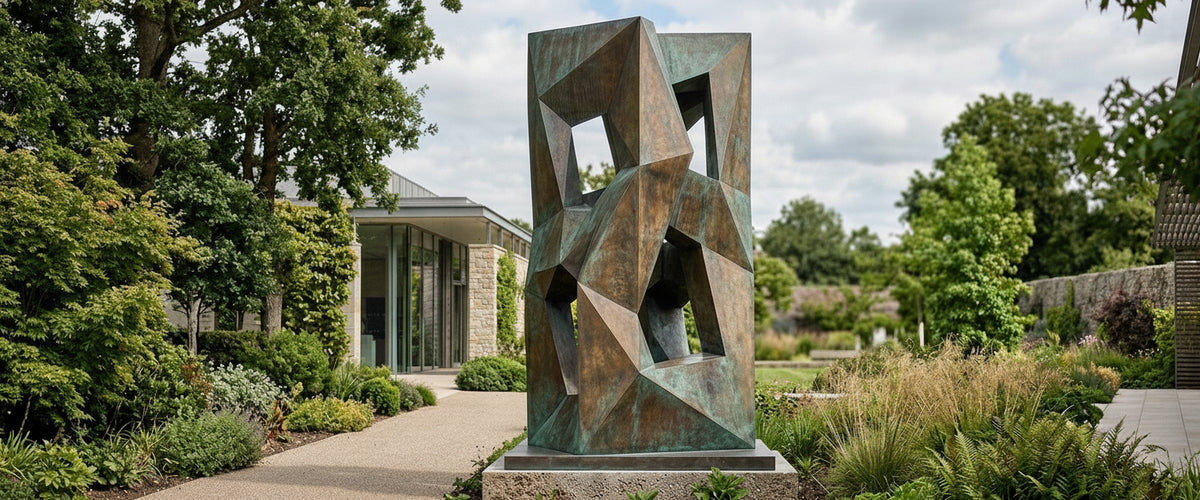

A modern art geometric sculpture can look flawless in a rendering and then read as clumsy the moment it stands in a real courtyard. The faces catch light differently at full scale. The angles that felt crisp on a screen turn heavy in bronze. This gap between the sketch and the finished piece is where most of the real work sits, and it is the part buyers almost never see. We have shipped enough modern art geometric sculpture commissions to know that the difference between a piece people walk past and a piece people stop for is decided long before fabrication starts.
If you are weighing up a geometric art sculpture for a garden, a lobby, or a corporate forecourt, it helps to understand what the studio is actually solving when you commission a modern art geometric sculpture. Below is how we think through it.

Key Takeaways
- Proportion at final scale, not sketch scale, is the make-or-break decision.
- Material changes everything: weight, cost, light behavior, and how the edges read.
- A piece designed for 10 ft (3 m) viewing rarely works at 30 ft (9 m) without adjustment.
- A proper studio process runs maquette, then sample, then fabrication, then install.
- Budget for a modern art geometric sculpture depends on material, scale, engineering, and finishing, so ask for a tailored quote rather than trusting a flat number.

What Sculptors Actually Think About Before Taking the Commission
The first question is never "what shape." It is "where will this live, and who walks past it." A modern art geometric sculpture for a private garden has a different job than one anchoring a city plaza. Sight lines, approach angle, and background all shape the geometry. A form that reads beautifully against open sky can vanish against a busy glass facade.
We also think hard about the negative space. This kind of work lives or dies on the voids as much as the solids. The gaps between planes frame the view behind the piece, and they change as you move around it. A good sculptor plans that choreography deliberately, so the modern art geometric sculpture rewards walking around it rather than freezing into one "correct" photo angle.
Then there is the honest conversation about intent. Some clients want a clean, reductive abstract; others are drawn to the stepped, faceted rhythm of an art deco geometric sculpture, where the lines carry a period confidence. Both are valid, but they lead to different proportions, different edge treatments, and different material choices. Naming the reference early saves months later.

Craft Decisions That Change the Result and the Price
Material is the biggest lever on any modern art geometric sculpture. Bronze gives you depth, warmth, and a surface you can patinate in dozens of ways; it also carries real weight and cost. Stainless steel reads cooler and more precise, which suits hard-edged geometric abstract art sculptures, and it can be polished to bounce the sky around. Corten brings a matte, rusted plane that softens angular forms in a planted setting. Stone and marble reward carved geometry but limit how thin an edge can go before it becomes fragile.
Edge treatment is the detail most buyers underestimate. A crisp 90-degree arris looks sharp but shows every imperfection and can chip. A slightly softened edge holds light more forgivingly and ages better outdoors. On a tall bronze form such as the Monumental Modern Abstract Geometric Figure Bronze Sculpture - 250cm, the way the planes meet is doing quiet work; it keeps a full-height piece from looking like flat card standing on end.
Finish is the third lever on a modern art geometric sculpture. A mirror polish demands near-perfect welds and a lot of hand time. A brushed or patinated finish hides more and often suits large-scale work better. The Foundation for Advancement in Conservation notes that outdoor metal finishes need planned, periodic maintenance to hold up against weather, so the finish you choose is also a maintenance commitment you are signing up for (see the AIC guidance on caring for objects). None of these choices are neutral. Each one moves the quote.

Why Some Pieces Read Right at 10 ft and Wrong at 30
Scale is not just "make it bigger." A geometric form designed to be met at close range, where you take in the whole thing in one glance, uses fine detail and tight transitions between planes. Blow that same design up to monument height and the detail disappears while the mass takes over. The piece can start to feel top-heavy or oddly thin, depending on how the volumes were balanced for the smaller size.
We had a client planning a courtyard modern art geometric sculpture who fell for a maquette that was, frankly, perfect at 3 ft. At 8 ft (2.4 m) it lost its tension because the base plane needed to grow faster than the upper forms to keep the eye anchored. We reworked the proportions, and the finished sculpture held its poise from every approach. That correction only happened because we tested it at scale before committing to metal.
The rule of thumb: the further away the primary viewing distance, the bolder and simpler the geometry needs to be. Fine faceting that delights at arm's length becomes visual noise at 30 ft. Where a plaza needs the eye to travel across a composition rather than settle on a single object, a grouped arrangement like the Monumental Modern Trio of Abstract Geometric Figures Bronze Sculpture - 250cm holds up better, because the relationship between the three forms stays legible even from across a large space.
Studio Process: Maquette, Sample, Fabrication, Install
A serious modern art geometric sculpture commission moves through clear stages, and skipping any of them is where projects go wrong.
- Maquette. A scaled model, physical or digital, that fixes proportion and the walk-around experience. This is where we test the piece against your actual site photos and sight lines.
- Material sample. A finish and edge sample in the real material, so you approve the patina, polish, or Corten tone in daylight rather than on a screen.
- Fabrication. Casting, welding, or carving the full piece, with internal armature and engineering sized for wind load and weight. Large bronze and steel work needs a proper structural base, not an afterthought.
- Install. Delivery, rigging, and fixing. For monumental work this often means crane access, a prepared foundation, and coordination with your landscaper or contractor.
At Giant Sculptures we treat the maquette and sample stages as non-negotiable for a bespoke modern art geometric sculpture, because they are the cheapest place to change your mind. Once the metal is committed, changes get expensive fast. If you want to see the range of forms before starting a commission, our geometric sculptures collection is a good place to gauge what suits your space, and the wider contemporary and modern sculptures range shows how these pieces sit alongside other abstract work.
Honest Red Flags Buyers Should Ask About Before Committing
A few questions separate a solid modern art geometric sculpture commission from a risky one:
- Can I see it at scale before you fabricate? If the answer is no, walk. Every credible studio can show you a maquette or scaled render.
- How is it engineered for wind and weight? A tall geometric form is a sail. Ask about the internal armature, base plate, and fixing method.
- What does the finish need over ten years? Bronze patina, polished steel, and Corten all age differently. Get the maintenance plan in writing.
- Who handles install and rigging? Monumental pieces are not a two-person lift. Clarify crane access and foundation requirements early.
- Is the quote itemized? Material, scale, engineering, finishing, and installation should each be visible. A single lump sum with no breakdown hides risk.
On budget, be wary of anyone who quotes a firm number before understanding your site and material. The cost of a modern art geometric sculpture is driven by the metal, the size, the structural engineering, the finish, and how hard it is to install. Those variables are exactly why we quote each modern art geometric sculpture commission individually rather than publishing a flat rate.
Choosing Well: A Quick Decision Framework
Start with viewing distance and pick the material for your modern art geometric sculpture to match the mood: cool and precise in stainless, warm and weighted in bronze, matte and earthy in Corten. Confirm the primary sight line and background. Then insist on a maquette and a material sample. Where a smaller indoor or garden setting suits your space better than a monument, a piece such as the Large Modern Abstract Bronze Sculpture - 94cm carries the same geometric language at a scale that ships and installs more simply. Get all of it in an itemized quote, and you will avoid almost every mistake we see buyers make.
For wider placement ideas, Modern Contemporary Wall Sculptures: What Actually Happens Before One Goes on Your Wall is useful companion reading before finalizing the setting and sightlines.