





































































































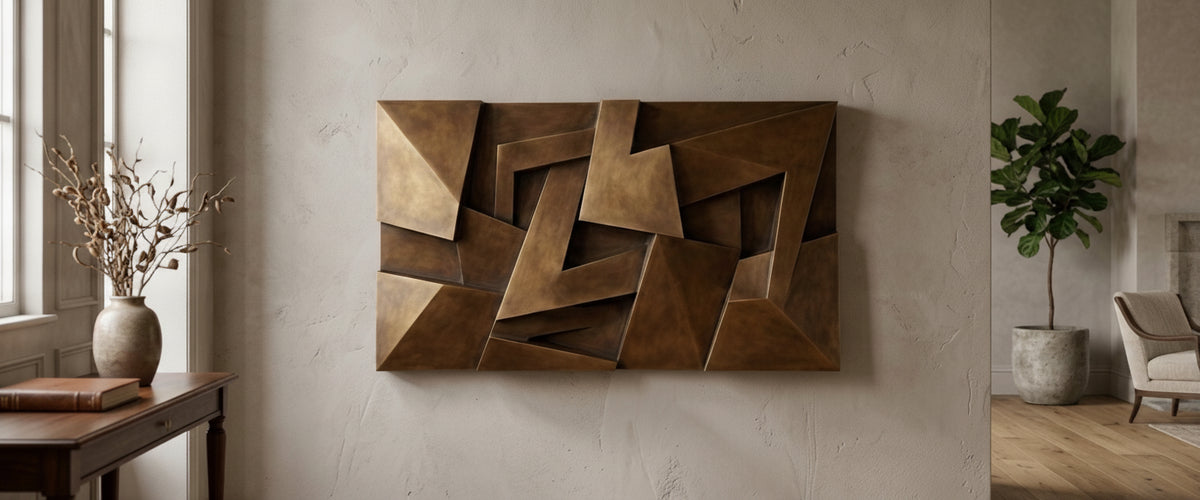

A wall sculpture that looks resolved in a photograph can still be wrong on the wall. The proportions read fine on a screen, then the piece arrives, goes up on a 24 ft (7.3 m) stairwell wall, and suddenly the forms feel timid and the shadows do nothing. That gap between the render and the room is where most disappointment lives, and it is exactly what a good sculptor is thinking about long before fabrication starts. Modern contemporary wall sculptures are unforgiving that way; they live at a fixed distance, in fixed light, and the eye has all day to pick them apart.
Looking for the full range in this category? Browse our Contemporary & Modern Sculptures collection for every available finish, size, and configuration of modern contemporary wall sculptures.
So before we talk finishes and pricing, here is the short version of what actually goes into getting one right.
A large relief judged by silhouette and shadow from across the room.

Key Takeaways
Viewing distance drives everything. A piece designed for 10 ft (3 m) rarely holds up at 30 ft (9 m), and the reverse looks fussy up close.
Material sets the mood and the maintenance. Bronze, stainless steel, and Corten each behave differently on a wall, indoors and out.
Relief depth is a craft decision, not a detail. Shadow does the heavy lifting; shallow work can vanish in flat light.
The studio process is staged for a reason. Maquette, sample, fabrication, install; skipping steps is where commissions go wrong.
Budget depends on material, scale, complexity, engineering, and mounting. Ask for a tailored quote on modern contemporary wall sculptures rather than trusting a headline figure.

What Sculptors Think About Before Taking On a Wall Commission
The first question is never "what should it look like." It is "where does it live, and who sees it, from how far away." A modern contemporary sculpture on a wall is a relief problem, which is a different discipline from work in the round. You are composing for one dominant angle and a narrow band of viewing positions, so the piece has to earn its keep from the sofa, the landing, or the lobby desk, not from every side.
We also ask about the wall itself. Solid masonry, stud partition, a rendered exterior facade, a glass-backed atrium; each changes the fixing strategy and the weight the wall can carry. A heavy bronze relief on a plasterboard wall needs blocking or a structural batten, and that has to be planned before anyone casts anything. Getting this wrong is not an aesthetic problem. It is a safety one, and it is why modern contemporary wall sculptures start with the wall, not the design.
Light is the third input, and it is the one buyers underrate most. Contemporary abstract modern sculpture in metal reads through shadow and reflection. A raking side light will carve depth into a shallow relief; flat overhead light will flatten it into wallpaper. If the wall only gets soft north light, the sculptor compensates with deeper undercuts and stronger edges. That decision, made early, is invisible in the final piece and completely determines whether it works.

Craft Decisions That Change the Result (and the Price)
Material is the first fork in the road for modern contemporary wall sculptures. Bronze gives you warmth, weight, and a patina you can control from near-black to green to a polished gold. It is the traditional choice for figural and relief work, and it ages honorably outdoors; the patina is a managed chemical layer, not simple corrosion, which is why conservators treat it as a surface to protect rather than remove (the Getty Conservation Institute documents this in detail). If you want a piece with obvious hand-modeled surface, bronze holds that texture beautifully. Where a single figural relief needs to anchor a wall on its own rather than lead a wider composition, a piece like the Classical Figural Torso Wall Sconce Bronze Sculpture - 90cm shows how much presence one form can carry.
How bronze, stainless steel and Corten each behave against wall light.
Stainless steel goes the other way. Polished or brushed, it is cooler, more architectural, and it plays with reflection instead of shadow. It suits contemporary modern sculpture in minimalist interiors and hard-edged exteriors, and it shrugs off weather with very little maintenance. Corten (weathering steel) is the third common route for outdoor walls: it develops a stable rust-colored surface that reads as warm and earthy against planting, which is why it turns up so often on facades and garden walls. All three materials give modern contemporary wall sculptures a different life on the wall.
Then there is scale of relief. Deep relief, where forms project several inches from the ground plane, costs more in material and fabrication but delivers drama and legibility at distance. Shallow relief is quieter, more graphic, and cheaper to make, but it needs good light to survive. When a subject needs to read as fully three-dimensional rather than as a picture pressed into metal, that projection has to be deliberate; the Traditional Horse Head Bronze Relief - 80cm uses depth exactly this way to let the animal step off the wall.
Finishing is the last big lever. Patina work, polishing, brushing, lacquering, and protective coatings all take skilled hours, and they change both the look and the longevity. This is why a fixed price up front is meaningless. The budget on modern contemporary wall sculptures depends on material, size, relief depth, engineering, finishing, and how it mounts. The honest move is to describe your wall and get a tailored quote against it.

Why Some Pieces Read Right at 10 ft and Wrong at 30
Here is the trap we see most often. A client falls for a piece at gallery distance, roughly 8 to 12 ft (2.4 to 3.7 m), then installs it on a wall they only ever see from across a large room or up a stairwell. Detail that carried the composition close up now disappears, and the silhouette that should be doing the work at distance was never designed to. This is the single most common failure with modern contemporary wall sculptures.
Distance rewards big gestures. At 30 ft (9 m), the eye reads outline, mass, and the pattern of light and dark before it reads any fine surface. So a wall piece for a double-height space needs a strong overall shape, bold negative space, and enough relief depth to throw real shadow. A relief for an intimate hallway can afford delicacy, texture, and quiet detail because you meet it at arm's length.
We shipped a large stainless piece to a Texas entrance hall where the client wanted "presence" on a 20 ft (6 m) wall. The first maquette was elegant and far too refined; from the front door it read as a smudge. We rebuilt it with fewer, larger forms and deeper separation between planes, and it snapped into focus from the doorway. Same idea, completely different execution, purely because of viewing distance. If you are browsing our modern art collection for a big wall, judge each of the modern contemporary wall sculptures by its silhouette first, not its close-up.

Studio Process: Maquette, Sample, Fabrication, Install
Bespoke modern contemporary wall sculptures move through stages for good reasons, and understanding them helps you spot a studio that cuts corners.
Maquette. A scaled model, physical or digital, that lets everyone agree the composition and proportions before committing to full size. This is where scale and viewing-distance problems get solved cheaply.
Material sample. A finish sample in the actual material, so you approve the exact patina, polish, or Corten tone under your own light. Approving a finish from a photo is asking for a surprise.
Fabrication. Casting, forming, welding, and hand-finishing at full scale. For large relief this includes building an internal mounting system that spreads weight correctly.
Install. Fixings, structural checks, and hanging. For anything heavy or exterior, this is a specialist job, not a picture-hook exercise.
Skip the maquette and you gamble on scale. Skip the sample and you gamble on finish. Neither is a gamble worth taking on modern contemporary wall sculptures meant to last decades.

Honest Red Flags to Ask About Before You Commit
Contemporary american sculpture modernism built a lot of its reputation on ambitious public and architectural work, and the lesson from that era holds: the failures were almost always about engineering and siting, not taste. Ask the hard questions early when you commission modern contemporary wall sculptures.
How does it mount, and what does my wall need? A serious studio will ask about your wall construction before quoting. If they do not, that is a flag.
What is the finish doing in 10 years? Indoors, outdoors, coastal salt air, freeze-thaw; the answer should be specific to your location.
Can I see a material sample and a maquette? Reluctance here usually means the studio is guessing at scale or finish.
Who installs it, and is the mounting engineered for the weight? Large bronze and steel reliefs can be heavy; the fixing must match.
What maintenance do I actually need to do? Bronze may want periodic waxing; stainless wants occasional cleaning; Corten wants correct siting so runoff does not stain adjacent surfaces.
Giant Sculptures works as a bespoke supplier of large-scale wall and freestanding pieces, so these are the conversations we have with buyers before any modern contemporary wall sculptures are made. If you want to see the range of finishes and formats first, the metal wall art collection is a good place to compare how bronze and steel behave on a wall, and the abstract art collection shows how contemporary abstract modern sculpture handles large negative space. Start with your wall, your light, and your viewing distance. The rest of the decisions on modern contemporary wall sculptures follow cleanly from there.
For wider placement ideas, Contemporary Metal Wall Art: How to Place It so It Actually Lands is useful companion reading before finalizing the setting and sightlines.