





































































































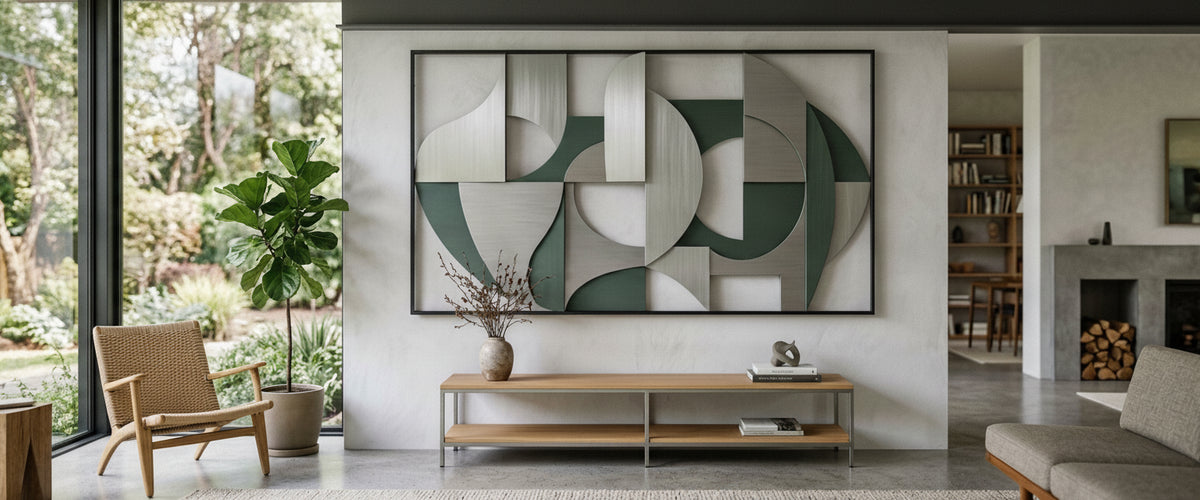

Most Nordic abstract wall art fails for the same quiet reason: it was designed to be photographed, not to be lived with on a real wall at a real distance. A piece can look assured in a product shot and then land flat above a 12-foot fireplace, because the person who made it never checked how it reads from across the room. Good Nordic abstract wall art solves that problem before fabrication starts. That is the difference between decor and a commissioned work, and it is the part buyers rarely get to see.
We spend a lot of time at Giant Sculptures making large metalwork behave at scale, so we tend to look at wall pieces the way a fabricator does: as objects with weight, edges, shadow lines, and a viewing distance. Here is what actually goes through a sculptor's head before they take the job.

Key Takeaways
- Scale is a design decision, not a size setting. A composition tuned for 10 feet often collapses at 30.
- Material drives everything else: price, weight, finish, and how the piece ages on the wall.
- The maquette stage is where money is saved. Fixing a proportion problem in a small model costs a fraction of fixing it in steel.
- Nordic abstract wall art leans on restraint: clean negative space, muted palettes, controlled texture.
- Ask about mounting and weight early. A heavy metal panel needs the right substrate behind it.

What Sculptors Actually Think About Before Taking a Nordic Abstract Wall Art Commission
The first question is never "what shape." It is "where does this hang, and who walks past it." A hallway piece gets read at 4 to 6 feet, so fine texture and layered surface earn their keep. A double-height living room or a lobby gets read at 25 or 30 feet, where fine detail turns to mush and only the big gesture survives. Nordic wall art tends to favor that second mode anyway: pared-back forms, honest material, breathing room around the composition.
Then comes the wall itself. Drywall, plaster, brick, and structural steel each change the mounting plan and the maximum safe weight. We have shipped metal wall pieces to clients who assumed any wall would hold them, only to find the mount needed blocking behind the plaster. Sorting that out early is far cheaper than discovering it on install day.
The third question is light. Nordic interiors chase daylight, and a brushed or Corten surface changes character as the sun moves. A flat matte finish stays constant; a raked, hand-worked surface will shift all day. Neither is wrong, but the sculptor needs to know which effect you want before choosing the finish.

Craft Decisions That Change the Final Result (and the Price)
Nordic canvas wall art and Nordic metal wall art sit at opposite ends of a spectrum, and the choice cascades through everything after it.
Canvas and cotton spray. Lighter, warmer, easier to hang, and forgiving on a plain plaster wall. Where a room wants the wall to feel quiet rather than commanding, a soft sprayed surface such as Aurista Botanical Flow holds a Nordic mood without shouting. Canvas suits bedrooms, studies, and rooms where you want restraint to do the work.
Metal. Steel, brushed aluminum, and Corten give you depth, real shadow, and durability that canvas cannot match. In a larger room that needs the composition to hold its own, a framed metal piece like Ecliptica reads with more authority, because the frame and the metal ground each cast their own shadow line. Metal also lets us push into outdoor-rated finishes if the piece heads to a covered terrace.
Framing. Nordic framed wall art often uses a thin, oiled-timber or matte-black surround to keep the eye on the composition. A heavy gilt frame fights the aesthetic. The frame is not trim; it is part of the drawing.
Finish and palette. Nordic forest wall art in particular relies on a narrow, cool palette (birch grays, spruce greens, snow whites) and restrained texture. Push the color too hard and it stops reading as Nordic. On metal, that restraint usually means a soft brushed grain or a controlled patina rather than a mirror polish.
Every one of these choices moves the budget. There is no honest fixed price for bespoke wall work, because cost tracks material, scale, engineering, finishing, and install complexity. The right move is to describe the wall, the room, and the effect you want, then ask for a tailored quote.

Why Some Nordic Abstract Wall Art Reads Right at 10 Feet and Wrong at 30
This is the single most common mistake we see. A composition that looks balanced in a 40cm sample can feel thin and busy when it is blown up to 8 feet across. The negative space that felt calm up close now feels empty; the fine linework that felt delicate now disappears entirely.
Enlarging a design is not a photocopy job. Line weights, gaps, and edge treatments all need retuning for the viewing distance. Where the wall is intimate and the piece is read close-up, a smaller studio work such as Ridthorpe Brown earns its texture in a hallway or reading nook. Scale that same idea to a stairwell and you would coarsen the texture and simplify the composition so it holds at distance.
The Museum of Modern Art's writing on abstraction makes a related point: abstract work asks the viewer to read relationships between forms rather than recognizable subjects, so the spacing and proportion of those forms carry the whole piece (see MoMA on abstraction). Get the proportions wrong at scale and there is nothing else for the eye to hold onto.
Studio Process: Maquette, Sample, Fabrication, Install
A bespoke Nordic abstract wall art piece follows a sequence that protects the buyer from expensive surprises.
- Maquette. A scaled model or digital mock-up placed against your actual wall dimensions. This is where we catch a composition that will not hold at distance, before any metal is cut.
- Sample. A finish sample on the real material: the actual patina, brush grain, or paint on the actual steel or canvas. Screens lie about color and sheen, so we make you a physical swatch.
- Fabrication. Cutting, forming, welding or stretching, then finishing. On metal, this is also where we engineer the mounting system, including a French cleat or standoff hardware sized to the wall and the weight.
- Install. For large pieces we plan crating, transit, and hanging so the work arrives ready to mount safely. Bigger metal panels usually want a professional install and the right blocking behind the wall.
None of this is showy, and that is the point. The unglamorous stages are where quality gets decided.
Honest Red Flags Buyers Should Ask About Before Committing
Whether you are buying a ready-made piece or commissioning, a few direct questions separate a real workshop from a drop-ship listing.
- "What is it actually made of, and how thick?" Thin printed foil on a board is not the same as formed metal. Ask for the gauge.
- "How much does it weigh, and how does it mount?" No weight, no mounting hardware detail, no confidence.
- "Can I see a finish sample on the real material?" A genuine maker can produce one.
- "Is the finish rated for where I am hanging it?" A bright kitchen with steam, a sunroom, or a covered terrace all test the coating differently.
- "Who handles install for a large piece?" Anything over a few feet across deserves a plan, not a picture hook.
- "Can you scale this design without ruining the composition?" If the answer is a flat yes with no discussion of line weight or spacing, be wary.
If you want to compare approaches, browse our Nordic art collection for the palette and restraint that define the style, and the wider metal wall art collection to see how depth and shadow change a piece at scale. For softer, painterly directions, the abstract art collection is the place to start.
A Note on Longevity
Wall art gets treated as disposable, which is a shame, because a well-made metal piece will outlast several redecorations. Formed steel or aluminum with a properly cured finish holds up for decades indoors. Corten and marine-grade coatings extend that to sheltered outdoor spots. Canvas is lovely but more sensitive to strong direct sun and damp, so keep it off a wall that bakes all afternoon. Buy for the wall you have and the life you want the piece to have, and Nordic abstract wall art stops being decor and starts being something you keep.
For wider placement ideas, 3d Porcelain Wall Art: What Sculptors Weigh Before They Say Yes is useful companion reading before finalising the setting and sightlines.