


































































































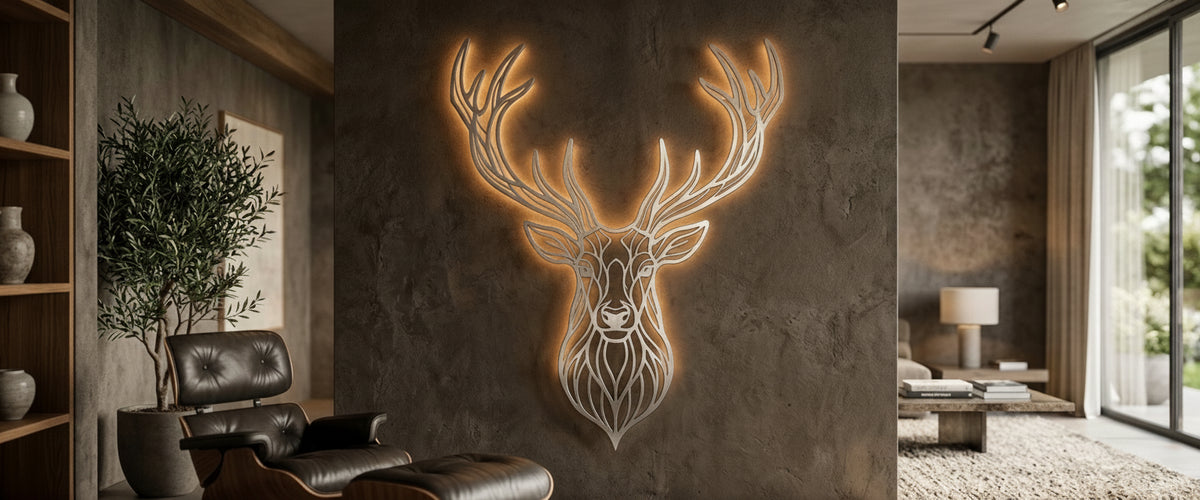

Most disappointing LED lighting wall art fails at exactly one moment: the first time it is switched on in the real room. The edge-glow that looked crisp in a studio photograph becomes a hot stripe of glare over a bar. The engraved circuit map that read beautifully on a laptop screen dissolves into a smudge from across the lobby. Nothing broke. The piece was simply designed for a photograph rather than for a wall, a viewing distance, and a decade of use.
We build LED lighting wall art alongside freestanding work at Giant Sculptures, and the difference between a commission that ages well and one that gets quietly unplugged usually comes down to craft decisions no buyer ever sees. Worth knowing them before you spend anything.

LED Lighting Wall Art at a Glance
- Diffusion beats brightness. A softly diffused panel at low output looks more expensive than a bright one with visible diodes.
- Viewing distance drives line weight. Fine detail that sings at 10 ft (3 m) can vanish at 30 ft (9 m).
- Drivers fail before LEDs do. Ask where the driver lives and how it is reached without pulling the piece off the wall.
- Material sets the mood. Brushed stainless bounces light coldly, bronze warms it, leather and wood absorb it.
- Budget is a function of scale, material, engineering and finish. There is no list price for bespoke; ask for a tailored quote.

What We Weigh Before Accepting an LED Lighting Wall Art Commission
The first conversation is rarely about design. It is about the wall. Stud-framed drywall, cast concrete, structural glazing and exterior render all behave differently, and each one changes the mounting strategy, the depth of the piece, and where power can realistically enter. One steakhouse commission taught us that lesson properly: the feature wall turned out to be poured concrete with post-tensioned cable runs the contractor would not let us near, so a recessed backbox became a standoff-mounted panel with a concealed side-entry feed. Same artwork, completely different fabrication drawing.
Then we ask who controls the lights. A private residence with a single dimmer is a different problem from a hotel lobby on a DMX show controller where the LED wall art has to behave alongside dozens of other fixtures. If a venue plans to run scenes, we need to know at the drawing stage, not after the panel is skinned.
Last comes the honest question: does this subject actually want light inside it? Some do. Line-based work, typography, maps and abstract wireforms all gain from internal illumination. Figurative relief usually does not; it wants light raked across it from outside. A cast piece such as the Traditional Horse Head Bronze Relief - 80cm looks far better with a tight external spot pulling shadow out of the mane than it ever would with diodes hidden behind it. Knowing when to say no to LEDs is part of the job.

The Craft Decisions That Change the Result, and the Quote
Diffusion and Pitch
Two numbers decide whether LED lighting wall art looks engineered or cheap: the spacing between diodes on the tape, and the distance from that tape to the diffuser. Get the ratio wrong and you see scalloping, a row of bright dots marching across the face. Tighter pitch plus a deeper cavity plus opal acrylic costs more and looks calm. That single choice moves a quote more than most clients expect.
Line Weight on Map and Circuit Pieces
Motorsport layouts are one of the most requested formats we see, and Spa-Francorchamps LED wall art is the classic example. A track outline is almost entirely thin line, so every millimeter of stroke width matters. Cut the channel too narrow and the light chokes; too wide and Eau Rouge loses its character. We normally cut three sample sections at different stroke widths, light them, and let the client stand back at the real viewing distance before we commit the full panel.
Color Temperature and the Surface Behind It
Cool white on brushed stainless reads clinical, which suits a gym or a tech campus atrium. Warm output against a textured surface reads residential. Where the surface should hold the light rather than throw it back, a piece like Vanguard Jade Surge Leather 3D LED Wall Art is closer to the right material logic: the leather absorbs rather than reflects, so the glow stays contained in the relief instead of flaring across the wall. Swap that same lighting scheme onto polished metal and you get a mirror of every diode in the room.
Metal, Wood or Composite Face
For wider placement ideas, LED Wall Art That Still Looks Good With the Lights on is useful companion reading before finalising the setting and sightlines.
Laser-cut stainless holds fine detail and survives damp environments. Wood gives warmth but moves with humidity, which matters if the piece sits near a pool enclosure or a commercial kitchen. Powder-coated aluminum is light enough for big spans on drywall. Across the metal wall art range, the face material changes the character of a piece long before a single LED is fitted.

Why Some LED Wall Art Reads Right at 10 Feet and Wrong at 30
Detail resolves at close range and collapses at distance. That is the whole problem. A residential client stands 8 to 12 ft (2.4 to 3.7 m) from the wall and can enjoy fine engraving, layered acrylic and subtle gradients. A hotel guest sees the same piece from 30 ft (9 m) across a lobby, at an angle, competing with daylight from a curtain wall. At that distance only silhouette, contrast and mass survive.
So we design LED lighting wall art for the longest realistic sightline first, then add close-range reward. Bold outer form for the room; finer texture, brushmarks and edge detail for the person waiting by the elevator. Glare control belongs in the same conversation, because a bright source in the visual field at eye level is fatiguing rather than flattering, a point the Illuminating Engineering Society has been making about luminance ratios for decades. Illuminated pieces in circulation spaces almost always want lower output and better diffusion than clients first assume.
Scale reads differently outdoors again. In open garden settings, a lit form has no wall to bounce off and no ceiling to contain it, which is why a freestanding form such as the Luminous Stag Silver Stainless Steel Sculpture holds a lawn where a flat panel would disappear. Plenty of clients commission that kind of piece with LED Christmas wall art in mind, then keep it lit long after the tree comes down. Seasonal intent, permanent value.
Inside the Studio Process: Maquette, Sample, Fabrication, Install
- Maquette or scaled mockup. For sculptural relief we build a small physical study. For flat LED illuminated wall art we tape a full-size paper outline to the actual wall and photograph it from the seating positions that matter. Cheap, and it kills bad proportions early.
- Lit sample. A section of the real face material, real diffuser, real diodes. Never approve a lighting scheme from a render. Color temperature on screen and color temperature on brushed steel are different animals.
- Fabrication. Cutting, forming, welding or laminating, then finishing. Electrical fit-out happens last so no finishing dust ends up inside the cavity.
- Bench burn-in. The piece runs in the workshop before it ships. Early driver failures tend to appear in the first hours of running rather than the first year, and we would rather find them here than in a client's dining room.
- Install coordination. Mounting hardware, power location, dimmer compatibility and access route all confirmed with the contractor in writing. For heavier metal pieces we supply weights and fixing specifications so the wall build-up can be checked before delivery.
Red Flags Worth Raising Before You Commission LED Lighting Wall Art
- "The driver is sealed inside." LED modules can last tens of thousands of hours; the driver is the part that gives up first. Insist on serviceable access.
- No stated ingress rating for anything exterior or humid. Poolside, covered terrace and spa rooms need components rated for damp or wet locations, and independent listing from a body such as UL Solutions is worth asking for by name.
- Dimmer compatibility left vague. Mismatched drivers and dimmers cause flicker and audible buzz. Get the control protocol confirmed in the quote.
- No spare parts plan. Ask whether the same tape, diffuser and driver will be obtainable in five years, and whether the maker holds stock.
- Proportions approved only on screen. If nobody has stood in the room with a full-size outline, the risk sits with you.
- Cleaning never discussed. Diffusers attract dust and fingerprints. Establish what solvents the finish tolerates before someone attacks it with the wrong spray.
Where to Find LED Illuminated Wall Art You Will Still Like in Ten Years
Buyers usually arrive with one of two briefs. Either they want a finished piece that ships and hangs, or they want something built around a specific wall, story or brand. Both are legitimate; the mistake is starting a bespoke conversation while shopping catalog prices, or expecting a stock piece to solve an awkward 20 ft (6 m) span.
Use these criteria to decide. If your wall is standard height, your sightlines are short and the subject is generic, buy off the shelf and spend the difference on good installation. If the wall is oversized, the sightline is long, the environment is damp, or the piece has to carry a venue's identity, commission it. The LED and neon art collection is the sensible starting point for the first route, and the broader wall art and wall decor range is useful for comparing lit and unlit approaches side by side. Where a client wants light in the room but not diodes inside the artwork, we often specify an external spot or a cast bronze sconce instead: the wall gets washed from outside, and the cast metal will outlast anything electrical fitted near it.
Whichever way you go, judge the maker on the questions they ask you. If nobody asks about wall construction, viewing distance, control systems or service access, you are buying a photograph, not a piece of LED lighting wall art built to live somewhere.