




























































































Switch the room lights off and almost any illuminated panel looks good. Switch them on and the truth arrives: a gray acrylic box, a visible power cable, and a hot spot where the diode strip sits too close to the face. That is the real test for led wall art, and it is the one most buyers skip. A piece that only performs after dark is a lamp with ambitions. A piece that reads as sculpture at noon and glows at midnight is worth the wall.

Key Takeaways Before You Shop
- Judge it in daylight first. Sculptural relief, material depth and edge detail carry the piece for the 12 hours a day the LEDs are off.
- Diffusion beats brightness. Even, indirect glow looks expensive; visible diodes and hot spots look cheap regardless of what you paid.
- Scale to the wall, not to the sofa. Underscaled illuminated panels are the single most common mistake we see in large US interiors.
- Plan power early. Recessed outlets, driver location and dimming control are architectural decisions, not accessories.
- Budget depends on material, size, complexity, engineering and installation. Ask for a tailored quote rather than assuming a category price.

What LED Wall Art Actually Is, and Who It Suits
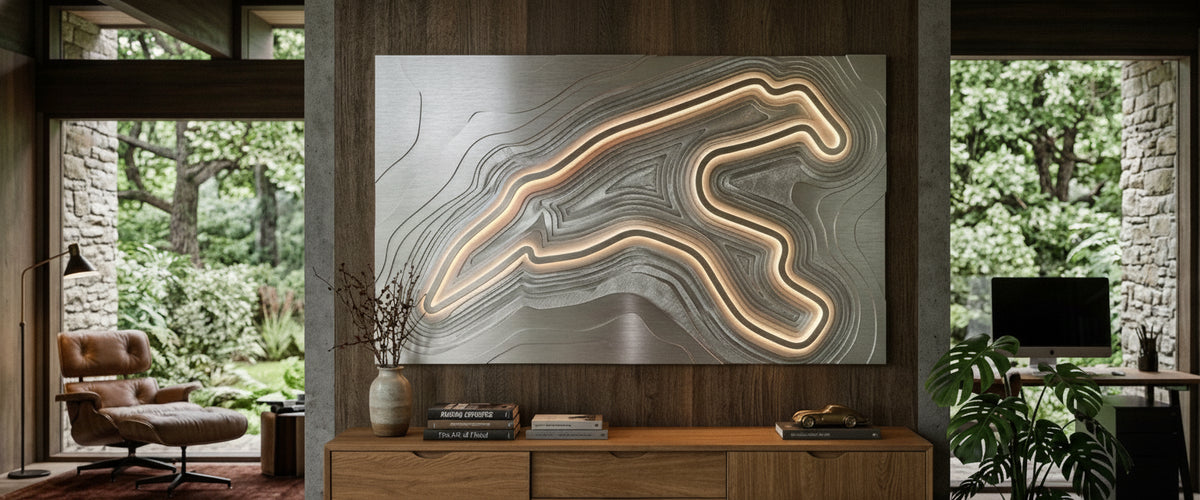
Strip away the marketing and led wall art means one thing: a wall-mounted artwork with integrated light, where the illumination is part of the composition rather than an add-on spotlight. That covers a wide field. Backlit sculpted panels, layered acrylic with edge-lit glow, framed pieces with concealed perimeter lighting, brushed metal reliefs with light washing across the texture, and neon-style linear work all sit under the same umbrella. Our LED and neon art collection spans most of these formats.
It suits three buyers particularly well. Commercial venue owners who need a wall to work in both a bright lunch service and a dim evening one. Homeowners with double-height living spaces or media rooms where a flat canvas disappears. And collectors of themed work, especially motorsport and aviation, where a lit outline carries graphic punch that print never manages. The spa-francorchamps led wall art searches are a good example of this last group: circuit maps of Spa, with Eau Rouge picked out in light, have become a fixture in garage builds and car collector rooms from Scottsdale to Greenwich. Same logic applies to led christmas wall art, though seasonal pieces come with a caveat we cover below.
Who it does not suit: anyone hoping led lighting wall art will replace proper room lighting. It contributes atmosphere, not usable task light. Plan your ceiling and lamp scheme independently.

Materials, Finishes and the Scale Decision
The face material decides whether the piece survives daylight. Acrylic diffuses beautifully and allows deep color saturation, which is why a layered acrylic panel works so well in a dark-walled media room: the depth between the sheets does the visual work whether or not the light is on. Thin, single-sheet acrylic is a different story. If you can see the diode line through the face, walk away.
Textile and leather-faced panels give you something acrylic cannot: a matte, tactile surface that absorbs rather than bounces light. Where a room needs the artwork to hold its own in full daylight, a sculpted leather face such as Vanguard Jade Surge Leather 3D LED Wall Art reads as relief sculpture first and only reveals its perimeter glow when the room dims. That dual life is exactly what you are paying for.
Metal is the durability play. Brushed stainless, blackened steel and bronze all take a grazing LED wash superbly, because the light exaggerates the tooling marks and hammer texture instead of fighting them. If your project leans traditional, consider whether you actually want lit sculpture rather than lit panel. A cast relief such as the Traditional Horse Head Bronze Relief - 80cm (about 31 inches), lit by a discreet linear fixture above it, gives you far more presence than an illuminated print, and bronze does not date the way trend colors do. For a wall that needs both, our metal wall art range is the usual starting point.
Getting the Size Right
Rule of thumb from years of shipping large work: a feature wall piece should occupy roughly two thirds of the visual width of whatever sits beneath it, and in a double-height room you should be thinking in feet, not inches. A 35 inch (90cm) panel that looks generous in a showroom photograph vanishes on a 20 foot (6m) wall in a Texas great room. We have had more than one client re-order at nearly double the original size after seeing the first piece hung. Measure the wall, tape out the footprint in painter's tape, and live with it for a day before you commit.
Vertical formats solve narrow walls that horizontal art cannot. On a stairwell, entry hall or elevator lobby where the eye travels upward anyway, a tall hanging format like Celestique Ancient Bonsai Framed Long Hanging LED Wall Art uses the height instead of fighting it.

Where to Place LED Illuminated Wall Art for Real Impact
For wider placement ideas, How Long Does LED & Neon Art Last? Lifespan, Brightness, and What Wrecks It is useful companion reading before finalising the setting and sightlines.
Placement decides half the result. A few positions consistently outperform:
- The wall you see from outside. In glass-heavy California and Hamptons builds, the piece visible through the window at dusk is doing double duty as landscape lighting for the terrace view.
- Behind a bar or reception desk. Hospitality venues get the best return here, because the illuminated backdrop photographs well and guests do the marketing for you.
- Stairwell and corridor walls. Low ambient light means led illuminated wall art holds attention without competing with anything.
- Media rooms and cinemas. Warm, dimmable perimeter glow reduces eye strain against a bright screen.
Two placements to avoid. Directly opposite a large window, where daytime glare flattens the surface and afternoon UV can fade pigmented faces over years. And directly above a fireplace with an open flue, where heat cycling and soot deposit are unkind to both electronics and finishes.
Outdoors is possible but demands honesty about ingress protection. A covered loggia in Napa is a different environment from an exposed Aspen courtyard, and the fixture rating needs to match. The IEC's IP rating system is the standard worth quoting back to any supplier who tells you a piece is simply "weatherproof." Ask for the number.
Budget, Commissioning and Delivery
There is no honest single price for led wall art, because the variables genuinely swing the number: face material, overall size, depth of relief, whether the metalwork is fabricated or cast, the driver and control specification, crating for a large panel, and whether installation needs a lift or a two-person hang. A quoted project is the only meaningful answer, and we would rather scope it properly than guess.
Specification points that are worth insisting on:
- Dimmable drivers as standard. We now spec dimming on nearly every commission after a restaurant client in Austin found the fixed-output version overpowered the room once the dining lights came down.
- Color temperature you have actually seen. Warm white around 2700K flatters bronze and leather; cooler outputs suit stainless and blue-toned acrylic. Get samples.
- Serviceable light sources. LEDs dim gradually rather than failing outright, and the US Department of Energy notes that useful life is defined by that lumen depreciation. Ask how the strip or module is replaced in ten years without dismantling the artwork.
- Concealed power route. Decide early between a rear-exit cable into a recessed outlet or a hardwired feed. Retrofitting this after the drywall is finished is nobody's favorite afternoon.
- Mounting hardware rated for the weight. Large metal-faced work can run well over 100 pounds (45kg). French cleats into studs or masonry anchors, never drywall plugs.
Pre-Order Checklist
- Wall dimensions measured, plus ceiling height and any obstructions.
- Tape outline lived with for 24 hours.
- Power source confirmed and located.
- Dimming and control method agreed (wall switch, smart control, inline).
- Color temperature sample approved in your actual room light.
- Face material chosen for how it looks unlit as well as lit.
- Delivery access checked: door widths, stair turns, elevator dimensions.
- Installation method and fixings specified in writing.
How Giant Sculptures Handles Bespoke LED Wall Art
Most of our illuminated commissions start when a client cannot find the right size. Someone has a 16 foot wall and a catalog full of 40 inch panels. Bespoke work solves that, and it also solves subject matter: a specific circuit map, a company mark rendered in brushed steel relief, a botanical study scaled to a lobby. Our studio works across bronze casting, fabricated stainless, Corten and engineered metalwork, so an illuminated commission can be built as genuine sculpture with light integrated rather than a printed face with a strip behind it.
The process is straightforward. You send dimensions, wall photographs and a sense of direction. We come back with material options, a scale study and a quote covering fabrication, finishing, crating and installation guidance. Pieces ship worldwide, and we crate large panels for freight rather than parcel carriers, which matters more than people expect once a piece passes about 5 feet (1.5m) across. Browse the wider wall art and wall decor range to see the formats we build most often, then tell us what you actually need.
One last piece of advice on seasonal work. Led christmas wall art tends to be bought fast and regretted slowly, because most of it is designed for six weeks of the year. If you want something festive that survives January, commission a piece with a neutral sculptural form and let the lighting scheme carry the season instead.