





































































































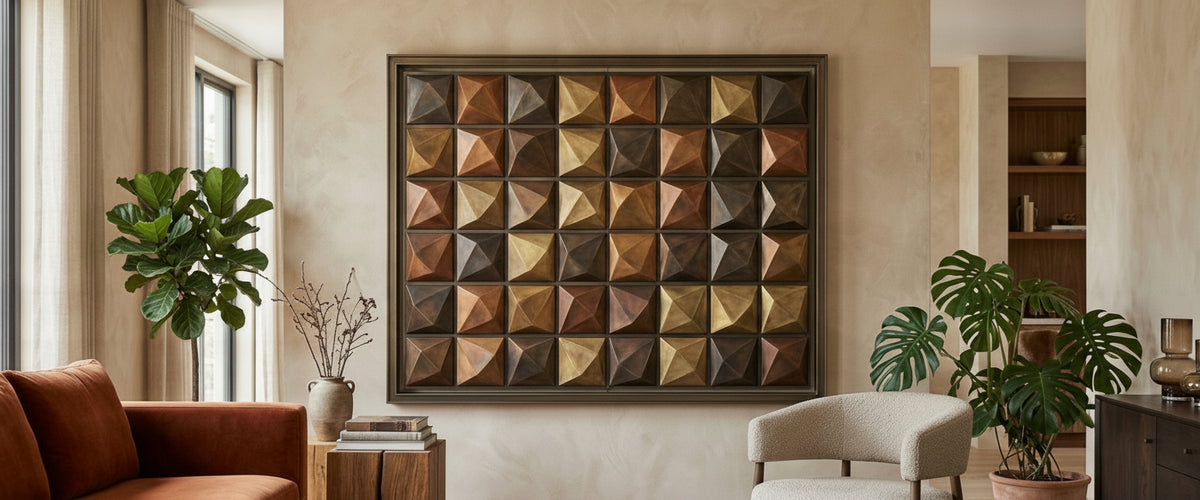

A framed array indoor piece can look effortless on a wall, which is exactly the problem. The effortless look is the product of a dozen decisions made before anyone touches metal: how deep the frame sits, how the modules repeat, how light rakes across the surface at breakfast versus at night. Get those right and the wall holds a room. Get them wrong and you have an expensive rectangle that reads flat from the sofa.
Looking for the full range in this category? Browse our Indoor Sculptures & Statues collection for every available finish, size, and configuration. A framed array indoor build lives or dies on those specifics.
We build large-scale and bespoke sculpture at Giant Sculptures, and framed array indoor wall work is one of the trickiest formats to specify well. It looks simple. It is not. Below is how makers actually think about these commissions, where the money goes, and the questions that separate a considered buyer from a hopeful one.

Key Takeaways for a Framed Array Indoor Commission
- Depth and shadow do the heavy lifting. A framed array indoor piece reads through relief and cast shadow, not just color, so the frame depth is a design decision, not a trim detail.
- Scale is not linear. A composition tuned for a 10 ft (3 m) viewing distance can fall apart at 30 ft (9 m), and the reverse is also true.
- Material sets the mood and the maintenance. Brushed stainless, patinated bronze, powder-coated steel and hand-painted acrylic panels each behave differently under indoor light.
- Process protects you. Maquette, finish sample, then fabrication. Skipping the sample stage is where regret lives.
- Ask about the wall, not just the art. Fixings, weight distribution and substrate matter as much as the sculpture itself.

What Sculptors Actually Think About Before Taking the Commission
The first conversation is rarely about the art. It is about the wall, the room, and how people move through it. Before we agree to a framed array indoor build, we want to know the throw distance (how far back the main viewing point sits), the light sources and their direction, and whether the wall is plasterboard, brick, or solid masonry. That last point decides the whole fixing strategy and, by extension, how many modules we can safely hang and how heavy each can be.
We also ask what the piece is competing with. A framed array indoor piece on a quiet gallery wall can be intricate and low-contrast. The same array above a busy open-plan kitchen needs bolder rhythm and deeper relief or it disappears behind the visual noise of cabinetry, pendant lights and traffic. Composition follows context. A maker who does not ask about the room is guessing.

Craft Decisions That Change the Result and the Price
Buyers often assume the material choice is the big cost lever. It matters, but the quieter decisions move the budget just as much on a framed array indoor commission.
Module count and repetition. An array made of forty small modules takes far more assembly, alignment and finishing time than one made of nine larger elements, even at the same overall size. More parts means more edges to finish and more chances for a misaligned reveal to catch the eye.
Frame depth and reveal. A shallow frame keeps the piece graphic and calm. A deeper frame, say three or four inches (roughly 75 to 100 mm), throws real shadow and gives the array movement as daylight shifts. Deeper frames cost more to build and demand more careful wall fixing, but they are often what makes an abstract metal wall sculpture feel alive rather than printed.
Finish. Hand-applied finishes carry the most labor. Where the room has controlled lighting and you want color and dimensional facets to play off each other, a hand-painted framed array indoor piece such as Terracube VI is closer to the right design language than a flat printed panel. Compare that with a brushed or patinated metal array, where the finish is worked into the surface and reads differently as you cross the room.
Edge and joint quality. This is the detail that separates a considered framed array indoor build from a decorative one. Clean, consistent reveals between modules read as intent. Wandering gaps read as a mistake, and the eye finds them instantly.

Why Some Framed Array Indoor Pieces Read Right at 10 ft and Wrong at 30
Scale is where most of these projects go sideways. A composition tuned for close viewing, fine texture, tight module spacing, subtle color shifts, can turn to mush from across a double-height room. From 30 ft (9 m) the eye reads mass, rhythm and silhouette long before it reads detail. Delicate work simply averages out into a gray field.
The reverse trap is just as common. A framed array indoor piece built with bold, widely spaced modules for a big atrium can feel crude and empty when a buyer later hangs it in a snug den where people sit six feet away. Now every gap looks like a design flaw and the relief feels heavy-handed.
Our rule of thumb: design the composition around the primary viewing distance, then stress-test it at the two extremes people will actually use. We do this with scaled renders and, for larger commissions, a partial mock-up. For clients considering large indoor abstract sculptures for lobbies, stairwells or open-plan living, this step alone prevents the most expensive mistake in the format, a piece that is technically beautiful and contextually wrong.
Studio Process: Maquette, Sample, Fabrication, Install
Good framed array indoor work runs through four stages, and each one exists to remove risk.
- Maquette. A scaled model, physical or high-fidelity 3D, that fixes composition, module rhythm and frame depth. This is where we settle proportion before any expensive material is committed.
- Finish sample. A physical sample of the actual finish on the actual material. Screens lie about metal. A patina that looks warm on a monitor can read cold and green on a north-facing wall. We insist on this because color and reflectivity behave differently under real interior light, a point conservation bodies make repeatedly about how surface and lighting interact over time (see the Getty Conservation Institute on material behavior and environment).
- Fabrication. Cutting, forming, welding or bonding, and finishing each module, then assembling and aligning the full array in the studio before it ever ships. We dry-fit the whole piece so the reveals are proven, not hoped for.
- Install. A framed array indoor piece is only as good as its wall. We supply a fixing specification matched to the substrate and, for heavier metal arrays, a hanging system that distributes load rather than trusting a couple of anchors. For international clients we crate modules with alignment references so a local installer can rebuild the array exactly as we proved it in the studio.
We once shipped a multi-module metal array to a client whose double-height stairwell wall was, we discovered late, mostly glass and steel with only a narrow masonry return. The fix was a bespoke sub-frame that spread the load and let the array float clear of the glazing. Had we not asked about the substrate at the maquette stage, that would have surfaced on install day, which is the worst possible time to learn it.
Honest Red Flags Buyers Should Ask About Before They Commit
A considered framed array indoor commission deserves considered questions, so treat it like one. Before you sign anything, get straight answers on these.
- "Can I see a finish sample on the real material?" If the answer is a render only, slow down. Renders sell; samples protect you.
- "How is this fixed to my specific wall?" A maker who has not asked about your substrate has not thought about install. Weight distribution is not an afterthought.
- "What is the primary viewing distance you designed for?" If they cannot answer, the composition has not been tuned to your room.
- "How do the modules stay aligned over time?" Temperature and humidity move materials. A good array accounts for it; a decorative one ignores it.
- "What does long-term care look like?" Indoor does not mean maintenance-free. Brushed metal shows fingerprints, patinas mature, hand-painted surfaces want gentle dusting rather than sprays.
- "Is the quote itemized?" Budget for a framed array indoor piece depends on material, module count, frame depth, finish complexity, engineering and installation. Ask for a tailored quote that breaks these out rather than a single number, so you can see what you are actually paying for.
The word "framed" hides a lot of engineering. A framed array indoor build that behaves indoors, holds alignment, throws the right shadow, and reads correctly from where people stand is the result of decisions made at the maquette stage, not lucky assembly at the end.
Indoor Now, Somewhere Else Later
Buyers often ask whether an interior piece could move outdoors, or whether an indoor/outdoor abstract metal wall sculpture is a smarter long-term buy. It is worth deciding early. A framed array indoor piece built purely for interior life can use finishes and bonds that will not survive weather, freeze-thaw or UV. If you think a piece might migrate to a covered terrace or an exterior courtyard later, tell us up front so we specify materials and fixings that tolerate both. Retrofitting weather resistance into an indoor build is rarely clean and often not possible.
Whether you want a quiet graphic array for a gallery wall or a deep-relief metal composition for a stairwell people see from three floors up, the honest path is the same: define the room, prove the finish, tune the scale, then build. That is how a framed array indoor piece earns its wall for decades rather than looking dated in five years.
For wider placement ideas, 3d Art Wall Panels: What a Sculptor Weighs Before Taking the Commission is useful companion reading before finalising the setting and sightlines.