





































































































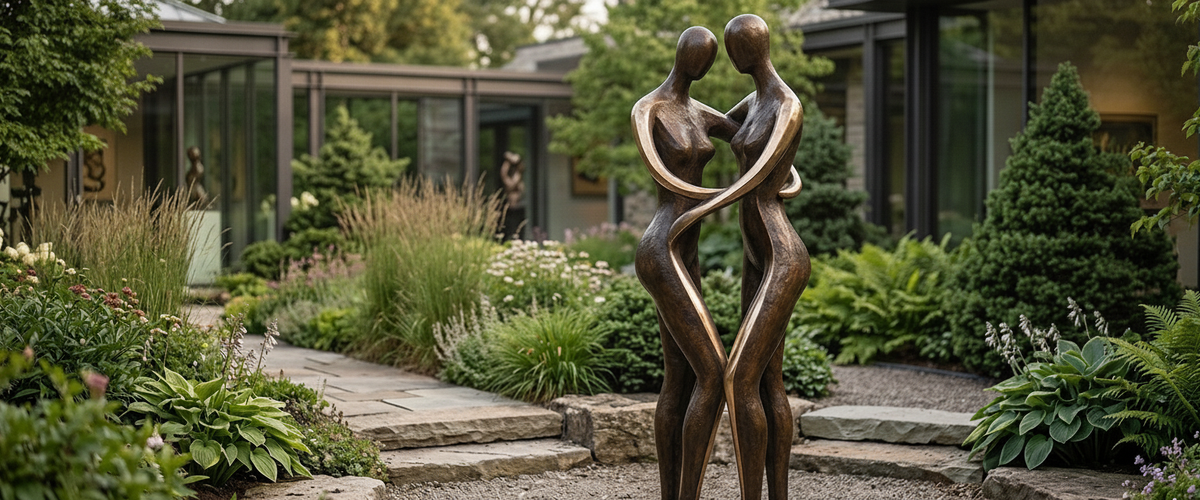

Two sculptures stand in the same yard. One was cast in 1961, the other finished last spring, and the price sheet files both under contemporary and modern sculpture as if the two words meant the same thing. They do not. One describes a closed historical period with its own habits of material and finish; the other describes work being made right now, by people you can email. Buyers who understand the gap negotiate better, place better, and stop paying a premium for a soft copy of a silhouette they already half recognize.

Key Takeaways
Modern is a period, roughly the 1860s to about 1970. Contemporary means work of our own time.
Dealers blur the terms because "modern" sells a look while "contemporary" sells currency.
Material and surface give the era away faster than the subject does.
Plinth habits changed: mid-century pieces sit up on a pedestal, contemporary work often sits low or direct on the ground.
Weathering and reflection are deliberate subjects in much current work, not faults to be polished out.
Pricing for contemporary and modern sculpture depends on material, scale, complexity, engineering, finishing and installation, so ask for a tailored quote rather than a headline figure.
Two Words, Two Eras: Where the Line Really Falls
Art historians treat modernism as a period with a beginning and an end, and most museum glossaries place the closing bracket somewhere around 1970, when conceptual and installation practice broke the old rules of the object. MoMA's glossary of art terms is useful here because it treats modern as a movement family rather than a mood. Contemporary work starts where that period stops, and it keeps moving. The blur is commercial. "Modern" flatters a clean abstract form; "contemporary" flatters a piece made this decade. Put them together in one phrase and the label covers everything, which is exactly why the category page for contemporary and modern sculpture needs reading with your eyes open rather than your search filters.

The Material Tell: Welded Steel, Resin and Carved Stone
Turn the sculpture around and the era usually announces itself. Mid-century makers worked direct: forged and welded steel with the seams left legible, plaster models taken straight to bronze, stone carved down with visible chisel rhythm. The hand is in the object. Much current work comes from a different pipeline, with 3D-scanned enlargements, laser-cut plate, mirror-polished stainless steel and cast polymer or resin bodies finished to a uniform skin. Neither route is dishonest, but they age very differently. Resin and composite shells are light and cheap to ship; they also chalk, yellow and crack under real sun. For anything outdoors and permanent, our studio pushes buyers toward bronze, stainless, Corten or stone, which is why most of the contemporary and modern sculpture we ship is cast or fabricated metal rather than composite.
Surface reads the date faster than subject does: legible toolmarks on one side, an even chemical patina on the other.
Bronze itself sits across both eras, so judge the surface instead of the material. A 1950s-informed bronze tends to keep its toolmarks and a warm, hand-worked patina. If the stretched, hand-modelled proportion of that period is the language you want, Modern Elongated Female Bust Bronze Sculpture, 150cm sits on that side of the line, where a current studio bronze is more likely to carry an even chemical patina, a crisp waxed finish, or a deliberate contrast between rough and polished zones.

A Modernist Form in a Victorian Hallway, and in a New Build
Context rewrites the object. Drop a tall abstract bronze into the hallway of an 1890s Victorian in San Francisco and the plaster cornices argue with it; the piece becomes a jolt, which can be the point if you stage it against one plain wall and give it a full stride of clearance. Put the same form in a double-height new build outside Austin or Scottsdale and it stops being a provocation and starts being architecture. Big open plans swallow scale fast. For a stairwell void or a courtyard axis, something with the presence of Monumental Modern Abstract Duo Bronze Sculpture, 260cm at around 8 ft 6 in holds the volume, where a 3 ft piece in the same spot would read as an accessory.
Plinth Conventions: Mid-Century Restraint Against Contemporary Sprawl
Display habits in contemporary and modern sculpture split cleanly. Mid-century etiquette was vertical and modest: a slim pedestal, a square stone block, the work lifted to eye level and left alone. Current practice sprawls. Pieces sit on low pads, in gravel beds, half in planting, or straight onto a terrace with the base plate as part of the design. That changes the engineering conversation more than people expect. At the height of Large Modern Abstract Anthropomorphic Figure Bronze Sculpture, 220cm, roughly 7 ft 3 in, the footing has to be sized to the sculpture's own footprint and wind loading, not to a decorative block bought to match the flooring.
Pedestal or gravel bed, the footing still has to match the base plate geometry and anchor pattern.
One hard-won lesson: a Napa client poured a concrete pad before our base plate drawing reached the landscape contractor. The pad was square, tidy, and too small for the anchor pattern. It came out again. Ask for base plate geometry and anchor positions at order stage, not at delivery.

When Weathering and Reflection Are the Subject
Plenty of current work treats surface change as content. Corten and other weathering steels are specified precisely because they build a stable oxide skin that seals itself, and the American Institute of Steel Construction's weathering steel guidance is clear that the process needs wet and dry cycles to work properly. Trap moisture against the steel and you get corrosion, not patina. Mirror-polished stainless does the opposite job: it borrows the sky, the pool, the lawn, and looks different every hour.
Corten: plan for runoff staining on pale stone or concrete in the first seasons. Set it in gravel or planting.
Stainless: rinse and dry with clean water and soft cloths; fingerprints and hard-water spotting are the real enemies.
Bronze: keep the wax coat alive on exposed pieces and wash off salt or fertilizer residue.
Stone and marble: avoid acidic cleaners entirely; check freeze-thaw exposure before siting.
Retro-Modern in Disguise: Spotting a Pastiche Sold as Contemporary Work
The market in contemporary and modern sculpture is full of forms that feel familiar for the wrong reason. Signs to watch: a silhouette that echoes a famous mid-century figure at slightly different proportions, toolmarks sanded flat so the surface reads as generic, listings that say "in the style of" without naming a maker, and edition language that avoids stating an edition size. Ask three plain questions. Who made it, what year, and is it an original design by that studio? Named-artist pages are the clean test; work from a studio such as Adam Illes is attributable, and attribution is the difference between a contemporary piece and a homage to 1958 with a new patina.

What to Ask a Studio When You Commission Contemporary and Modern Sculpture
Is this an original design, an edition, or a reinterpretation of an existing form?
What alloy, gauge or stone grade, and what thickness at the thinnest section?
How is it built internally: armature, welded frame, solid cast sections?
What finish is specified, and can I see patina or polish samples before casting?
What are the base plate dimensions, anchor pattern and finished weight in pounds (and kg)?
Who signs off the footing design, and what wind and seismic assumptions were used?
What is the first-year care schedule, and what happens if the surface is damaged in transit?
How does scale change the quote, since material, complexity, engineering and installation all move the number?
Figurative subjects have not gone anywhere either. Animal work is one of the strongest current threads, proof that a modelled surface can stay expressive without turning nostalgic. Start with the contemporary and modern sculptures collection, compare it against the purer geometry in abstract sculptures, then talk to us about scale. Giant Sculptures builds bespoke pieces to site, and the sooner the footing and the finish are decided together, the better the result lasts.
For wider placement ideas, Tap It, Weigh It, Light It: How to Judge a Modern Large Resin Statue is useful companion reading before finalising the setting and sightlines.