





































































































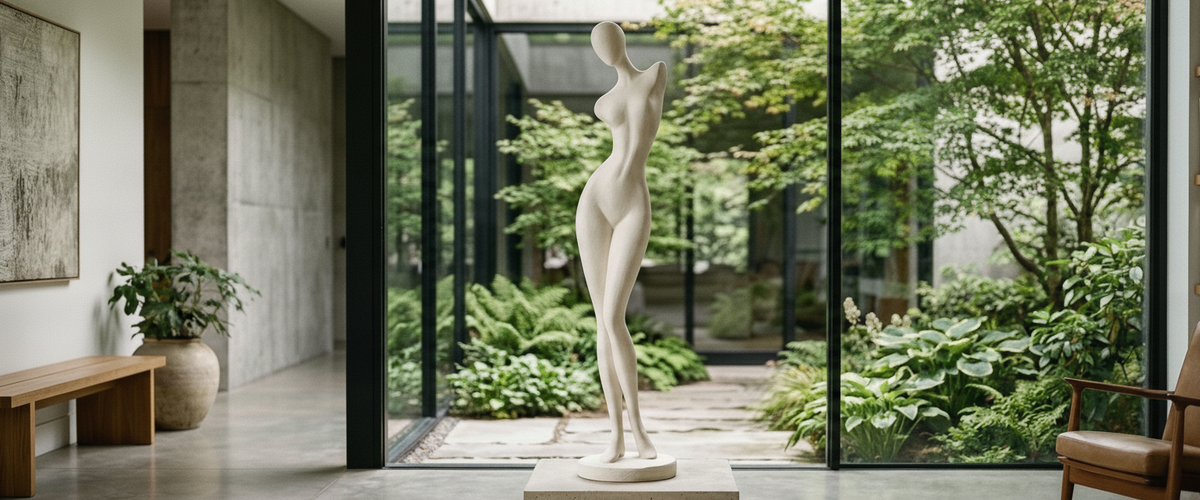

Tap a modern large resin statue with a knuckle and it will tell you most of what you need to know. A well-built cast answers with a short, dense knock. A thin-walled one rings like an empty bucket, and that sound usually predicts every problem that follows: flex in the torso, seams that creep open, a piece that skates across the floor when a dog runs past. Resin is a legitimate material for indoor figures at real scale, but the gap between a good cast and a cheap one is wider than in almost any other sculpture medium.

Key Takeaways
Wall thickness beats headline height. A 2 m (6 ft 7 in) figure with a flimsy shell will never feel like sculpture.
Seams are the honest tell. Look along the spine, the inside of limbs and behind the base.
Weight is the reason resin exists indoors. Upper floors, mezzanines and apartment landings rarely take stone.
Matte and metal-leaf finishes hide handling. High-gloss lacquer shows every fingerprint.
Sunlight ages resin, not damp. UV through glass is the enemy in a bright interior.
If the piece is destined for a ground floor or a garden, price bronze too. Our studio will quote both.
The Hollow Tap Test on a Modern Large Resin Statue
Almost every cast figure over four feet is hollow; nobody pours a solid block of polymer at that size. The question is how thick the shell is and whether it is reinforced. Run your knuckles from the shoulder down to the hip. You want a consistent, muted knock. A change in pitch halfway down usually means the layup thinned out where the mold was hardest to reach, which is exactly where cracks start.
The tap test: a dull, even knock from shoulder to hip signals a thick, reinforced shell.
Press gently on a broad flat area such as a thigh or a chest plane. Any give at all is a warning. A properly built modern large resin statue uses a gel-coated outer skin, laminated fiberglass or mineral fill behind it, and internal ribbing or a steel armature at the ankles, wrists and neck. Ask the seller which of those is present. Vague answers are informative.

Where the Seams Hide on a Six-Foot Figure
Big casts come out of multi-part molds, so seams on a modern large resin statue are unavoidable. Good makers put them where the eye does not travel: down the back of the calves, inside the upper arm, under the jaw, around the rear of the plinth. Then they dress them, which means grinding flush, refilling low spots, re-sanding and re-finishing so the line disappears under the coating.
Badly dressed seams show up as a faint ridge you can feel with a fingertip, or a ghost line that reappears under raking light from a floor lamp. Check the crown of the head and the top of the shoulders, since those catch daylight and are the first places a seam betrays itself. On figurative work, also look at the fingers and toes; if the parting line cuts across a knuckle, the mold was built for speed rather than for the sculpture.
The Weight Math: Why Resin Sits Where Marble Cannot
This is the practical case for resin. Marble runs roughly 168 lb per cubic foot (about 2,700 kg/m³) and cast bronze closer to 535 lb per cubic foot (about 8,600 kg/m³). A hollow composite figure of the same size can land in the tens of pounds rather than the tons. US residential floors are typically designed around a 40 lb per square foot (roughly 195 kg/m²) live load, and a heavy stone figure concentrates far more than that onto a base the size of a dinner plate.
That arithmetic is why a modern large resin statue can stand on an upper-floor landing, a loft mezzanine or a converted attic studio where stone is simply off the table. We have shipped tall figures into Manhattan apartments where the freight elevator and the co-op board decided the material before the client ever chose a pose. On a slab floor, a ground-floor gallery or a Napa courtyard, the calculation flips. Where the floor can carry the load and the piece may never move again, a cast metal form such as the Large Modern Abstract Bronze Sculpture, 120cm buys mass, permanence and a surface that improves with age, none of which resin can offer.
High-Gloss Lacquer, Metal Leaf and Matte: Which Finish Forgives Fingerprints
Finish decides how a modern large resin statue lives with you. High-gloss automotive lacquer looks superb in photographs and is merciless in a hallway; skin oils, dust and the swipe of a vacuum cleaner all register. Matte and satin coatings hide handling best and read more like stone under warm light. Metal leaf, whether gold, copper or white gold, sits in between: the broken surface of the leaf disguises marks, but it must be sealed or it will burnish where hands land.
Matte, satin, gloss and gilded samples behave very differently in a busy room.
Smaller resin pieces are an inexpensive way to test your tolerance for a finish before you commit to it at full height. Live with a compact cast such as the Holtholme White Cat Sculpture - 42cm in a busy room for a month and you will learn quickly whether you are a gloss person or a matte one. The wider resin sculptures range is worth comparing surface by surface at that stage.

UV, Not Rain, Is What Ages a Modern Large Resin Statue
Buyers worry about spills and humidity. The real culprit is ultraviolet light, which breaks down polymers and yellows white and pale finishes from the sun-facing side first. We have seen cream figures go faintly butter-colored along one shoulder after a couple of summers beneath a clerestory window while the shaded side stayed true. Conservation guidance on plastics and modern materials, including the V&A's advice on caring for plastics, consistently points to light and heat as the main agents of change.
Practical fixes: keep the piece off the direct beam of a south or west window, specify UV-inhibited topcoats when you commission, fit low-E or film-treated glazing in sun-trap rooms, and rotate the sculpture twice a year so any change happens evenly. Dust with a soft dry cloth and skip solvent cleaners entirely.
Scaling the Figure So the Size Reads Intentional
The most common mistake we see is a piece bought at the size the room can accept rather than the size the room needs. A figure that stops just below the eyeline of a standing adult looks apologetic. Push it taller, or drop it onto a low plinth and let it own the floor. In double-height spaces, a sculpture should reach at least a third of the wall height or it disappears into the architecture; at that point the conversation moves to pieces in the two-meter-plus range, where something with the presence of the Large Modern Abstract Anthropomorphic Figure Bronze Sculpture - 220cm sets the right register against a tall wall.
Mock it up. Tape the footprint on the floor, stack boxes to height, then look from the doorway, from the sofa and from the top of the stairs. Leave clear circulation on the approach side. And read the ratings with that in mind: most modern large resin statue for home floor decor sculpture reviews describe packing, courier damage and delivery windows, rarely how the mass actually sits in a room. Those judgments have to be yours.

Buyer's Checklist Before You Commit
Knuckle-tap three points on the body and listen for a consistent, dull knock.
Ask what reinforcement sits behind the skin: fiberglass laminate, mineral fill, internal ribs, steel armature.
Run a fingertip along the spine, inner arms and base edge for undressed seams.
Confirm the finish type and whether the topcoat is UV-inhibited.
Check the base: weighted, bolt-down capable, felted to protect timber floors.
Measure the route in, not only the room. Doorways, stair turns, elevator depth, ceiling clearance.
Ask whether the same design can be cast in bronze or fabricated in stainless if the piece may move outdoors later.
Request a tailored quote; budget depends on material, scale, complexity, engineering, installation and finishing.
When to Commission Instead of Buying Off the Shelf
A modern large resin statue is the right call for tall indoor figures where weight rules, for gilded and painted surfaces, and for editions where a client wants two matching pieces flanking an entry. Once a sculpture has to face weather, salt air, mountain winters or public contact, we steer buyers to bronze, Corten or stainless steel. Giant Sculptures makes both paths available: pick a finished piece from our contemporary and modern sculptures, or send us a sketch, a mood image and a ceiling height and we will develop a bespoke figure with the right material, armature and finish for where it is actually going to stand. That conversation about weight, light and access is the one worth having before the tap test, not after.
For wider placement ideas, Large Abstract Wall Art for Hallways: Bold Lines Win at Walking Speed is useful companion reading before finalising the setting and sightlines.