



























































































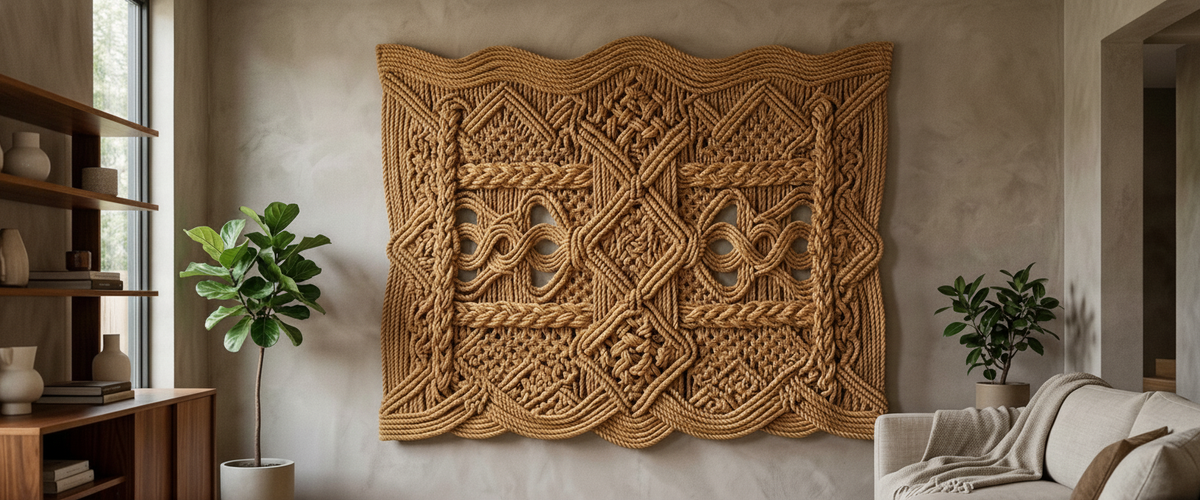

Rope looks forgiving. Tie it, hang it, walk away. Then July arrives, the humidity swings, and the panel a designer specified for your entry hall is drooping off its top rail with two cords pulled out of line. Most problems with woven rope wall art start with fiber choice and frame engineering, and both are settled long before the first knot is tied.

Key Takeaways Before You Buy
Fiber decides longevity. Sisal and manila hold their line; soft jute and loose cotton relax fastest.
The frame carries the piece, not the knots. Ask what is behind the weave before you ask about the pattern.
Two hooks are rarely enough on a wide panel. Spread the load along a continuous rail.
Direct sun bleaches and embrittles natural fiber, and the damage does not reverse.
Buy bigger than feels comfortable. Most rope panels land about a third under the wall they were bought for.
Jute, Sisal, Manila and Cotton: Which Fibers Hold Their Line
Jute is the cheapest cord in the room and it behaves like it. Soft, hairy, pleasant to touch, and prone to stretching under its own weight once the weave gets wide. It also yellows and grays faster than buyers expect. Sisal, drawn from agave leaf, is stiffer and coarser, which is exactly why it keeps a crisp knot profile across a big span. Manila, made from abaca, is the old marine standard: strong, more tolerant of damp air, and it ages to a warm honey tone rather than a tired beige. Cotton cord dyes beautifully and drapes like nothing else, but it is the first to sag and the first to collect dust. The CAMEO materials database at the Museum of Fine Arts, Boston is a useful reference if you want to compare fiber structures before committing.
For large commissions we usually push clients toward sisal or manila for the structural weave, with cotton reserved for accent passes and fringe details where load is low. Hybrid cords with a synthetic core and a natural outer wrap are worth asking about too. They keep the tactile read of woven rope wall art while removing most of the creep that makes a panel look tired in year two.

The Hidden Frame Behind the Knotwork Does More Work Than the Knots
Every serious piece of woven rope wall art is a frame with a surface treatment. Cheap pieces use a softwood batten that twists as it dries, and once the batten bows, the weave telegraphs it across the whole face. Better work uses powder-coated steel flat bar, stainless tube, or a kiln-dried hardwood armature with corner bracing and fixing points that were designed in, not screwed on afterward.
Sisal cord terminated into a powder-coated steel armature. The frame carries the panel; the knots only describe it.
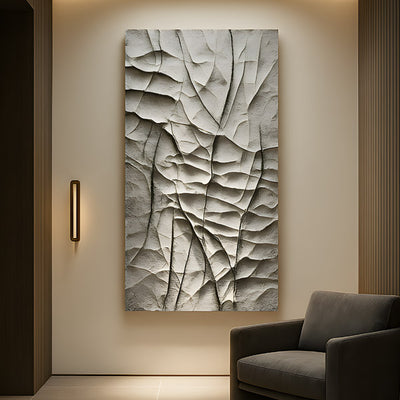
Ask three specific questions: what is the frame made of, how are the cords terminated at the frame, and where are the hanging points located relative to the frame's stiffest axis. If a supplier cannot answer, they are reselling. It helps to compare a rope weave with a piece where the texture is cut into a rigid substrate rather than tensioned across one; set beside a carved panel like Barwick Charcoal Flow Abstract 3D Carving Wall Art, the depth is locked into the material and nothing moves with the seasons, which is the standard a good rope frame is trying to imitate.
Weight, Span and Fixings: Why Two Hooks Are Rarely Enough
Densely wrapped cord is heavier than it looks, and large-scale woven rope wall art is heavier again. A panel 8 feet (2.4 m) wide can run to a serious weight, and hanging it on two picture hooks concentrates that load at two points while the middle deflects. You get a slow smile across the top edge within a season.
Spread the load. A continuous French cleat, screwed into studs at standard 16 inch (406 mm) centers, is the most reliable answer for framed timber walls. Masonry needs proper expansion or chemical anchors sized by the installer, and drywall without backing needs toggles rated well above the panel weight, with more of them than feels necessary. Get your installer to confirm the wall build-up before delivery day rather than during it. We have shipped commissions where the structural wall was sound and the plaster skim over it was not, and that is a five-minute conversation that saves a repair.

South-Facing Rope Goes Brittle and Pale First
Natural fiber and ultraviolet light are a bad marriage. Sun-facing rope loses color unevenly, then loses tensile strength, and by the time you notice the fading the fiber is already brittle at the surface. There is no rehydrating it and no re-dyeing it convincingly. Conservation guidance on light damage to textiles from the American Institute for Conservation makes the same point about cumulative, irreversible exposure.
Practical response: keep woven rope wall art off walls that take hours of direct summer sun, add UV-filtering film to adjacent glazing, or accept that this is a wall for metal and choose accordingly. Our metal wall art pieces exist partly for this reason; brushed steel and patinated bronze shrug off the light that kills cord.
The Scale Error: Most Panels Are Bought a Third Too Small
This is the single most common mistake we see. Buyers measure the wall, then order something that fits inside their comfort zone rather than the architecture. In a double-height great room or an open stairwell, a 4 foot (1.2 m) panel reads as a sample.
A vertical run sized to the architecture, not to the buyer's comfort zone.
A workable rule: cover roughly two-thirds to three-quarters of the width of the furniture below, and in a tall stairwell think in vertical runs rather than single squares. In a double-height stairwell, a piece on the order of Annunciation Arch-Topped Marble Relief Wall Art - 300cm, close to 10 feet tall, reads as correctly scaled rather than oversized, and woven rope wall art on the same wall needs the same ambition. Browse the wider wall art and wall decor range to calibrate your eye against real dimensions before you commit.
Dust, Moths and the Ten-Minute Annual Clean
Rope is a dust shelf with a pattern. Left alone it grays from the top down, and any wool or blended fiber in the weave is an open invitation to clothes moths. The maintenance is genuinely small if you do it once a year.
Vacuum the face with a soft brush head on low suction, working with the direction of the cord.
Lift stubborn dust from knot recesses with a dry natural-bristle brush; never soak natural fiber.
Spot-treat marks with minimal moisture and dry fast with airflow, not heat.
Check for moth casings on the reverse and behind the top rail, and use cedar or pheromone traps nearby if you have a history of them.
Test every fixing point by hand and re-torque anything that has loosened.
Rotate or reverse-hang symmetrical panels where possible to even out light exposure.

Hard Rooms, Restaurant Walls and Stairwells: Where Rope Repays the Maintenance
Rope earns its keep in rooms full of hard surfaces. Stone, glass, steel and polished concrete bounce sound and flatten a space; a deep fiber weave absorbs some of that and gives the eye something warm to land on. Restaurant designers use woven rope wall art for exactly this reason, and it works well on a stairwell wall where people pass close and read texture rather than image.
It is the wrong choice near a working range, in a steam-heavy bathroom, or anywhere outdoors, including covered terraces. Those walls want stone, bronze or Corten. Where a client wants the same handmade grid and shadow play on a wall that will never get an annual clean, a carved timber panel such as Barwick Charcoal Grid Abstract 3D Carving Wall Art is closer to the right specification, and our 3D wall art and wood wall art collections cover the same ground with materials that hold their profile indefinitely.
Commissioning Woven Rope Wall Art at Scale
Bespoke is where large rope work stops being decor and starts being architecture. Send us the wall dimensions, the ceiling height, the primary sightline, the lighting positions and a photo of the room in daylight. From there we can advise on fiber, frame construction, hanging system and finish, and coordinate installation with your contractor.
Budget for a piece like this depends on scale, fiber specification, weave density, frame engineering, finishing and installation, so we quote each commission individually rather than publishing a figure. Giant Sculptures works across bronze, stainless steel, Corten, stone and marble as well as textured wall pieces, which means we will tell you honestly when woven rope wall art is right for a wall and when it is not.
For wider placement ideas, 3d Wall Art for Office Spaces: The Two Distances That Decide Everything is useful companion reading before finalising the setting and sightlines.