






































































































Most wall art fails for one boring reason: it is too small for the wall it hangs on. A 24-inch print floating in the middle of a 12-foot living room wall reads as an afterthought, no matter how good the image is. Getting wall art and decor right is less about taste and more about proportion, weight, and the way a surface catches light across a day. Once you treat the wall as a piece of architecture rather than a blank space to fill, the whole decision changes.
We build large-scale and bespoke pieces for clients who have run out of patience with framed prints, so the advice below leans toward sculpture, relief, and dimensional metalwork rather than posters. If you want a wall that stops people mid-conversation, depth and material do the work.
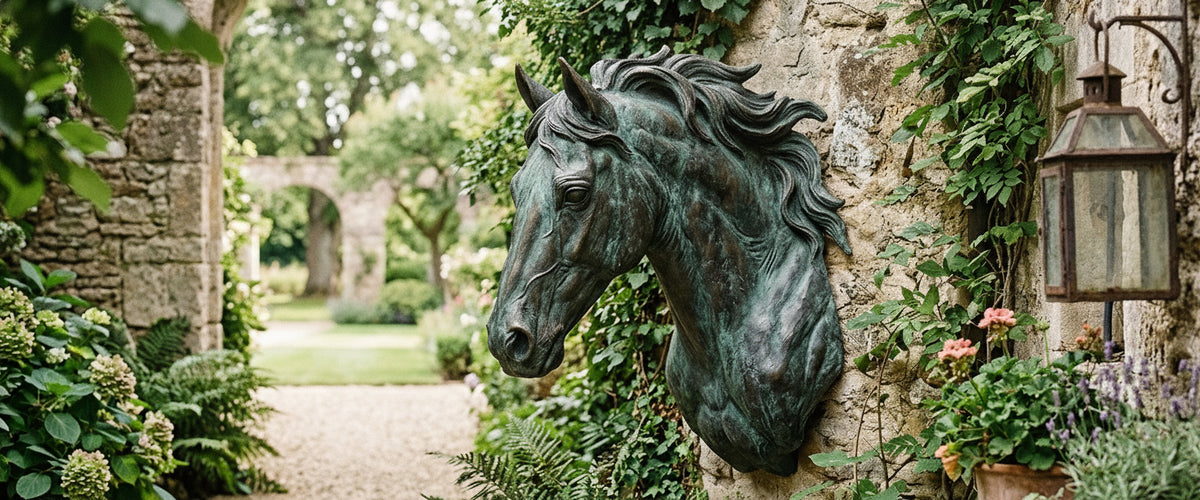
A dimensional bronze relief anchors a feature wall where a flat print would disappear.

Wall Art and Decor at a Glance
Get scale right first. A single piece should cover roughly two-thirds the width of the furniture or wall section beneath it.
Dimensional beats flat. Bronze reliefs, cast heads, and metal panels throw shadow that changes through the day; prints do not.
Match material to the room's temperature. Warm bronze for traditional and transitional interiors, brushed or mirror stainless for contemporary spaces.
Weight matters. Heavier pieces need proper fixings and, often, a stud or masonry anchor, not a drywall hook.
Bespoke solves the awkward wall. Double-height stairwells, wide fireplace breasts, and long hallways are where off-the-shelf sizes give up.

What Wall Art and Decor Means, and Who It Suits
Wall art and decor covers everything that hangs on or projects from a vertical surface for visual effect: reliefs, sconces, cast heads, framed work, mirrors, and sculptural panels. The category is broad, but the buyers who come to us tend to want the same thing, which is presence. They have a wall that carries the room, and a print no longer earns its place there.
This guide is aimed at homeowners furnishing a principal room, interior designers speccing for clients, and venue owners dressing lobbies, restaurants, and boutique hotels. If you are hanging a small gallery wall of family photos, you do not need us. If you are staring at a 14-foot feature wall in a Napa great room or a double-height entry in a Texas new-build and nothing you have found feels big enough, that is exactly the problem we solve.

How to Compare Wall Art and Decor Options Before Buying
Start with the wall, not the piece. Measure the full width and height, then note the furniture line below it and the sightlines into the room. A piece read from across a lobby has different demands than one viewed from three feet away in a dining nook.
From there, run every candidate against a short set of criteria:
Proportion: Does it fill enough of the wall to look intentional? Undersized art is the most common mistake we see.
Depth: Flat or dimensional? A relief or projecting piece adds shadow and reads as more considered.
Material honesty: Solid cast bronze ages beautifully; thin resin printed to look like metal does not survive close inspection.
Viewing distance: Fine detail is wasted at 20 feet; bold silhouette is wasted at arm's length. Buy for how the piece is actually seen.
Longevity: Will this still look right in ten years, or is it tied to a trend that will date?
Where a wall needs a subject that earns its place through mass and modeling rather than surface pattern, a cast bronze relief such as the Traditional Horse Head Bronze Relief - 80cm at roughly 31 inches (80cm) works precisely because the form does the talking. That is the difference between decor that anchors a room and decor that merely occupies it.

Key Materials, Finishes, and Scale Decisions
Material sets the mood before anyone registers the subject. Here is how the main options behave on a wall.
Bronze, stainless steel, and carved wood each set a different temperature on the wall.
Bronze
Bronze is our default recommendation for wall pieces that need to feel permanent. It takes a patina that deepens with age, catches warm light, and sits comfortably in both classical and contemporary interiors. The metal's staying power is well documented; the Metropolitan Museum of Art holds cast bronzes that have survived for thousands of years. Where the wall calls for sculpture that happens to live vertically rather than a framed image, a projecting form like the Classical Figural Torso Wall Sconce Bronze Sculpture - 90cm at around 35 inches (90cm) gives you real depth at close range. Browse the wider range in our bronze wall art collection to see how much depth changes the impression.
Stainless steel and metal
Brushed or mirror-polished stainless suits modern rooms with cooler palettes and hard architecture. It bounces light rather than absorbing it, so it lifts spaces that feel heavy. Our metal wall art covers everything from clean abstract panels to figurative relief, and the reflective finishes are useful in narrow hallways where you want a wall to feel less like a corridor.
Wood
Carved and layered wood brings warmth and texture that metal cannot, and it softens rooms that read too cold. It is the right call for a mountain home or a room built around natural materials. The wood wall art range shows how grain and relief carving hold attention up close.
On scale: as a working rule, a single wall piece should span about two-thirds the width of the console, sofa, or fireplace beneath it. Over a large sectional, that can mean a piece four to six feet wide, or a grouping that reads as one mass. When in doubt, size up. A slightly too big piece looks confident; a too-small one looks lost.
Where to Place Wall Art and Decor for the Strongest Impact
For wider placement ideas, Abstract Metal Wall Art: A Buyer's Guide to Scale, Finish and Placement is useful companion reading before finalising the setting and sightlines.
The best wall in the house is usually the one you see first. That means the entry, the wall facing the front door, or the surface at the top of a staircase where the eye lands as you climb. These are the spots where a single strong piece does more than a dozen small ones scattered around.
A few placements that consistently work:
Above the fireplace: A cast head or relief here becomes the room's focal point. For a masonry chimney breast where the mass needs to read well against stone, a piece like the Classical Bull Head Bronze Relief - 70cm at about 28 inches (70cm) holds the wall at that scale.
Double-height walls: Entry halls and stairwells swallow normal art. This is where oversized or paired pieces pay off, and where bespoke sizing usually becomes the practical answer.
Long hallways: A single projecting sconce or relief breaks the tunnel effect better than a row of small frames.
Behind a dining table: Viewed at close range across a meal, so reward detail here. A modeled bronze surface rewards the second and third look.
Lighting matters as much as position. Dimensional pieces need a light source raked slightly across them to throw the shadow that gives them life. A directional spot or a picture light set at an angle turns a flat-looking relief into something that shifts as you move past it. The wall art and wall decor collection is worth browsing with this in mind, since projecting forms behave very differently under raking light than flat panels do.
How to Match Wall Art With Furniture and Decor
Match by temperature and weight, not by literal color. A warm bronze relief pulls together a room with leather, walnut, and brass. Cool stainless or a monochrome panel supports a room built on gray, concrete, and glass. Pick up one existing tone in the space, whether that is the metal of a light fixture or the wood of a floor, and let the piece echo it rather than copy it.
Weight is the trap people miss. A visually heavy sofa under a delicate wire piece looks off-balance; a substantial cast relief over a spindly console looks top-heavy. Aim for the art and the furniture to feel like they belong to the same category of mass. When they match, the wall settles.
Budget, Commissioning, and Delivery Considerations
Cost for serious wall art and decor depends on material, scale, complexity, the finishing process, and whether the piece is bespoke or from stock. A hand-finished bronze relief involves casting, chasing, and patination that a printed panel never touches, and that work shows. Rather than quote a figure that would mislead you, we price each project against the actual brief, so the sensible step is to request a tailored quote once you know your wall dimensions and material preference.
For bespoke work, plan for lead time. Casting and finishing cannot be rushed without showing it, and larger metal pieces need proper structural review before they ship. We crate and ship worldwide, and heavier pieces travel on custom mounts so the fixing points are sorted before the piece leaves the studio. One lesson worth passing on: we always ask for a photo of the wall and its construction (drywall, brick, stone) early, because the right anchor for a 40-pound (18kg) bronze is not the right anchor for a plaster wall, and getting that wrong is the fastest way to ruin an install.
How Giant Sculptures Helps With Bespoke Wall Projects
We started as a large-scale sculpture studio, which is why oversized and awkward walls are our comfort zone rather than our limit. When a client sends us a stairwell that no standard size fits, we can adjust scale, model a new subject, or rework a finish to suit the room. Bronze, stainless steel, and carved wood are all on the table, and we handle the engineering and mounting for the heavier work so the piece hangs safely for decades.
The wall art and wall decor collection is the best place to see the range and get a feel for scale before you talk to us about a commission. If you already know the wall is the star of the room, we would rather build for it than watch you settle for something that fits the box but not the space. Done properly, conservation-grade bronze finishing outlasts the room it goes into, a point conservation departments make about cast metal generally.