





































































































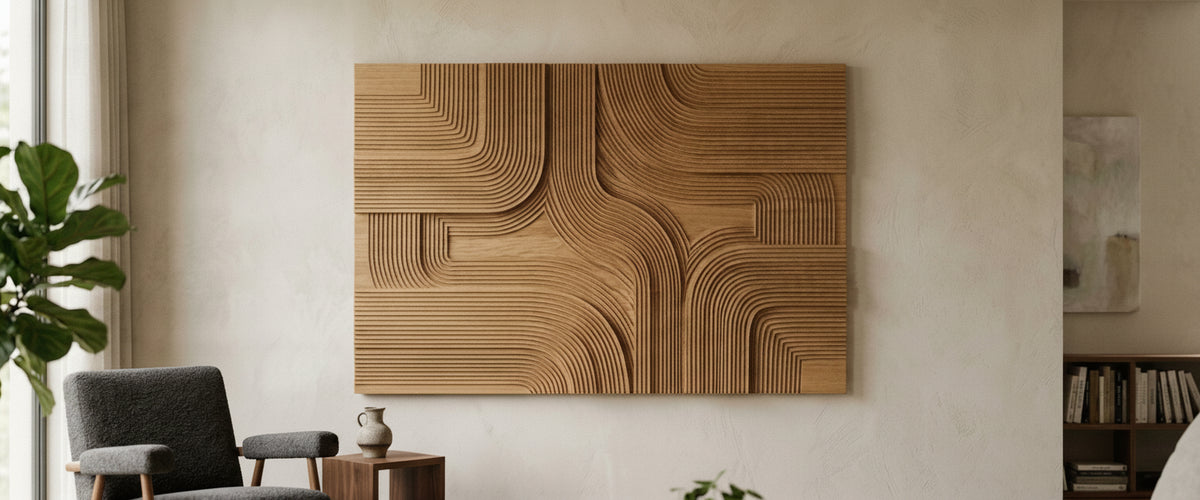

A blank wall over a fireplace or behind a dining table is one of the hardest surfaces in any home to get right. Hang something too small and it floats. Hang a flat print and it reads as a placeholder. This is where wood carving wall art does work that framed pieces cannot: it throws real shadows, catches raking light along the grain, and gives a room something with actual depth to look at. Done at the right scale, a wood carving wall art panel becomes the reason people stop in the doorway.
We ship large and bespoke pieces worldwide, and carved timber panels are one of the categories buyers most often get wrong before they call us. So here is the honest version of how to choose wood carving wall art.

Wood Carving Wall Art at a Glance
- Best for: large blank walls, double-height entryways, above sideboards and headboards, hospitality lobbies and restaurant walls.
- Strengths: genuine relief and shadow, warmth of grain, tactile surface, one-of-a-kind carving marks.
- Watch for: humidity and direct sun (wood moves), undersized pieces on big walls, and hollow-core imitations sold as solid carving.
- When to commission: when your wall dimensions, subject, or interior palette do not match any wood carving wall art off the shelf.
- Budget: driven by size, timber species, carving complexity, and finish. Ask for a tailored quote rather than trusting a headline figure.

What Wood Carving Wall Art Means and Who It Is Best For
Wood carving wall art is any wall-mounted piece where the surface has been cut, gouged, or relief-carved from timber rather than printed or applied. That covers a wide field: figurative reliefs, abstract linear panels, mandala-style rounds, and landscape carvings where a scene is worked into layers of depth. The common thread is that the material itself does the visual work.
Wood carving wall art suits buyers who want texture and warmth without the coolness of metal or the weight logistics of stone. Interior designers reach for it when a room has gone too smooth, all lacquer and glass, and needs an organic counterpoint. Where a calm, architectural presence matters more than a loud figurative statement, a linear panel like the Stratara Beige Wood Carving Mirror Linear Wall Art is closer to the right design language, especially in pale interiors where a busier piece would fight the space.
It is less suited to rooms with wild humidity swings or hours of direct afternoon sun, and we will come back to that under care and placement.

How to Compare Wood Carving Wall Art Options Before Buying
Most disappointing purchases come down to three decisions made too quickly. Slow down on these when you compare wood carving wall art.
Solid carving versus surface relief
Look at the depth of cut. True carved work has undercuts and shadow that shift as you move past it. Some mass-market panels have a shallow machined pattern pressed into thin stock; from three feet away the difference is obvious. Ask the seller whether the relief is carved into solid timber or applied to a veneer over a hollow core. It changes both the look and the lifespan.
Grain direction and figure
Grain is not decoration you can ignore. On a large panel, the way the figure runs governs how light moves across the piece through the day. A carving oriented with the grain feels resolved; one that cuts hard against it can look busy. This matters more the bigger the piece gets.
Single panel versus multi-panel
A wide wall sometimes wants one continuous wood carving wall art panel, and sometimes wants two or three pieces reading as a set. Multi-panel groupings give you flexibility on very long walls and are easier to ship and install, but the spacing has to be deliberate. Get the gaps wrong and it looks like a mistake, not a composition.

Key Materials, Finishes, and Scale Decisions
Species matters more than most buyers expect. Denser hardwoods like oak, walnut, and teak hold crisp detail and resist knocks; softer timbers carve faster and cost less but bruise more easily on a busy wall. Reclaimed timber brings its own character, with tighter old-growth grain and the odd honest mark, which suits rustic and transitional interiors. To anchor a room with darker joinery, a deeper tone such as the Stratara Dark Brown Wood Carving Mirror Linear Wall Art holds its own better than a pale finish, which instead keeps a light scheme airy.
Finish is where a piece is made or ruined. An oiled finish keeps the grain matte and tactile and is easy to refresh; a lacquered finish adds sheen and protection but is harder to repair invisibly if it chips. For any timber, movement is the real design constraint. Wood expands and contracts with moisture in the air, which is why conservators track relative humidity so carefully; the Smithsonian's guidance on wooden objects points to stable indoor humidity as the single biggest factor in long-term condition. Keep a carved panel off a bathroom wall and away from a radiator, and your wood carving wall art will stay flat for decades.
On scale, err larger than instinct tells you. A common error is choosing a piece sized for the furniture below rather than the wall around it. As a working rule, a single piece over a sofa or console should fill roughly two-thirds of the furniture width, and on a tall empty wall you often want a piece measured in feet, not inches. If your wall runs eight feet (about 2.4 m) or more, a modest panel will look stranded.
Where to Place Wood Carving Wall Art for the Strongest Visual Impact
For wider placement ideas, Wood Wall Art Decor: A Buyer's Guide to Scale, Finish, and Placement is useful companion reading before finalizing the setting and sightlines.
Placement is lighting plus sightline. The best walls for carved work are the ones people approach at an angle, because raking light down the surface is what reveals the relief. Flat, straight-on light flattens everything you paid for.
In practice, the wood carving wall art pieces we ship most often land in a few spots. Above a fireplace in a Napa or Aspen living room, where the carving reads against stone or plaster. Behind a headboard in a primary bedroom, where a wide horizontal panel calms the space. For a hospitality lobby or restaurant wall that needs to give arriving guests something to read while they wait, a layered landscape carving such as the Vista Sunset Urban Landscape Carving Wall Art makes more sense than an abstract panel, since it rewards a longer look. Stairwell walls are underused and often ideal, since you move past them at exactly the angle that flatters carved depth.
If your interior already leans toward metal, you do not have to switch teams entirely. Some designers pair a warm carved panel on one wall with a metal piece elsewhere; our metal wall art collection is worth a look if you want to see how the two materials play against each other before committing.
Whatever the spot, add a small adjustable spot or a wall-washer angled from above. Even an inexpensive light aimed correctly transforms how a carving reads at night.
Budget, Commissioning, and Delivery Considerations
Price on carved work is not arbitrary, and it is not something we quote from a chart. It tracks timber species and how much of it is used, the size and thickness of the panel, the complexity of the carving (a deep figurative relief is many more studio hours than a linear pattern), the finish, and the mounting hardware needed to hang serious weight safely. A large solid hardwood panel is genuinely heavy; expect proper cleat mounting and, for the biggest pieces, wall fixings rated well above the load. We will always spec this rather than leave you guessing.
Delivery of large wood carving wall art is a crated affair. Timber travels well when it is packed to control moisture and protected against impact on the corners, which is where damage almost always happens. For international orders, we plan for climate differences between our studio and your room, because a panel that leaves a stable workshop and lands in a dry desert home needs a little acclimatization before hanging.
Buyer checklist before you commit
- Measure the wall, then the furniture, then decide on scale (in that order).
- Confirm solid carving versus veneer, and the timber species.
- Check the finish and how it is maintained or repaired.
- Ask about the mounting system and the weight in pounds (and kilograms).
- Note your room's light direction and humidity.
- For anything oversized or wall-specific, ask about a bespoke wood carving wall art commission.
How Giant Sculptures Can Help With Bespoke Projects
Off-the-shelf wood carved wall art works beautifully when your wall matches a standard size and your palette suits an existing finish. Often it does not. That gap is where our commission work sits, building wood carving wall art to a wall that will not cooperate with anything standard.
We recently worked with a designer fitting out a double-height entry wall that measured just over eleven feet (about 3.4 m) tall, where nothing standard came close to holding the space. A bespoke carved panel, scaled and finished to the room, solved a wall that had defeated three previous attempts with framed art. That is the kind of problem carved timber is made for.
A commission lets you set the species, the subject, the depth of relief, the finish tone, and the exact dimensions, with mounting engineered for your wall. If you prefer to start from something you can see, browse the wood wall art collection or the broader wood art range, then tell us what you would change. We build from there.
Send your wall dimensions, a photo of the space, and a note on the light, and we will advise on scale, material, and whether an existing wood carving wall art piece or a bespoke carving is the smarter call for your room.