





































































































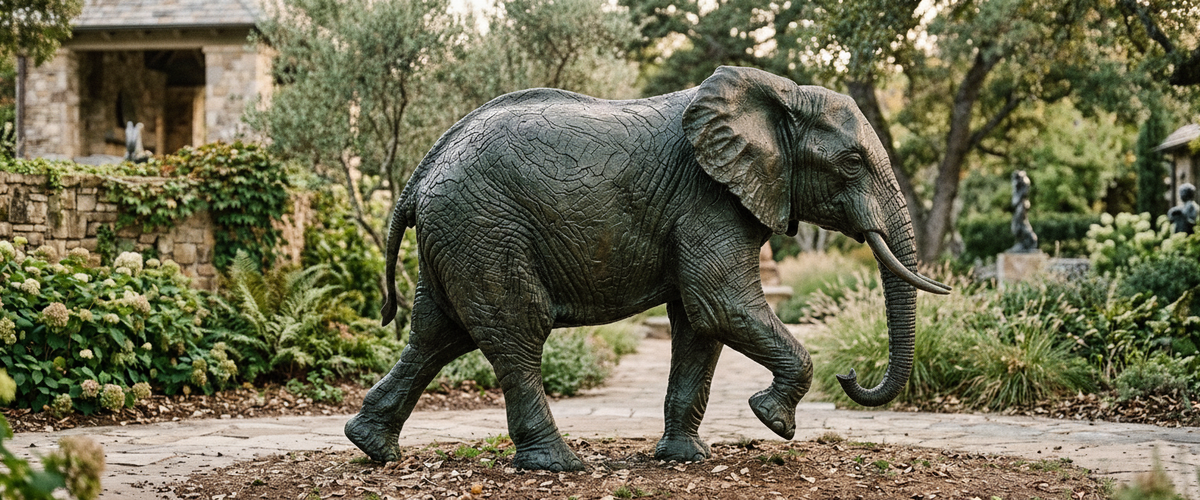

Most wildlife sculptures fail in the legs. The head can be beautifully modeled, the hide texture can be sharp enough to read from ten feet away, and the whole thing still looks like a mounted trophy because the sculptor never decided which leg carries the weight. Buyers rarely name the problem out loud. They just say the piece feels stiff, walk away, and never work out why.

Key Takeaways Before You Shortlist
Pose first, finish second. Weight distribution tells you more about quality than surface detail ever will.
Bronze stays the benchmark for fur, hide and feather because wax can be chased at hair-level detail before casting.
Scale is a site decision. An elephant that suits a Texas ranch entrance will bully a Hamptons lawn.
Two animals read as a herd. Five read as a retail display unless the spacing is deliberate.
Specify patina before casting, not after delivery. It is far cheaper and far more controllable.
Weight on Which Leg? The Tell That Separates a Living Animal from a Taxidermy Pose
Stand in front of any animal bronze and ask one question: if this creature took the next step, where would it go? A living animal is always slightly off balance. A stag mid-turn drops one shoulder. A leopard descending a rock loads its forelimbs and lets the spine curve. A hare at rest still has tension in the hindquarters, because a hare at rest is a hare about to not be at rest.
The nineteenth-century animaliers built entire careers on this. Antoine-Louis Barye dissected carcasses and drew at the Paris menagerie so his big cats would carry real anatomy under the surface, and the Metropolitan Museum of Art's Heilbrunn Timeline of Art History is a useful primer on the animalier tradition if you want to train your eye before spending. Symmetry is the warning sign. Four legs planted evenly, head square to the shoulders, tail centered: that is a specimen, not an animal.

Bronze, Welded Steel and Cast Resin Against Fur, Hide and Feather
Different coats want different materials. Bronze wildlife sculptures dominate the category for a practical reason: the lost-wax process lets a modeler work hair, wrinkle and pore into soft wax, and the alloy holds that record for centuries. Elephant hide, with its deep cracked plates, is almost purpose-built for bronze. So is bird plumage, where overlapping feather edges need a crisp casting to catch light.
Cracked hide reads best in cast bronze, where the wax is chased before the metal ever cools.
Welded and forged steel goes the other way. It abstracts. A stainless steel stag built from faceted plate will never fool anyone into thinking it is fur, and it should not try; it reads as line and reflection, which suits contemporary architecture and modern planting. Corten does something similar with a warm rust surface that sits beautifully against ornamental grasses. Cast resin has a place indoors and in decorative schemes, but we steer clients away from it for permanent exterior wildlife pieces in strong sun, where UV and thermal movement work against it over the long run.
Indoors, the constraint is usually floor space rather than material. Where a hallway or stairwell landing cannot give up the square footage a freestanding animal needs, a pattern-led wall piece such as Imperia Wildlife-Inspired Zebra & Leopard Dual Frame Wall Art carries the same hide-and-marking language in two dimensions, and it sits comfortably in a house that already has one strong bronze elsewhere.
African Wildlife Sculptures at Western Scale
African wildlife sculptures are the most commonly misjudged buy we handle. Clients picture a Land Rover-window view and order accordingly. Then a full-size bull elephant lands on a two-thirds-acre lot and the house disappears behind it. A mature African elephant stands roughly 10 to 12 feet at the shoulder (about 3 to 3.6 m) and can weigh several tons in bronze at that scale, which changes foundations, craneage and access before it changes anything aesthetic.
Three-quarter scale solves more problems than people expect. A rhino at around 80 percent still dominates a lawn, still reads as heavy, and no longer competes with the architecture. We shipped a Corten rhino to a Napa vineyard where the client had originally asked for life-size; after a site walk we cut the scale and moved the piece 30 feet further from the terrace, and it gained presence rather than losing it. Distance does work that size cannot.

A Pair Reads as a Herd, Five Read as a Shop Display
Groups are the second common error. Two animals imply a wider population off-stage, especially with different postures: one grazing, one alert. The eye completes the story. Four or five identical castings spread evenly across a lawn kill that illusion instantly, because nothing in nature spaces itself at regular intervals. If you want a larger group, vary size (adult and juvenile), vary orientation, and cluster unevenly with one outlier further out.
Two postures and uneven spacing suggest a herd continuing beyond the garden boundary.
Ground Line and Plinth Height: Mounting an Animal So It Looks Like It Walked There
Terrestrial animals want the ground, not a pedestal. Raise a wolf 3 feet (0.9 m) onto a stone block and it becomes a monument to a wolf. Set the same casting so the pads meet grass or gravel, with the base plate buried and planting brought up to the hooves or paws, and it becomes an animal in a garden. Birds and marine subjects are the exception: a heron in a pond edge, a fish rising from water, an eagle on a rock outcrop. Water pieces are worth exploring in the bronze fountains range, where the ground line is handled by the basin itself.
Engineering still has to happen underground. Large castings need a concrete pad, stainless anchor bolts and drainage so freeze-thaw does not heave the piece off level.
Head Turn and Eye Direction as a Placement Tool
For wider placement ideas, Large Wall Art Is Usually Too Small: How to Buy at the Right Scale is useful companion reading before finalising the setting and sightlines.
Where an animal looks controls where people walk. Point a lioness across a driveway and visitors slow down at that spot. Turn a buffalo's head back over the shoulder and it pulls attention toward whatever sits behind it, which is useful when you want to draw the eye to a view, a gate or a specimen tree. Never aim a large predator's gaze straight at a dining terrace unless you enjoy watching guests shift their chairs.
Ten Winters on a Bronze Coat: The Patina to Specify Before Casting
Patina is a chemical finish, not paint, and it keeps moving after delivery. In coastal Long Island or the Pacific Northwest, salt and moisture push bronze toward green; in dry inland air it darkens and holds browner. Sheltered undersides stay dark while rain-washed backs lighten, which is why a good foundry varies patina intensity across the form deliberately. The National Park Service's Conserve O Gram technical notes on outdoor bronze and metal care are a sober read on what weather actually does over decades.
Specify at commission stage: base color, highlight treatment, and whether you want a hot wax or lacquer protective coat. Then wash annually with clean water and a soft brush, and re-wax before winter. That is genuinely the whole maintenance program for most bronze animal pieces.

Commissioning Checklist for Wildlife Sculptures
Confirm the species, sex and age of the animal; a young bull and an old cow are different sculptures.
Agree the pose from a clay maquette, and ask which leg carries the weight.
Set final height against the nearest building element, not against a catalog number.
Check crane access, gate widths and ground bearing before sign-off.
Lock the patina recipe in writing, with a sample swatch retained by the foundry.
Ask for anchor and foundation drawings alongside the artwork.
Budget varies with material, scale, engineering, installation and finish, so request a tailored quote rather than working from assumptions.
Giant Sculptures builds bespoke animal work at architectural scale, and most of our commissions start with a photograph, a rough site plan and a conversation about behavior rather than dimensions. Browse the wildlife sculptures range for pose and species ideas, or the large bronze sculptures collection if you already know the scale you are working toward.