
























Most bronze wildlife sculptures are chosen in a single catalog moment and then lived with for decades, and those two experiences reward very different things. The rearing stallion or charging rhino that stops you on a screen can feel like shouting by the fiftieth time you walk past it with your morning coffee. At Giant Sculptures we cast and ship large-scale animals for estates, resorts and private gardens in the US and UK. The pieces clients still write to us about years later are rarely the loudest ones.
Looking for the full range in this category? Browse our Bronze Sculptures collection for every available finish, size, and configuration.

At a Glance
Pose: Calm, attentive poses hold interest longer than peak action.
Scale: True life size usually beats overscaled "heroic" versions in a garden.
Species: African wildlife sculptures need space and long sightlines to settle in.
Patina: Dark brown suits lawns and planting; verdigris belongs near water.
Commissioning: Good reference photographs and measurements decide the result before any wax is poured.
The Charging-Animal Problem
Drama is a one-note instrument. A lunging bull reads in half a second, which is exactly why it runs out of things to say. We see the same pattern often: a client chooses a charging bison for the view from a terrace, then comes back a year or two later for a grazing companion to stand behind it, because the first piece never settles. The pairing usually works. The lesson holds: in sculpture, wildlife caught mid-attack freezes a moment the eye knows cannot last, and that tension turns into fatigue.
Action poses still have a place. They suit a hotel forecourt or a club entrance, where most people pass once and keep moving. In a garden you see every day, bronze wildlife sculptures have to survive familiarity.

Grazing, Resting, Listening: Quiet Poses in Bronze Wildlife Sculptures
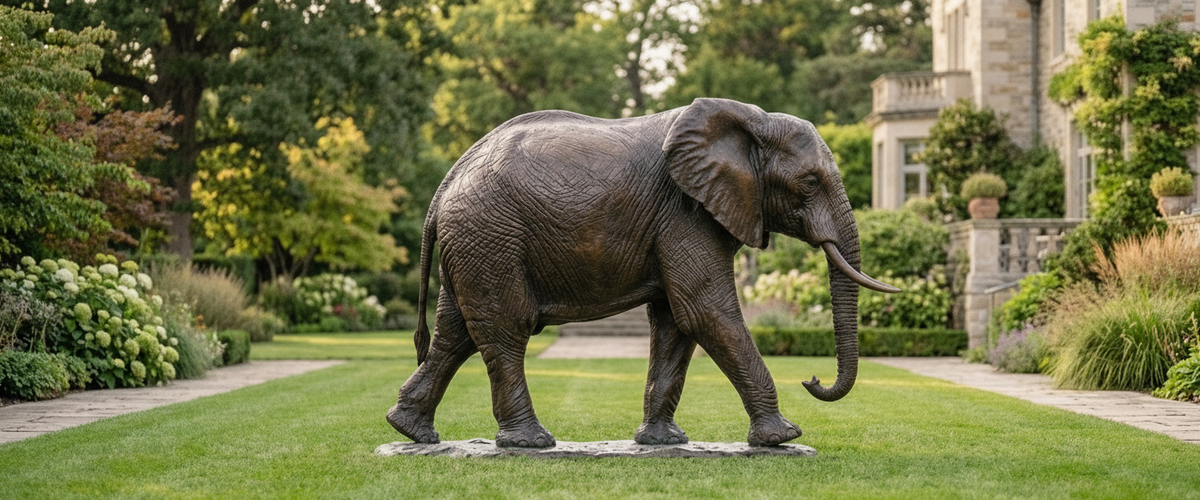
The poses that keep paying back are the ones where an animal is doing something ordinary. A deer with its head lowered to graze. A hare sitting upright, ears turned toward a sound you cannot hear. An elephant mid-stride with its trunk loose. These poses carry small details that reveal themselves slowly: the weight shift through a back leg, the angle of an ear, the fold of skin at a joint. In the studio we spend more time on ear position than on almost anything else, because it is where an animal's attention lives.
Slow species make the point best. A tortoise barely moves in life, and a low, grounded bronze such as the Large Traditional Giant Tortoise Bronze Sculpture - 200cm becomes something guests sit beside, touch and photograph, season after season. Quiet bronze wildlife sculptures also sit more comfortably with planting, since nothing about them fights the garden for attention.
Life Size, Not Heroic
Overscaling is the most common mistake we are asked to make with bronze wildlife sculptures. A fox at one and a half times life size stops reading as a fox that wandered into your borders and starts reading as a theme park prop. The brain knows how big a rabbit is. When the bronze matches that expectation, the illusion holds; when it overshoots, the sculpture announces itself as decoration. That is why the smaller animals in our bronze rabbit and fox statues are cast close to true size.
Monumental scale belongs to public and commercial settings viewed from a distance, such as a corporate campus drive or a civic plaza. At 280cm, a bird like the Monumental Bald Eagle Bronze Sculpture - 280cm is meant to be read from across a courtyard, not from a garden bench. For a private garden in Napa or the Hamptons, match the animal's real size and let placement do the work.

African Wildlife Sculptures in US and UK Gardens
An elephant in a Connecticut meadow or an English parkland should feel odd. The good ones don't. African wildlife sculptures settle in when they are given what the real animals need: space, open ground and a long approach. At about 280cm (roughly 9 feet 2 inches) tall, a group such as the Life-Size Pair of African Elephants Bronze Sculpture - 280cm looks right at the end of a lawn or across a paddock, where you see it first from far away and then walk toward it. Squeezed against a boundary wall, the same pair looks trapped.
The animalier sculptors of 19th-century Paris, led by Antoine-Louis Barye, studied exotic species from life at the Jardin des Plantes and showed that anatomical accuracy gives an animal more presence than exaggeration does. That still holds. A walking elephant in snow outside Aspen reads as calm and slightly surreal, which is a good thing.
Patina That Ages With the Setting
Bronze wildlife sculptures keep changing outdoors, so choose a patina that will age in the direction your setting is already pushing it. Dark brown patinas suit lawns, gravel and mixed planting; they deepen gently and read as shadow against green. Near ponds, fountains or coastal air, a verdigris finish makes sense, because moisture will pull the surface toward green anyway. Fighting that tendency means more waxing and more disappointment. To compare how different finishes sit against real planting, look through our bronze garden statues.
How to Choose: Four Decision Points
Viewing frequency. A daily view from a window favors a quiet pose; an occasional view from a drive can take more drama.
Viewing distance. Pace out where people will first see the piece. Life size works close up; larger scale only earns its place at a distance.
Ground and access. Large bronzes need a proper footing and crane or lift access. Check this before falling for a species.
Budget. Cost depends on scale, complexity, engineering, installation and finishing, so request a tailored quote rather than working from assumptions.

What We Ask for Before Casting a Species
When a client wants an animal we have not cast before, the sculpt is only as good as the reference. Before modeling begins we ask for:
Side, front, rear and three-quarter photographs of the species, ideally of the same individual or subspecies
Close shots of eyes, ears, feet and any distinctive markings
Real measurements for the life size you want: shoulder height, length and head size
Photos of the intended site with a person standing in frame for scale
A note on the pose and mood you want, in plain words
From there we sculpt in clay, share progress images and refine before casting. If you would rather start from existing work, our wildlife sculptures collection is the best place to begin, and every one of our bronze wildlife sculptures can be adapted in scale or patina as a bespoke commission.
For wider placement ideas, Choosing a Large Bronze Fountain Statue That Sounds Right is useful companion reading before finalizing the setting and sightlines.