





































































































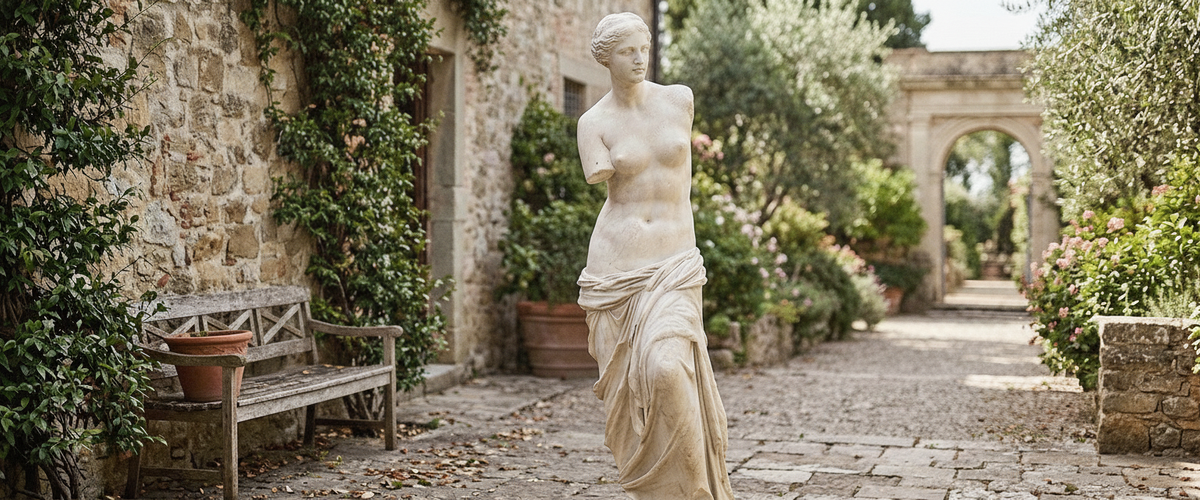

Stand a poor Venus de Milo statue beside a good one and you can tell them apart from thirty feet away, long before you are close enough to touch the stone. The good one has a spine. The hips swing one way, the ribcage answers, the shoulders settle back against the movement, and the whole figure looks caught mid-turn. The poor one stands square and polite, as if someone ironed the pose out of it. That difference is rarely a matter of taste; it usually comes down to how many generations of mould sit between the piece in front of you and the original.

Quick Answer: What Separates a Good Copy From a Tired One
Contrapposto depth. Look for a visible hip-to-shoulder twist from the side, not just the front.
Drapery edges. Thin, undercut, shadow-catching folds mean a fresh mould or real carving. Thick, rounded folds mean a copy of a copy.
Material honesty. Carved marble, marble-dust composite and plaster all behave differently in raking light and in weather.
Scale honesty. The original stands roughly 6 ft 8 in (about 2 m). Shrink a Venus de Milo statue too far and the pose stops working.
Surface evidence. Seam lines, soft shoulder breaks and pinholes tell you where the piece sits in the casting chain.
Contrapposto First: The Twist Cheap Copies Quietly Flatten
The Hellenistic sculptor who carved the original, the marble found on the island of Melos in 1820 and now held by the Louvre, built the figure around a diagonal. Weight drops onto the right leg, the left knee pushes forward under the fabric, the torso rotates, and the missing arms once carried that rotation outward into space. Everything in the piece depends on that spiral.
The side profile is the honest angle: the S-curve from supporting hip to far shoulder either reads, or it does not.
Now here is the practical test. Ask for a photograph taken from the figure's left side, not the catalog front view. In a well-made Venus de Milo statue you will see a clear S-curve running from the supporting hip through the waist to the far shoulder. In a flattened copy that curve reads as a gentle lean. Sellers photograph front-on for a reason: the front view is the most forgiving angle a slack cast has.
Drapery Edges Date a Mould Faster Than Any Price Tag
The fabric gathered around her hips is the most technically demanding part of the figure, and it is the first thing to go. Every time a rubber mould is pulled from an existing cast, the sharpest details lose a fraction of a millimeter. Thin edges thicken. Undercuts fill. Deep folds turn into shallow grooves that no longer hold a shadow.
Raking light at roughly 45 degrees separates crisp carving from a fourth-generation cast in a single photograph.
In our studio we judge drapery with a flashlight held at roughly 45 degrees, close to the surface. Crisp folds throw hard, legible shadows with a clean dark line where the cloth lifts away from the thigh. A fourth-generation cast under the same light produces mush: gray, soft, evenly lit, with the fold lines reading more like creases in clay than cut stone. If you cannot inspect in person, ask for that raking-light photo. Any serious supplier will take it.

Marble, Marble-Dust Composite and Plaster Under the Same Light
For wider placement ideas, Outdoor Sculptures for Music Venues Have to Survive the Crowd is useful companion reading before finalising the setting and sightlines.
Hand-carved marble behaves like nothing else because light travels a short distance into the stone before it bounces back. Edges glow faintly. Shoulders and knees pick up a soft inner warmth. That subsurface quality is the reason a carved Venus de Milo statue such as the Venus de Milo Marble Sculpture, 180cm still holds its modelling at midday, when a resin surface of the same size would bleach out and go flat.
Marble-dust composite (crushed marble bound in resin) can carry fine detail beautifully and takes a convincing polish, but it reads opaque. Light stops at the surface. Plaster is opaque and porous, shows tiny pinholes along fold lines, and chips into white powder rather than a crystalline fracture. None of these materials is dishonest. What matters is knowing which one you are buying, and where you intend to stand it.
Scale Honesty: Where a Shrunken Venus de Milo Statue Replica Fails
The original is a little over life-size at roughly 6 ft 8 in (about 2 m). Most decorative reproductions land far shorter, because shorter is cheaper to carve and cheaper to ship. The problem is proportional: as the figure shrinks, the drapery folds shrink with it, and below a certain point they stop reading as cloth and start reading as texture.
For a lawn terminus in a Napa garden or the end of a pool axis in Texas, scale matters more than any other decision you make. Something around 5 ft to 6 ft (150 to 180 cm) holds a large outdoor space. Smaller formats earn their place indoors, where the viewer stands within a few feet: a 120cm figure such as the Venus Italica Marble Sculpture works on a plinth in an entrance hall precisely because it is never asked to carry a long sightline. If you need a specific height to suit a niche or a sightline, that is exactly the kind of bespoke commission we quote for; budget depends on material, scale, carving complexity, base engineering, finishing and installation, so ask for a tailored quote rather than guessing.
Seam Lines and Shoulder Stumps: Spotting a Fourth-Generation Cast
Run a hand down the outside of the left thigh and along the back of the drapery. Cast pieces are made in sections, and a faint ridge or a slight change in texture often marks the join. A well-finished cast has those seams dressed back until they disappear. A rushed one leaves a thin raised line you can feel with a fingertip even when the photograph hides it.
The shoulder breaks are the other giveaway. On the original, the arms are lost at fracture planes with angular, crystalline, genuinely broken faces. Repeated moulding rounds those planes into soft domes that look sanded rather than snapped. A convincing Venus de Milo statue replica keeps the breaks abrupt and slightly irregular. If the stumps look like smooth knobs, you are looking at a copy several removes from a good source.
Why a Niche Flatters the Twist and a Room Corner Kills It
A shallow arched niche is the most sympathetic setting available, because the curved back wall wraps light around the figure and the rotation of the torso plays against a fixed frame. Freestanding on a plinth in the open works too, so long as you can walk around at least 180 degrees of the piece.
Room corners are where the figure dies. Two walls meeting behind a rotating body cancel the twist, the drapery loses its shadow side, and you end up with a pale silhouette. We shipped a carved Venus de Milo statue to a client outside Scottsdale who had planned exactly that corner; moving it 4 ft forward and turning it 30 degrees off the wall transformed the piece without spending another dollar. Where a flat backdrop is genuinely unavoidable, a seated or crouching subject like the Venus Bathing Marble Sculpture, 160cm is the safer choice, because its composition resolves from the front and does not depend on being read in the round.

Frost and Freeze-Thaw: What Winter Does to Marble Outdoors
Marble is porous. Water works into the surface, freezes, expands, and lifts thin flakes away, and the damage concentrates exactly where you least want it: thin drapery edges, the crown of the head, the fracture faces at the shoulders. Historic England's guidance on stone decay and freeze-thaw action is a useful primer on why open-textured stone suffers most.
If you are placing a Venus de Milo statue in Aspen, upstate New York or the Berkshires, plan for it. Raise the figure on a drained plinth so it never sits in standing water, keep it away from sprinkler spray, and use a breathable cover through the hard months rather than plastic sheeting that traps moisture. Resin-bound composite avoids frost spalling but can chalk under years of intense UV. Where winters are genuinely severe and the piece must stay out year-round, bronze is the more forgiving answer, and we regularly discuss that swap with clients during commissioning.
Buyer's Checklist Before You Commit
Request a side-angle photograph to confirm the hip-to-shoulder twist.
Ask for a raking-light shot of the hip drapery; look for hard-edged shadows.
Confirm the material in writing: carved marble, marble-dust composite or plaster.
Check the finished height against your sightline, plinth height included.
Inspect seam lines along the thigh and back, and the character of the shoulder breaks.
Confirm base fixing, weight and lifting access before delivery day, not after.
Agree a winter protection plan if the piece is going outdoors in a freeze-thaw climate.
Judged this way, a Venus de Milo statue stops being a generic garden ornament and becomes a piece you can live with for decades. Giant Sculptures works with clients on both catalog pieces from our Greek and Roman statues range and fully bespoke carvings sized to a specific niche, terrace or courtyard. If you are weighing options across periods and subjects, our wider classic sculptures collection is a good place to compare poses and scale before you brief us.