





































































































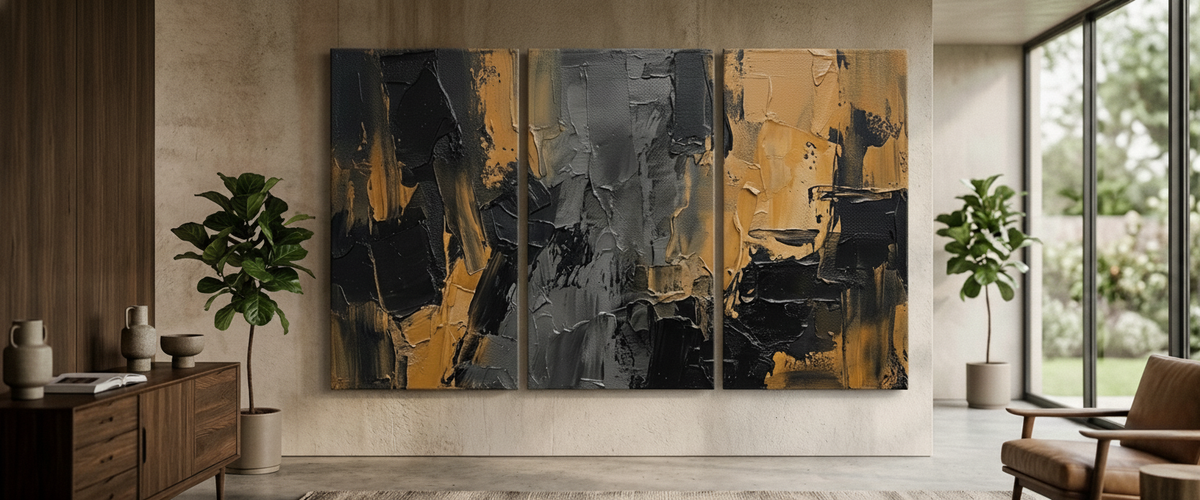

Hang a 24 inch (61 cm) piece above a nine foot sofa and the wall wins, every time. The most common failure we see with canvas art in private homes and hospitality projects has nothing to do with subject, palette or frame profile. It is scale. Buyers pick the size that feels safe on a screen, then live with a wall that looks half-finished for the next decade.

Key Takeaways
Size canvas art to roughly 60 to 75 percent of the furniture width below it, not to the wall.
Printed canvas holds up beautifully at 6 to 10 feet (1.8 to 3 m); at conversational distance, surface texture is what sells it.
Big canvas art needs deeper stretcher bars and cross-bracing, or the center will wave within a season.
Glare angle is measured from the seated eye line, not from where you stand with the tape measure.
When the wall is a focal point rather than a backdrop, a sculpted relief or metal panel often outperforms canvas.
The 60 Percent Rule, and Why Rooms Get It Wrong
Interior designers use a simple ratio: artwork above a piece of furniture should span about 60 to 75 percent of that furniture's width. A 96 inch (244 cm) sofa wants roughly 58 to 72 inches (147 to 183 cm) of canvas, whether that is one panel or a grouped set hung as a single visual block. Most people buy 30 inches and wonder why the room feels unresolved.
Span 60 to 75 percent of the furniture below, whether that is one panel or a tight set.
Grouped sets are the honest workaround when a single stretched panel would be awkward to ship or carry upstairs. Where a wide sofa wall needs more span than one practical stretcher can deliver, a three-panel arrangement such as Fantoria 3-Set Abstract Portrait Oil Canvas Wall Art covers the distance and still reads as one wide gesture, provided the gaps stay tight at 2 to 3 inches (5 to 8 cm) between panels. Open them up much further and the eye starts counting objects instead of reading a composition.
Ceiling height changes the math too. In a Texas great room with 20 foot ceilings, a piece sized correctly to the sofa can still look stranded. That is when we start talking about stacking, going vertical, or moving to a sculptural wall piece with real depth.

Viewing Distance Decides Everything
Ask one question before choosing between canvas art prints and something with physical relief: how close will people actually stand? At 10 feet (3 m), a good pigment print on cotton canvas is convincing. Color depth carries, composition carries, and the weave gives just enough tooth to avoid looking like a poster.
Close in, the rules change. At 3 feet (0.9 m) a flat print gives up its edge, because there is nothing for raking light to catch. This is why textured and built-up surfaces earn their place in hallways, powder rooms and dining rooms where guests pass within arm's reach. Where a wall is walked past rather than viewed across a room, a layered, sculpted surface such as Stratura I Black & White Layered Paper Canvas Wall Art is the safer material choice, because the shadow keeps shifting as you move. Tate's own definition of a stretched canvas explains why the substrate itself matters as much as the image sitting on it (Tate, canvas).
Stretcher Depth: When Big Canvas Art Starts to Wave
Here is the part almost nobody asks about. A canvas over about 48 inches (122 cm) on its long side needs a deeper stretcher bar, and past roughly 60 inches (152 cm) it needs cross-bracing behind the face. Skip that and humidity does the rest: the fabric slackens, the center bows, and you get a soft ripple that catches light across the middle of the piece.
Past 60 inches on the long side, bar depth and a center brace decide whether the face stays flat.
We had this conversation with a client in Aspen whose previous canvas had gone slack after one winter of dry heat and fireplace use. The replacement went out on a braced frame with keyed corners, and it has stayed flat. Ask any supplier of big canvas art two questions: what is the bar depth, and is there a center brace? A vague answer is an answer.
Hotels, Restaurants and Atriums: The Glare Angle Nobody Measures
Commercial walls kill more artwork than commercial budgets do. Downlights aimed at 90 degrees onto a satin-varnished canvas produce a hot band of reflection right where the guest is seated. The fix is boring and effective: aim fixtures at roughly 30 degrees from vertical, and check the reflection from a seated eye line of about 45 inches (114 cm), not standing height.
Light level matters as much as angle, since sustained high illuminance fades pigments over time, a risk museums manage carefully (Smithsonian, light and its damage). In bars and music venues, the oversized album art canvas is a popular request and a glare trap, because the strongest graphic imagery is usually the highest contrast. Matte finishes and off-axis lighting are non-negotiable there.

Measure from the Sofa Line, Not the Wall Edge
Centering to the wall is the default instinct, and it is often wrong. If the sofa, console or headboard sits off-center under the wall, center the canvas wall art to the furniture. The eye reads the pairing, not the plaster.
For height, aim the visual center around 57 to 60 inches (145 to 152 cm) from the floor in a standing room, and drop it in a lounge or dining room where everyone is seated. Above a sofa, leave 6 to 10 inches (15 to 25 cm) between the sofa back and the bottom of the frame. Any more and the two elements stop speaking to each other.
When a Relief Panel or Metal Piece Beats Canvas
Canvas is the right call for color-led, image-led walls. It is the wrong call when the wall is the room's focal point and needs to hold attention from multiple angles. Depth, weight and shadow do that job better.
When a client wants canvas colour but sculptural presence, a hybrid construction like Loftera Red Grid Sculpted Fabric & Abstract Canvas 3D Wall Art is closer to the right design language than a flat stretched panel, and the mixed media art range picks up from there. In double-height entries and exterior-adjacent walls, we usually move clients to metal entirely: brushed stainless, patinated bronze or Corten panels handle scale, sunlight and moisture in a way stretched fabric never will. That is where our bespoke commissioning work usually starts.

Commissioning to Size: The Three Numbers We Ask For
Before we cut a bar or size a panel, we ask for three measurements: the width of the furniture or wall run below, the clear wall height between any fixed obstructions, and the primary viewing distance. Those three numbers settle format, depth and finish faster than any mood board.
Two more things help. Send a photo of the wall taken from the seating position with the lights on as they will be at night, and tell us your access route, since door widths and stair turns dictate whether one panel or a set is realistic. Budget is set by scale, material, structural engineering, finishing and installation, so a tailored quote is the only honest number we can give.
Before You Order: A Quick Canvas Art Checklist
Measure the furniture width and calculate 60 to 75 percent of it.
Tape the outline on the wall in painter's tape and live with it for a day.
Confirm stretcher bar depth and whether the frame is braced at your chosen size.
Check the reflection angle from where people actually sit.
Plan two anchor points into studs or suitable fixings for anything over 40 inches (102 cm) wide.
Note humidity swings from fireplaces, HVAC or coastal air before choosing canvas over metal or stone.
Ask about lead time and crating early if the piece is going into a scheduled fit-out.
Browse the full canvas art range for image-led walls, and talk to Giant Sculptures about a bespoke commission when the wall deserves something built to its exact dimensions.
For wider placement ideas, Paper 3d Wall Art: How to Buy a Panel That Holds Its White is useful companion reading before finalising the setting and sightlines.