





































































































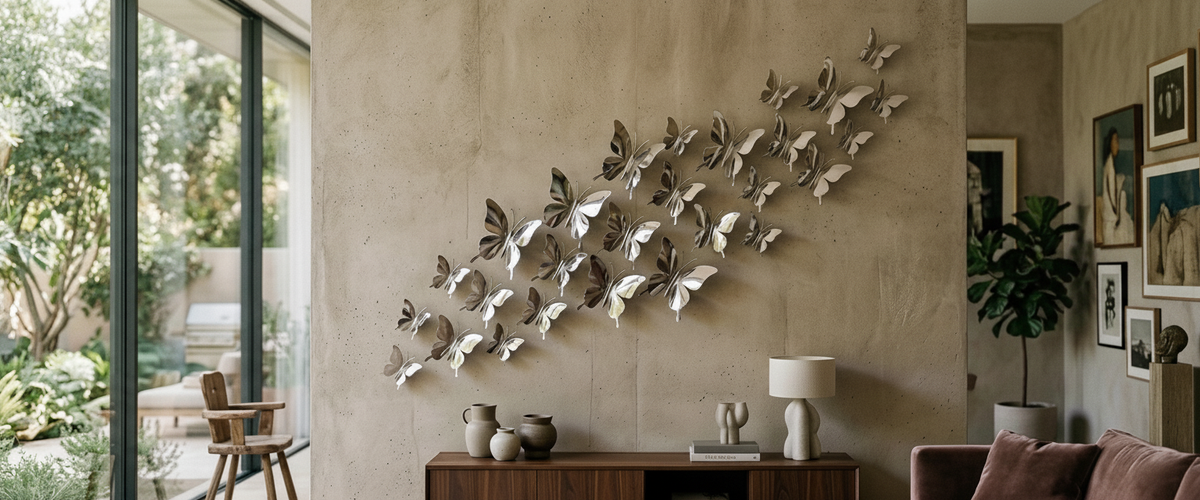

Stand six feet back from most butterfly panels and the effect drains away. Up close you see shape; at conversational distance you see a gray smudge on a gray wall. The difference between decoration that dies and 3D butterfly wall art that holds a stairwell comes down to one thing most listings never mention: whether the wing is lifted far enough off the surface, and curled sharply enough, to throw its own shadow.

Key Takeaways
A butterfly reads at distance because of shadow, not color. Flat laser cutouts lose their edge past a few feet.
Wing curl angle and standoff depth are the two numbers worth asking about before you buy 3D butterfly wall art.
Metal holds a crisp wing edge for decades; layered paper and light resin soften and sag in warm, humid rooms.
Odd-numbered clusters with uneven gaps imply flight. Even grids imply wallpaper.
Framed panels carry their own shadow anywhere; loose swarms depend entirely on the wall's light.
Wing Curl And Standoff Depth: The Two Numbers That Do The Work
Every piece of 3D butterfly wall art is really a small shadow machine. Lift a wing 1 inch (25 mm) off plaster under side light and you get a soft gray echo. Lift it 2 to 3 inches (50 to 75 mm) and the shadow separates cleanly from the metal, so the eye reads two butterflies where there is one. That doubling is what carries across a room.
Curl matters just as much. A wing bent at a shallow 15 degrees catches light along a narrow strip and looks timid. Bend the outer third closer to 40 or 50 degrees and each wing gives you a lit face and a shaded face at the same time. In our studio we test new wing profiles by taping samples to a white board and walking backward until the form breaks down. If it dies before 20 feet (6 m), the curl is too lazy for a double-height space.
Standoff depth of 2 to 3 inches is what separates the shadow from the metal.
Metal, Resin Or Layered Paper: Judge 3D Butterfly Wall Art By The Wing Edge
Forget the material name for a moment and look at what the edge does to light. Brushed stainless holds a hairline highlight along the wing rim that moves as you walk past. Powder-coated steel gives you a matte body with a hard shadow line, which suits dark or heavily patterned walls where gloss would get lost. Bronze, hand-finished, reads warmer and denser and behaves beautifully in a room with lamplight rather than daylight.
Layered paper and card look charming in photographs and fail in practice. Wings relax, curl angles drop, and anything near a kitchen, bathroom or sunlit south wall discolors within a season. Cast resin sits in between: fine for small indoor clusters, but the edge is thicker and blunter, so the shadow it throws is fuzzier than sheet metal of the same size. If you want butterfly wall art 3D that still looks deliberate in ten years, sheet metal is the honest answer. Real butterfly wings get much of their color from microscopic structure rather than pigment, which is why polished and iridescent metal finishes mimic them so convincingly; the American Museum of Natural History has good background on how those scales behave.
Cluster Math: Odd Counts, Flight Lines And Useful Gaps
3D butterfly wall art installed on an even grid stops being sculpture and becomes pattern. Work in odd counts (7, 11, 17, 23) and build a loose diagonal flight line rising from low left to high right, or spilling up a stairwell in the direction people walk. Tighten the cluster at the origin point, then let the spacing stretch as the swarm climbs. Those widening gaps are what the eye reads as acceleration.
Vary scale too. A swarm of identical butterflies looks manufactured. Mixing three sizes, say a 4 inch (100 mm) wingspan, an 8 inch (200 mm) and a 14 inch (355 mm), builds depth before anyone notices why. The same relief logic runs through textured abstract panels: on a piece like Sandmere Shell Mosaic Abstract 3D Wall Art, dozens of small raised elements read as one continuous shadow field rather than as individual bumps, which is exactly what a well-graded swarm is doing at larger scale.

Framed Swarm Panels Trap Their Own Shadow
There are two routes. A framed backing panel carries its own background, so the shadows land on a controlled surface and travel with the piece if you move house. That makes 3D butterfly framed wall art the safer choice for rental homes, hotel corridors and walls you would rather not drill twenty times. The tradeoff is containment: the swarm stops at the frame edge.
Loose flights borrow the wall. They can turn a corner, cross a doorway, climb three floors of a stairwell. They also expose every flaw in the plaster and every fixing hole if you ever take them down. Where a wall needs contained relief rather than a flight that borrows the plaster, a deep-carved panel such as Barwick Mocha Orbital Abstract 3D Carving Wall Art builds the shadow depth into the object itself, so the effect holds regardless of what the room does with light.
Light Changes Everything: Raking Sun Versus Flat Downlight
We shipped a stainless swarm to a house outside Austin, Texas, set on the tall wall of a west-facing stair. In morning light the wall is nearly flat and the butterflies read as quiet silver marks. By late afternoon the raking sun stretches each shadow a foot across the plaster and the whole wall appears to move. That is not a flaw, it is the point, but the client needed to know it before install.
Side light at roughly 30 degrees does more for relief than any extra lumens.
Flat ceiling downlights are the enemy of relief. They drop light straight down, shadows collapse under the wings, and your 3D butterfly wall art loses half its depth. Fix it with a wall washer or a track head set at roughly 30 degrees from the wall face, positioned to one side rather than dead center. Where the lighting cannot be changed at all, a surface cut with deep internal channels, along the lines of Barwick Charcoal Grid Abstract 3D Carving Wall Art, keeps more of its modeling under flat downlight than a shallow-curled swarm ever will.

Fixings Checklist Before You Drill
Run any 3D butterfly wall art through this list before the first hole goes in the plaster.
Threaded standoffs for anything over 8 inches (200 mm) across, or where you want a guaranteed, repeatable gap.
Concealed pins for small butterflies on plasterboard; quick, but check the pin is welded, not glued.
Rare-earth magnets with steel discs when you want to reposition the swarm during the first week. Almost everyone does.
Paper template first. Tape the full layout, live with it for two days, then mark centers.
Outdoor walls need stainless or marine-grade fixings and a finish rated for exterior exposure; the Powder Coating Institute is a useful reference on exterior coating performance.
Clean with a dry microfiber cloth. Wing edges collect dust fast and dulled edges kill the highlight.
Commissioning A Bespoke Swarm
Off-the-shelf sets cap out quickly once a wall runs past 10 feet (3 m). For atrium walls, restaurant frontages and double-height entrances, we build bespoke 3D butterfly wall art to the specific surface: wing profiles cut and formed to a set curl, sizes graded across the flight, finishes matched to the surrounding metalwork. Giant Sculptures makes bespoke wall installations in stainless steel, bronze, Corten and powder-coated steel, and we regularly work from an architect's elevation drawing rather than a photograph.
Cost depends on material, overall span, the number and size of individual elements, forming complexity, finish and installation access, so the sensible first step is a tailored quote rather than a guessed figure. Send the wall dimensions, a photo taken at the time of day the room is most used, and a note on lighting. If you are still comparing formats, the 3D wall art range is the place to judge relief depth, and the metal wall art collection the place to judge finish behavior. Both tell you more about how a piece will act on your wall than any flat product photo will.
For wider placement ideas, 3D Mirror Wall Art: Check the Opposite Wall Before You Buy is useful companion reading before finalising the setting and sightlines.