





































































































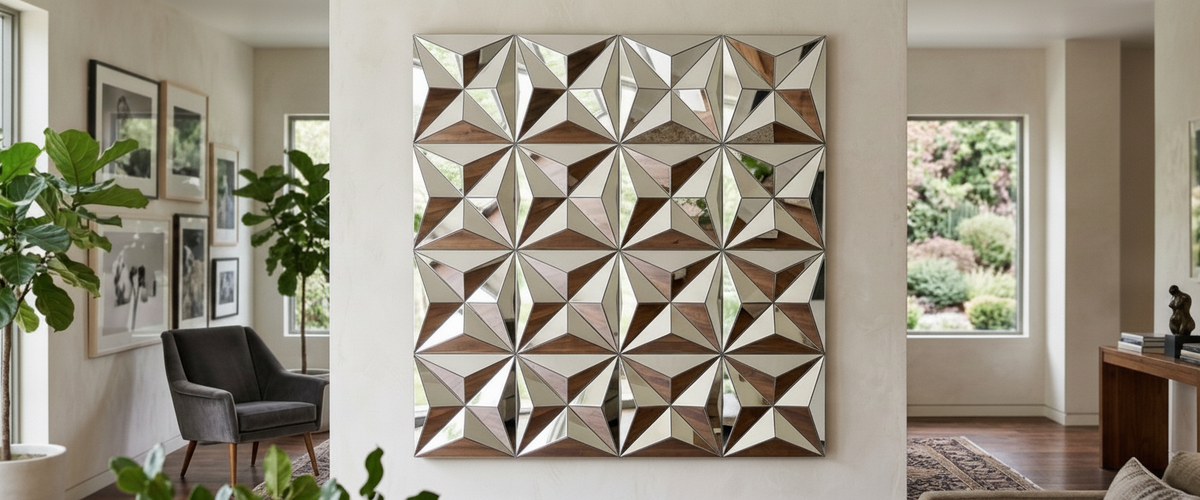

Hang a mirrored panel and you have not decorated the wall it sits on. You have put the wall opposite it on permanent display, full size, lit by whatever happens to be shining that day. That one fact decides whether 3D mirror wall art reads as a considered design move or a showroom accident, and it is the thing most buyers check last.
Faceted panels are unusually rewarding when the reflection has something worth repeating, and unusually punishing when it does not. Before the material question, before the size question, stand where the piece will hang and turn around.

Key Takeaways
The facing wall is the actual subject. Judge it first, in daylight and at night.
Facets multiply point light beautifully and fragment clutter badly.
Hallways, stairwells and bar backs are the three walls that repay faceted mirror most reliably.
Adhesive 3D mirror wall art stickers are a temporary trick; corners lift within a season.
Acrylic is light and forgiving; real glass is flatter, heavier and needs proper structural fixing.
Budget depends on scale, substrate, facet geometry, mirror type and installation. Ask for a tailored quote.
The Wall Facing the Piece Is the Real Artwork
A flat mirror gives you one image of the room. A faceted panel gives you dozens, each tilted a few degrees off its neighbor, so the reflected content arrives chopped and re-sorted. That is flattering to simple geometry and cruel to visual noise. A plain plaster wall with a single sconce turns into a field of soft repeated glows. A gallery wall of twenty framed prints turns into confetti.
We ask clients to photograph the facing wall on their phone and then squint at the image. If the photo still reads as clean shapes at thumbnail size, 3D mirror wall art will look expensive. If it reads as speckle, choose relief without reflection instead. A carved timber panel such as Barwick Charcoal Grid Abstract 3D Carving Wall Art keeps the same rhythm of light and shadow across the surface without importing the rest of the room into the artwork.
Point light is the ideal subject: every facet returns the same pendant at a slightly different angle.

Facets Multiply a Pendant Light and Shred a Bookshelf
Point sources are what 3D mirrored wall art was built for. A brass pendant, a run of candle sconces, a single tall window: each one is caught by every facet at a slightly different angle and returned as a constellation. Diffuse sources do far less. A ceiling of flat recessed downlights opposite a faceted panel produces gray, not sparkle.
Clutter is the other variable. Open shelving, cable runs, a television, a kitchen worktop with appliances on it; all of these get fragmented rather than tidied. Where the facing wall has to stay busy, a textured low-reflectivity surface like Sandmere Shell Mosaic Abstract 3D Wall Art is closer to the right design language, because the depth comes from the surface rather than from mirror. You still get relief and movement, and nothing borrows the mess across the room.
Three Walls That Repay Faceted Panels
Hallways are the first place 3D mirror wall art earns its keep. Corridors are usually narrow, dim and short of features, and a faceted run along one side widens the space visually while giving people something to walk past rather than through. Keep the panel above dado height so shoulders and luggage never touch it.
Stairwells come second, and they are the most wasted wall in most large houses. A double-height stair void gives you 14 to 20 feet (roughly 4.3 to 6 meters) of uninterrupted vertical surface, viewed from three different levels. Facets read differently from each landing, which is exactly what you want from a piece people pass ten times a day.
Bar backs are the third. We shipped a faceted panel for a private tasting room in Napa where the client had already installed low warm spots above the bottle shelf. Those spots hit the facets at a shallow angle and the whole back wall lit up without a single extra fixture. A bar is the one place where reflected glassware genuinely improves the reflection.
A stair void gives the same panel three different viewing heights, so the facet pattern never repeats itself.

What a Window Opposite Does at Four O'Clock in December
For wider placement ideas, 3d Wall Art for Office Spaces: The Two Distances That Decide Everything is useful companion reading before finalising the setting and sightlines.
Direct sun on a faceted mirror is not soft. Low winter light coming in at a shallow angle will bounce off angled facets and land as hard bright patches on the ceiling, the floor and occasionally somebody's eyes. In a Texas or Southern California room with big west-facing glazing, that can mean a hot half hour most afternoons from October through February.
Two fixes work. Angle the piece off the direct axis of the window so the bounce goes into a corner instead of across the seating. Or specify shallower facet angles, which narrows the spread of reflected light. This is one of the practical reasons a bespoke commission beats an off-the-shelf panel: facet depth can be set for your room rather than for an average one. Where the glazing simply cannot be worked around, a deeply cut matte relief such as Barwick Mocha Drift Abstract 3D Carving Wall Art gives you the same raking shadow line as the sun moves, with none of the bounce.
3D Mirror Wall Art Stickers Lift at the Corners
Adhesive tile kits sell hard because they are quick and need no fixings. They are also the most common regret we hear about. Thin acrylic tiles expand and contract with the room, foam pads cure and shrink, and the corners begin to peel within a single season of heating cycles. Once one tile tilts, the reflection line breaks across the whole array and the eye goes straight to it.
Stickers have a place: rentals, short-term staging, a teenager's room. If the piece is meant to stay for a decade, buy panelized 3D mirror wall art with a rigid backing board and mechanical fixings. Longevity is a structural question, not an adhesive one.
Acrylic Mirror or Real Glass
Acrylic mirror is light, shatter-resistant and easy to cut into complex facet shapes. Its weakness is flatness. Bond acrylic to a backing and it can telegraph the smallest ripple in the substrate, which shows up as a wobble in the reflected line of a door frame. It also scratches, which is another argument for keeping hallway panels above dado height.
Glass gives you optical accuracy and a cooler, truer image, and it stays that way for decades if the silvering is protected at the edges. It is heavy, roughly 1.6 pounds per square foot per 1/8 inch of thickness (about 8 kg per square meter), so a large sheet of 3D mirror wall art is a genuine structural load. The Glass Association of North America publishes handling and installation guidance for mirrored glass that is worth reading before anyone lifts a large sheet, and the Corning Museum of Glass is the better source on how silvering itself developed.

Fixing Into Plaster, Brick and Stud Without a Ripple
Distortion in a mirrored panel is almost always an installation fault rather than a manufacturing one. Fix a rigid mirrored face to an uneven wall and you will see it.
Plasterboard and stud: locate studs, use a full-width aluminum cleat, and never rely on plug fixings alone for a heavy glass panel.
Solid brick or block: ideal for weight, but old walls are rarely flat. Pack behind the cleat and check with a long level.
Lath and plaster: treat as decorative only. Fix through to the timber structure behind.
Every substrate: shim the mounting rail, not the panel. Shimming the panel is what creates the ripple.
Multi-panel arrays: set out from the center line so any tolerance error lands at the outer edges where nobody reads it.
Commissioning 3D Mirror Wall Art at Scale
For anything above about 6 feet (1.8 meters) wide, bespoke is usually the sensible route. Giant Sculptures builds large wall pieces to measured drawings, which means facet geometry, panel joints and fixing centers are designed around your actual wall rather than shipped in a standard size and trimmed on site. Steel-framed and engineered metalwork versions handle scale that adhesive tiles cannot, and our metal wall art range shows how far relief alone can go before you add mirror.
Two practical requests before you commit to 3D mirror wall art. Ask for a mockup: brown paper on the wall at full size, taped for a week, is the cheapest design tool there is. And ask what happens in ten years, because edge sealing, backing board stability and the fixing system decide whether a mirrored panel still looks precise or starts to sag at one corner. The mirror art and 3D wall art collections are useful for scale and finish references, then send us the room photograph. The wall opposite tells us more than the dimensions do.