
























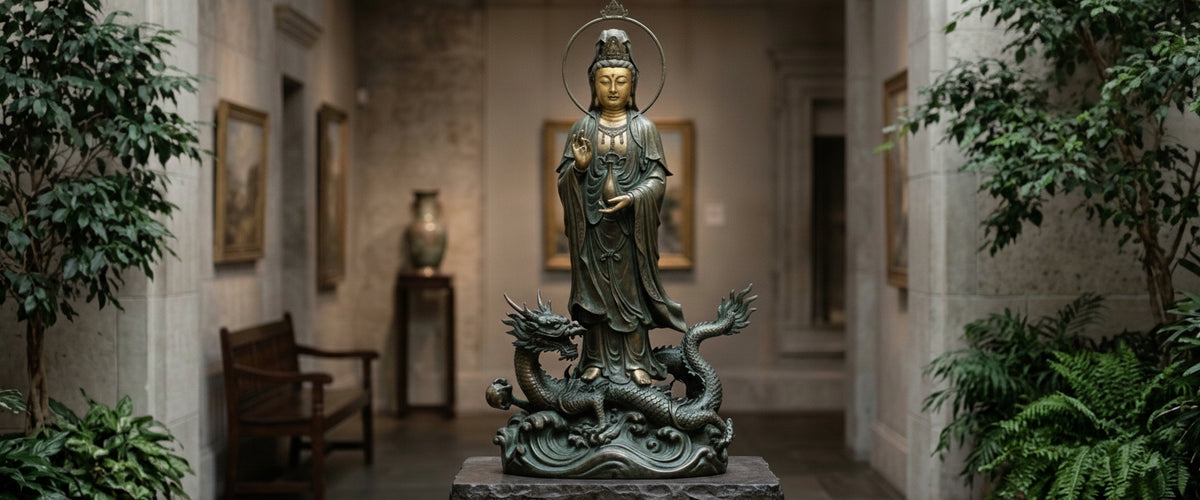

Most Kuan Yin figures sold online fail in the same place: the face. The proportions may be correct and the patina convincingly aged, yet the expression reads as blank or faintly sulky, which defeats the whole point of the subject. A Kuan Yin bronze statue exists to hold calm. If the casting cannot carry that calm across a garden, no amount of gilding will rescue it.
Quick Answer
Origin: Kuan Yin is the Chinese form of the bodhisattva Avalokiteshvara. Over centuries the figure became gentler and, in later Chinese art, usually female.
Pose matters: royal ease invites the viewer in, the lotus throne asks for stillness, and the standing figure with willow and vase offers something outward.
The dragon mount ties the figure to water and belongs near a pond or rill.
Judge quality at the eyelids, fingertips and drapery undercuts before anything else.
Outdoors, cold-painted color fades. Patina and gilding last far longer.
Placement: the lowered gaze was designed to fall on a viewer standing below it.
From Avalokiteshvara to Kuan Yin: Why the Figure Softened in Chinese Bronze
Early Indian and Himalayan images of Avalokiteshvara are often princely and ornamented, sometimes many-armed. As the figure moved into China, sculptors loosened the jewelry, lengthened the robes and lowered the eyes. By the later dynastic periods Kuan Yin was most often shown as a serene woman in flowing drapery, a shift you can trace through the Chinese holdings of the Smithsonian's National Museum of Asian Art. For a collector, this history explains why a good Kuan Yin bronze statue depends on softness: the modeling of the cheek, the weight of cloth, the slight inward turn of the shoulders. Bronze punishes that softness when it is cast badly and rewards it when it is cast well.

Royal Ease, Lotus Throne, Willow Vase: What Each Pose Asks of the Viewer
Royal ease shows Kuan Yin seated with one knee raised and an arm draped across it. It is relaxed and conversational, so it suits a terrace or courtyard seen from a bench, where the viewer is also at rest.
The lotus throne is the meditative, symmetrical seated pose. It asks to be approached head-on, which means it needs a clear axis: the end of a path, the far side of a reflecting pool, a niche in a hedge.
The standing figure with willow branch and vase pours compassion outward, traditionally as pure water. It reads from a distance and holds a long sightline better than any seated pose, which makes it the natural choice for larger grounds where the figure may be first seen across a lawn.
The Dragon Mount: Protection, Water and the Garden Pond
In Chinese imagery the dragon governs rain, rivers and the sea. Kuan Yin standing or seated on a dragon above cast waves is a figure of protection over water, and the composition makes most sense beside a pond or stream. Buyers searching for a Kuan Yin garden with dragon bronze statue in color are usually picturing exactly this: a figure over a koi pond, the dragon's scales catching light off the surface. If you have been looking at bronze garden statues, dragon pieces in particular, note that the dragon adds real mass at the base. That lowers the center of gravity, which helps outdoors, but it also means the plinth and footing must be engineered for the full weight. A standalone dragon behaves very differently from one carrying a figure, and the range of bronze animal sculptures is a useful place to see how much presence the creature has on its own.
How to Judge a Kuan Yin Bronze Statue Before You Buy
Face and Hands First
On any Kuan Yin bronze statue, look at the eyelids. On a well-chased casting the upper lid has a crisp edge and the eyes are fully lowered, not half-closed and sleepy. The mouth should hold a very slight lift at the corners. Then check the hands: in a mudra or holding the vase, each finger should be separated and articulated. Fused fingers and a soft, doughy face are the two clearest signs that a cast was taken from a worn mold and never properly finished by hand.
Drapery Folds That Give Away Sand Casting versus Lost Wax
Sand casting needs the pattern to be drawn out of the mold, so deep undercuts are difficult to achieve. The result is shallow drapery, folds that stop abruptly, and sometimes a faint seam where mold sections met. Lost-wax casting, the method behind most of the great figurative bronzes in collections such as the V&A's sculpture holdings, captures overlapping folds, hollow sleeves and fine hems. On a bronze Kuan Yin, where the robes carry most of the movement, that difference is visible from across the garden.
Eyelids sharp, gaze fully lowered
Fingers separated, not webbed
Drapery undercut, with shadow inside the folds
No visible mold seams along the sides
Even wall thickness, confirmed by the maker
Fixing points designed into the base, not drilled afterward
Cold-Painted Color on Bronze: What Fades Outdoors and What Endures
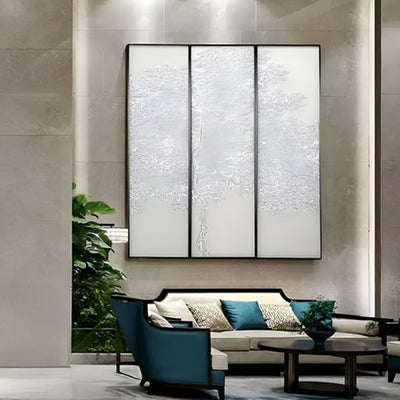
Cold painting means pigment applied after casting with no firing. On a bronze Kuan Yin it looks rich on day one. Outdoors, UV, rain and temperature swings lift it, and reds and blues usually go chalky first. It is common to find a painted figure with robes faded to pink after a few hot summers while the gilded face still looks almost untouched. Gold leaf and chemical patinas are bonded into or onto the metal and last far longer with a periodic wax. If you want green, ask for it in the patina rather than in paint: the verdant finish on the branches of the Clear Resin & Verdant Bronze Scholar Tree Sculpture - 180cm is the kind of green that belongs in the metal itself, and it is worth asking a maker to match that tone on robes or a dragon's scales. Keep full polychrome for a covered loggia.

Water, Stillness and Eye Level: Placing the Pose the Way Old Courtyards Did
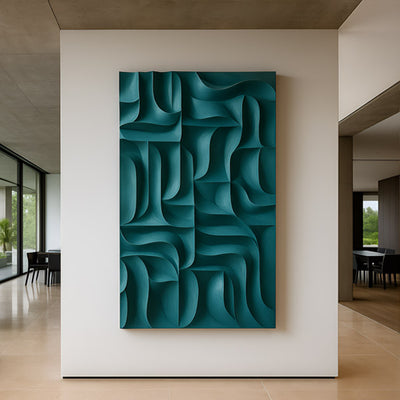
Kuan Yin's lowered gaze was made for a viewer standing below the figure in a temple hall. Put a Kuan Yin bronze statue at ground level and she stares at the gravel. A figure set on a low stone beside a koi pond tends to look oddly withdrawn. Raising it so the eyes sit a little above head height, roughly 6.5 to 7 feet (2 to 2.1 m) for a life-size figure, turns the gaze back onto the water and the person beside it. Still water in front doubles the figure and slows the approach. Where the courtyard is contemporary and the dragon's waves need an echo rather than a second figure, a sculpture such as the Textured Bronze Ridge & Teal Resin Wave Sculpture - 200cm is closer to the right design language, carrying the water theme across the space without competing with Kuan Yin's face.
Commissioning a Kuan Yin Figure
Giant Sculptures makes bespoke bronze figures at scales that suit gardens, hotel courtyards and private collections. Budget depends on material, scale, complexity, engineering, installation and finishing, so we quote each piece individually. For a Kuan Yin bronze statue, start with the pose and the sightline, then talk to us about patina and base. Browse our bronze mythology and goddess statues or the wider bronze garden statues collection, and request a tailored quote.
For wider placement ideas, Best Bronze Tabletop Sculptures: What Holds up at Arm's Length is useful companion reading before finalising the setting and sightlines.