





































































































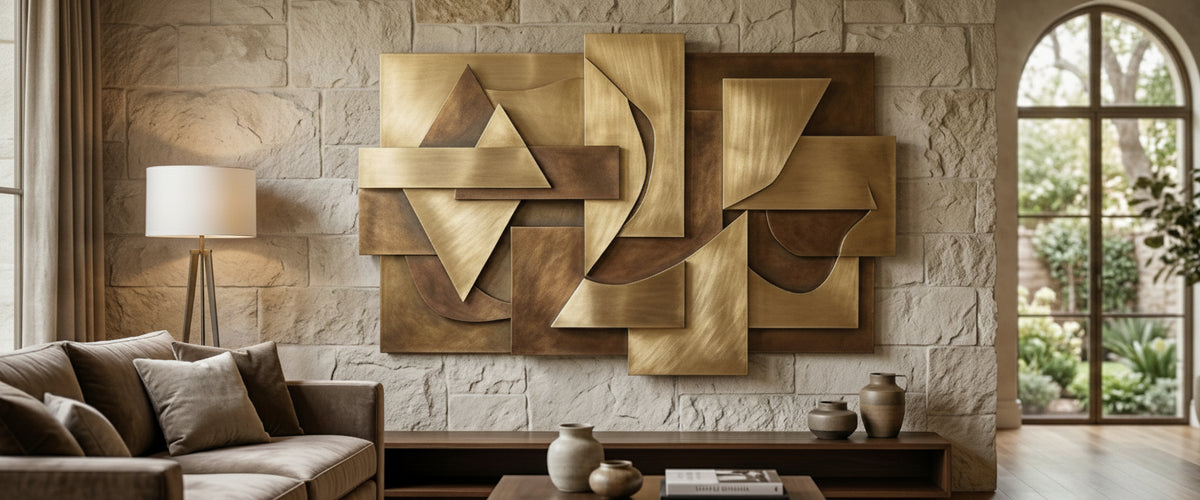

The wall behind the sofa is usually the biggest flat surface in the house, and in most homes it sits empty. That is exactly why wall sculptures for the living room earn their keep: relief work throws real shadow and shifts through the day as light moves across it, which no flat print will ever do. The catch is that choosing living room wall sculptures is a scale and light problem long before it is a taste problem. A piece has to read from the far side of the room and hold up in the light you actually have, at a height that still works when people are seated. Get that wrong and a good sculpture looks stranded on the plaster. Get it right and the wall is the first thing guests mention.
This guide covers how to compare living room wall sculptures, what each material really does over years of ownership, how to size a piece to your wall, and where to hang it for the strongest effect. It is written for buyers furnishing a real room, not styling a showroom.

Key Takeaways
Scale first. A living room wall sculpture usually wants to fill roughly two-thirds of the wall or furniture width below it. Timid sizing is the most common mistake.
Material sets the mood. Metal reads modern and catches light; wood warms a room; paper-craft and 3D layered pieces add texture without weight.
Placement is about eye line. Center the visual weight of living room wall sculptures around 57 to 60 inches (145 to 152 cm) from the floor, adjusted for seated sight lines.
Weight affects fixings. Heavier metal and multi-panel work needs anchoring into studs or masonry, not drywall alone.
Bespoke solves odd walls. Double-height rooms and long horizontal runs often call for custom living room wall sculptures sized to the space, because off-the-shelf art cannot match them.
What Wall Sculptures for the Living Room Really Means
A wall sculpture is any piece designed to sit proud of the surface rather than flat behind glass. That covers layered metal abstracts, carved and stacked wood, modular grids, and dimensional paper-craft blooms. The shared trait of living room wall sculptures is relief: they throw shadow and change as daylight moves across the room. A framed canvas gives you an image. A wall sculpture gives you an object.
This suits buyers who want a focal point without committing floor space to a freestanding piece. Living room wall sculptures work especially well above a sofa, over a fireplace, or on the long uninterrupted wall of an open-plan space, the kind you find in newer California and Texas builds where the living, dining, and kitchen run together. If the room already has strong architecture, a single confident piece often does more than a cluster of small frames.
How to Compare Wall Sculptures for the Living Room Before Buying
Before you fall for a finish, run any candidate through a short set of questions. These sort the living room wall sculptures that will still look right in five years from the ones that are only styled for a catalog shot.
Does it read at distance? Stand back the length of your room. If the detail disappears, it is too fussy or too small for the wall.
How does it behave in your light? High-relief and metallic living room wall sculptures depend on directional light. A north-facing room mutes gloss; a room with strong afternoon sun rewards it.
Is the color anchored or trend-led? A rustic bronze glow or ivory tone dates slowly. A very specific accent color can trap you into repainting around it.
What is the build quality up close? Look at edges, welds, layering, and mounting hardware. Cheap wall art betrays itself at the seams.
Can it be scaled or repeated? Modular systems let you extend later; a single fixed panel does not.
Where the wall wants a modern, light-catching focal point rather than an all-over color statement, a defined metal piece such as the Eclat Sphere Red Abstract Metal Wall Art gives you sculptural depth with a single controlled accent. If you want warmth and quiet texture instead, layered wood reads very differently in the same spot.

Key Materials, Finishes, and Scale Decisions
Metal wall art
Metal is the workhorse of contemporary living room wall sculptures. It holds crisp edges, takes brushed, polished, or patinated finishes, and reflects light in a way flat art cannot. Brushed and matte finishes hide fingerprints and dust better than high polish, which matters over a fireplace where warm air carries fine particles. Where the setting leans toward warm neutrals and stone rather than bright color, a gold-edged abstract such as the Astrid Gold Edge Earthy Abstract Wall Art pairs metallic line work with grounded earth tones and flatters a stone fireplace without shouting. Browse the wider metal wall art range to compare finishes side by side.
Wood and 3D relief
Wood living room wall sculptures bring warmth that metal cannot, and they suit rooms leaning Scandinavian, Japandi, or rustic. Modular block grids give you geometry and shadow; for a wall that catches raking side light, the Artiora Red Edge & Wood Block Modular Grid 3D Wall Art is closer to the right design language than a single flat panel, and the grid can be extended later. Solid wood does move with humidity, so keep it off walls that share a chimney breast or sit directly above a heat source, and away from unshaded south-facing glass. The USDA Forest Products Laboratory has long documented how wood expands and contracts with moisture cycling, which is worth respecting indoors as much as out (Wood Handbook, FPL).
Paper-craft and dimensional pieces
For softer, gallery-quiet texture, dimensional paper-craft blooms add relief without visual heaviness, and they are among the lightest living room wall sculptures you can hang. Over a low console or in a reading corner where you want form rather than color, a piece like the TerraLuma Ivory White Bloom Paper Craft 3D Wall Art makes more sense than a heavy metal composition. These are best kept out of high-traffic hallways and away from damp; a settled living room wall suits them well.
Scale
Scale is where most living room wall sculptures go wrong. Over a sofa, aim for a piece (or arrangement) spanning around two-thirds of the sofa width. On a tall feature wall in a double-height room, a single small panel looks marooned; you want height to carry the vertical space, or a stacked composition that climbs it. Measure the wall, mark the intended outline in painter's tape, and live with it for a day before committing.
Where to Place Wall Sculptures for the Living Room
For wider placement ideas, Extra Large Wall Art: How to Get the Scale Right in a Living Room is useful companion reading before finalizing the setting and sightlines.
Placement decides whether a good piece earns its keep. Living room wall sculptures tend to land in a few reliable positions:
Above the sofa. The most common and most forgiving spot. Leave 6 to 10 inches (15 to 25 cm) between the top of the sofa back and the base of the sculpture so they read as related, not stacked.
Over the fireplace. A strong focal position, but check surface heat and rising warm air. Metal handles it best; keep delicate paper and untreated wood away from direct heat.
The long open-plan wall. Here horizontal or modular living room wall sculptures stretch the sight line and define the living zone within an open floor plan.
Facing the entry. The wall you see first when you walk in rewards a bolder, more sculptural choice; it sets the tone for the whole room.
Center the visual weight at roughly 57 to 60 inches (145 to 152 cm) from the floor for standing sight lines, then drop it slightly for a room where people mostly sit. Directional lighting matters as much as height when you hang living room wall sculptures. A wall washer or a discreet picture light set to graze the surface at an angle exaggerates relief and shadow; flat frontal light kills it. Lighting guidance from the Illuminating Engineering Society is a sensible reference if you are planning fixtures around the piece (IES).

Budget, Commissioning, and Delivery
Living room wall sculptures cover a wide price band, and cost tracks material, scale, complexity, finishing, and whether the design is stock or made to order. Rather than quote figures that would not survive contact with your actual wall, we price each commission to the specification. A small stock metal abstract and a large bespoke multi-panel installation are not remotely comparable, so ask for a tailored quote once you know your dimensions.
On delivery, larger and heavier living room wall sculptures ship crated and often arrive with mounting hardware specified to the weight. This is where fixings matter: a light paper-craft panel is happy on quality drywall anchors, while a substantial metal composition wants fixing into studs or masonry. If you are unsure what your wall can carry, tell us the wall construction and we will advise before anything ships. We regularly ship internationally from our UK studio to homes across the US, so cross-border logistics and crating are part of the standard conversation, not an afterthought.
How Giant Sculptures Helps with Bespoke Wall Projects
Some walls simply are not served by stock sizes. A double-height living room in Aspen, a wide gallery wall in a Napa home, a long horizontal run above built-in seating; these are the projects where bespoke living room wall sculptures pay off. Giant Sculptures works on made-to-order pieces where you set the dimensions, finish, and color, and we handle the engineering and mounting spec so the finished work sits safely and looks intentional.
A recent example from the studio: a client with a very long, low wall above a media unit wanted movement without clutter. A single framed print would have vanished. We developed a horizontal modular metal composition sized to the wall, finished to pick up the room's warm brass fittings. It reads as one considered piece rather than a gallery wall assembled over time. That is the advantage of commissioning living room wall sculptures: the work is built for the wall, not squeezed onto it.
If you are starting out, browse the living room art collection to gauge scale and finish, then come to us with a wall measurement and a photo. We will tell you honestly whether a stock piece fits or whether bespoke living room wall sculptures will serve the room better.