





































































































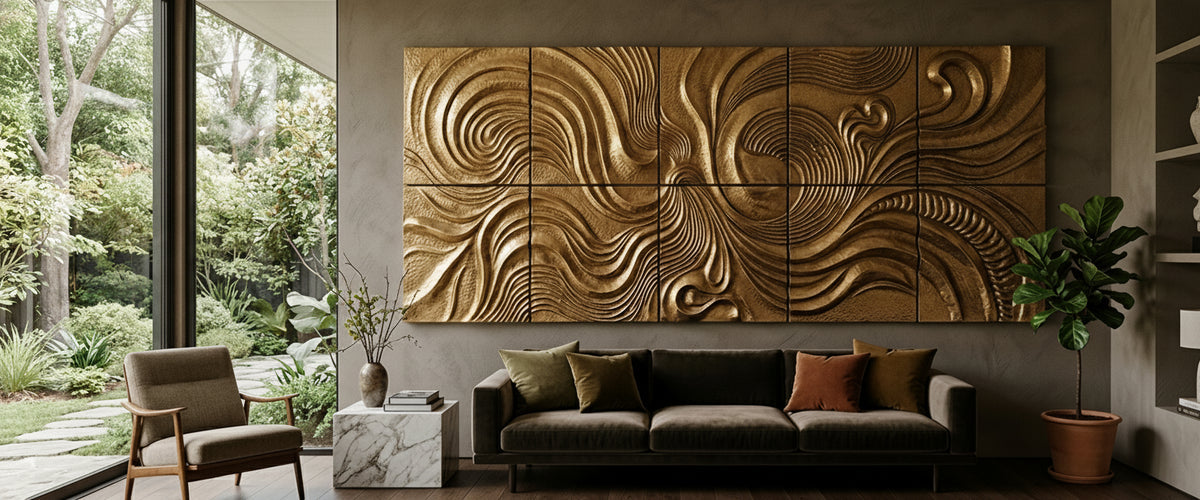

A blank double-height wall punishes timid art. We have seen it dozens of times in commission photos: a beautiful 24-inch panel marooned on a 16-foot wall, looking like a postage stamp on a packing crate. The wall is not the problem. The scale is. When a room calls for extra large wall work, half-measures read as a mistake the moment you walk in, and no amount of clever framing fixes an undersized piece.
Looking for the full range in this category? Browse our Wall Art and Wall Decor collection for every available finish, size, and configuration of extra large wall art.
So before you fall for a single image online, it helps to think the way we think when a client sends through their architect's elevations. Where does the eye land first? What height does the piece sit at? What is behind it, and what light hits it at 4pm? Get those right and an extra large wall piece looks inevitable.

Quick Answer: Sizing Extra Large Wall Art
Cover roughly two-thirds to three-quarters of the available wall width for a single statement piece. Anything smaller floats.
Center the visual weight near eye level for standing viewers, around 57 to 60 inches (145 to 152 cm) to the optical center, then adjust up for double-height walls.
Match the material to the room's light and humidity, especially near windows, fireplaces, or open-plan kitchens.
Plan the fixings before you buy. Extra large 3D wall art has real weight and needs the right anchors, not a single picture hook.
When nothing off the shelf fits, commission to the wall. That is what we do most often for tall or unusually proportioned spaces.

What Extra Large Wall Art Actually Looks Like in a Room
The phrase covers a wide span. At the gentler end, a single sculptural panel four or five feet across anchors a sofa wall. At the ambitious end, a multi-panel metal or carved-wood composition runs eight feet or more across a stairwell or a great room with a 20-foot ceiling. The intent is the same: one element that owns the wall instead of decorating it. This is exactly the role that good extra large wall art for living room schemes is meant to play.
Outdoors, the logic carries over. A weatherproof metal piece on a garden wall or a poured-concrete pool surround needs the same generosity of size, because open air swallows scale even faster than a tall interior. An extra large wall work that feels bold in the showroom can look modest against a hedge line or a wide stucco facade.
Texture is what separates an oversized statement piece from a flat print at this size. Relief and dimensional carving throw shadow that shifts through the day, which keeps a big surface alive rather than static. Where a wide expanse needs that kind of movement, a textured work such as Skriva Indigo Script Textured 3D Carving Wall Art reads differently at noon than at dusk, and that shift is a large part of why dimensional pieces hold a surface a flat canvas cannot.

Scale, Sightlines, and Mounting Height
Two numbers decide most of the outcome: how wide an extra large wall piece is relative to the wall, and how high its center sits relative to the viewer.
For width, a single work that covers about two-thirds to three-quarters of the usable expanse (the span left after you account for furniture and trim) almost always reads as intentional. If you want something smaller than that, group several units so the cluster hits the same footprint. Where a single panel cannot span the surface on its own, a three-panel set such as Alvarae 3-Panel Flowform Wood Carving 3D Wall Art earns its place precisely because the panels combine into one large gesture instead of three small ones competing.
For height, the museum convention puts the optical center of a work near 57 to 60 inches from the floor, the average standing eye level. That guidance comes straight from gallery hanging practice, and you can read the reasoning behind a fixed center line in the curatorial notes published by institutions like Tate. The catch: in a double-height room, slavishly following eye level leaves a huge empty band above the art. Lift the piece, or better, choose an extra large wall piece tall enough to bridge the gap.
If you are working over a fireplace or a long credenza, measure the sightline from your seated position too. A living room is mostly seen from the sofa, not standing. We have shipped pieces that were hung six inches too high because the client only checked them while standing during install, then felt they loomed once everyone sat down.

Indoor Versus Outdoor: When Each Wins
Indoors, you have controlled light, stable temperature, and no weather. That opens the door to carved wood, sandstone-finished relief, and delicate metalwork that would not survive a hot summer outside. For an interior surface where the finish stays dry and ages gracefully, a carved relief such as Arcuza Olive I Wood Carving Sandstone 3D Wall Art is the kind of material that belongs indoors rather than facing the elements.
Outdoors, the brief changes. UV, rain, salt air, and freeze-thaw cycles all attack materials, so the conversation shifts toward marine-grade stainless steel, powder-coated aluminum, Corten, or cast bronze. The American Institute for Conservation publishes useful guidance on how environmental exposure degrades different materials over time, and it is worth a read before you commit an expensive extra large wall piece to a coastal garden. We steer outdoor commissions toward engineered metalwork for exactly this reason: it takes the weather and keeps its line.
The decision often comes down to one question. Will the wall ever get wet, frosted, or baked? If yes, choose for the climate first and the look second. If no, the field is wide open.
Light, Backdrop, and Contrast
The most common reason an extra large wall piece underwhelms is not size; it is the surface behind it. Tone-on-tone kills relief work. A pale carved panel on pale plaster loses every shadow that gives it depth, and the result looks flat from across the room.
Aim for honest contrast between the piece and its backdrop. A warm metallic work, for instance Dynasty Golden Cliffs Acrylic 3D Wall Art, sings against a deep charcoal or forest-green wall and goes quiet against magnolia. Dark pieces need light grounds; light pieces need depth behind them.
Light direction matters as much as light level. Grazing light, where a fixture sits close to the wall and rakes across the surface at a shallow angle, exaggerates texture and is the single best trick for dimensional art. Flat front lighting, by contrast, washes the relief out. If you can add a picture light or an angled ceiling spot, do it. For browsing more dimensional options that reward this treatment, our 3D wall art collection is the place to start, and the broader metal wall art range covers the heavier statement end.
Placement Mistakes We See in Commissions
For wider placement ideas, Sandstone Art Panels That Redefine 3D Wall Decor is useful companion reading before finalizing the setting and sightlines.
A few errors come up again and again. None of them are hard to avoid once you know to look.
Buying for the photo, not the wall. An extra large wall piece that looks huge in a studio shot can be modest in a 20-foot room. Always map the dimensions onto your actual wall with painter's tape before ordering.
Ignoring furniture lines. A large work should relate to the sofa or console below it. Center it on the furniture, not just the wall, when the two do not line up.
Underestimating weight. Extra large 3D and metal pieces can run into tens of pounds. A single drywall hook will fail. Find the studs, or use proper toggle or anchor fixings rated well above the piece's weight.
Hanging too high in tall rooms. The instinct on a double-height wall is to push art upward to fill space. Resist it. Keep the visual anchor connected to the room people actually use.
Forgetting the 4pm light. A surface that looks neutral at 10am can flare with low afternoon sun. Check the piece at the time of day the room is most used.
How to Choose and Arrange, Step by Step
Here is the sequence we walk clients through when they ask how to pick living room wall art of any real scale, especially an extra large wall piece that has to carry the room.
Measure the usable wall. Width and height, minus furniture and trim. Note ceiling height.
Set the target footprint. Two-thirds to three-quarters of usable width for a single piece, or the same total span for a group.
Choose single or multi-panel. One bold work for a clean wall; a set when you want rhythm or need to bridge an awkward proportion.
Match material to environment. Wood and sandstone relief indoors; metal and weatherproof finishes anywhere damp or outside.
Pick a contrasting backdrop. Light piece on a deep wall, or vice versa.
Plan the fixings and the light. Confirm wall construction and add grazing light if you can.
Tape it out. Mark the outline, live with it for a day, then commit.
For a DIY arrangement, lay the pieces on the floor first and shuffle them until the grouping reads as one shape, then transfer that layout to the wall with paper templates. It saves a wall full of trial holes.
When to Commission Instead of Buy
Sometimes the wall simply does not have a match. The proportions are unusual, the ceiling is very high, or the room needs an extra large wall piece in a specific finish to tie into the architecture. That is when a bespoke commission earns its keep. As a bespoke sculpture supplier, Giant Sculptures builds large wall and freestanding work to the exact dimensions, material, and finish a space needs, including engineered metalwork for outdoor surfaces that has to last decades.
Pricing on oversized and bespoke extra large wall work depends on material, scale, structural engineering, finishing, and installation, so the honest answer is to send us the wall measurements and a photo and ask for a tailored quote. We would rather size the piece to the room than sell you something that almost fits.