




























































































You can tell within a second whether a metal fish sculpture is swimming or just hanging there. It is almost never about size, and it is rarely about price. It comes down to the tail line, the way the surface handles light, and how many bodies you put in the composition. Get those wrong and a seven-foot fish looks like signage. Get them right and a 15-inch piece on a console table still reads as a fish cutting through water.

Quick Answer: What Separates a Good Metal Fish Sculpture From a Flat One
Curved spine, always. A body with an S-line and a tail that breaks off the vertical suggests thrust. A straight, symmetrical fish is a diagram.
Surface decides the sparkle. Hammered or planished scales keep catching light as you walk; flat laser-cut plate goes still.
Odd numbers move better. Three fish at staggered heights outperform one solo piece in almost every room and garden we have installed.
Wall pieces need a shadow gap. Standoff mounting is what makes a metal sculpture wall hanging float instead of stick.
Outdoors, grade matters more than looks. Coastal salt punishes the wrong stainless and the wrong fixings.
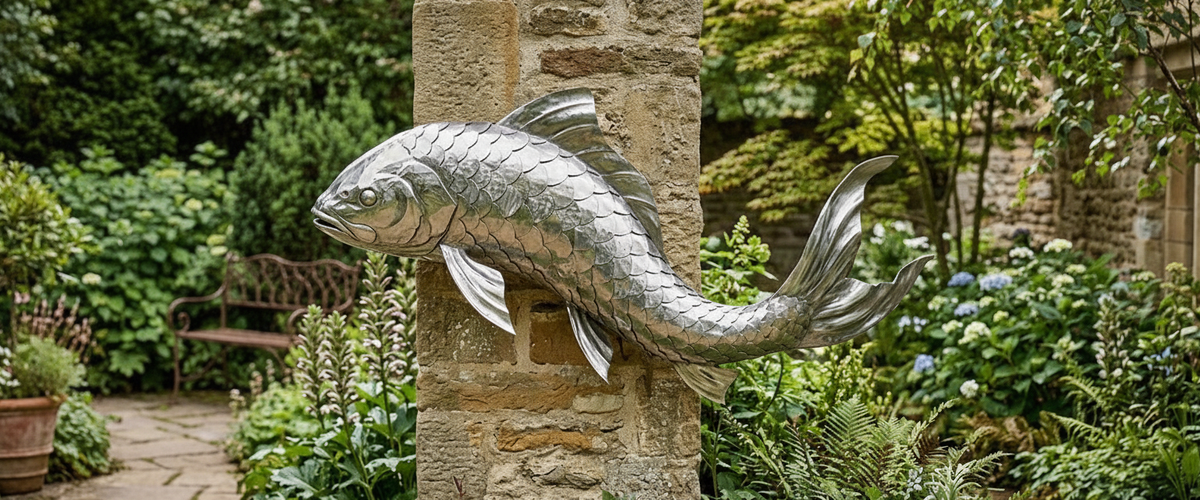
Hammered scales keep the highlight moving as you walk past the piece.
The Tail Line Decides It
Look at the tail before anything else. In a well-modeled fish the caudal fin sits off-axis, twisted a few degrees away from the body plane, as though the animal has just pushed water sideways. That single twist creates asymmetry, and asymmetry is what your eye reads as motion. A tail cut flat and square to the body kills the effect instantly, no matter how detailed the scales are.
The same rule governs the spine. A gentle S-curve through the body implies the next beat of the tail. Ascending pieces exaggerate this on purpose. Where the composition needs to climb rather than cruise, a form like the Aurefin Golden Ascend Koi Fish Sculpture - 160cm leans the whole body onto a diagonal, borrowing from the carp-climbing-the-waterfall tradition instead of sitting parallel to the floor. The tail angle is the first thing we redraw on a commissioned metal fish sculpture, and it is almost always the change that makes the drawing come alive.

Hammered Scales Versus Laser-Cut Plate
Two very different surfaces dominate the category. Hand-hammered or planished metal leaves thousands of shallow facets, so light skitters across the body as you move past it. Laser-cut or waterjet plate gives you crisp graphic edges and a calm, architectural read, but the highlight stays put. Neither is better. A hammered metal fish sculpture wants side light and movement around it; a cut-plate piece is happy under even, flat illumination.
Faceted, multi-panel bodies split the difference, which is why something on the scale of the multi-colour faceted hanging fish at about 7 feet 3 inches (220 cm) holds a double-height stairwell so well. Each plane picks up a slightly different value, so the form never flattens out under a single downlight. In a low-lit restaurant or a north-facing atrium, faceting is doing the work that lighting cannot.
Why Three Fish Out-Swim One Big Solo Piece
Clients usually ask for one large fish. We tend to come back proposing three at different heights. A single metal fish sculpture, however well made, gives the eye one stopping point. A shoal gives it a path: the eye enters at the lowest fish, climbs to the middle, and exits on the leader. That travel is the movement.
Stagger heights by unequal amounts, never evenly. Vary the fish sizes too, and rotate each body a few degrees so they are not all facing exactly the same way. A small polished group is an inexpensive way to test the principle at desk scale before you commit to a wall-sized commission. Framed pairs are the exception that works, because the frame itself acts as the third element and supplies the negative space the shoal needs.
Hanging a Metal Fish Sculpture Wall Piece Without Killing the Drift
A metal fish sculpture wall hanging lives or dies on three details: standoff depth, spacing rhythm and eye height. Mount the piece 1 to 2 inches (25 to 50 mm) off the plaster on hidden standoffs and the cast shadow becomes part of the artwork. Screw it flush and it turns into a plaque.
Uneven spacing and a shadow gap turn three bodies into a shoal rather than a row.
For spacing, avoid a grid. Cluster two fish closer together and push the third out further, so the group looks like it is spreading rather than parading. Center the visual mass slightly above standard picture height when the fish are ascending, because an upward composition wants headroom. If you would rather not make a dozen small judgment calls from the top of a ladder, a framed piece such as the Red Fish Pair in a Metal Frame Sculpture - 120cm arrives with the spacing decision already resolved inside the frame.

Pond Edges, Spike Mounts and the Small Sway
Outdoors, the best metal fish sculptures are not sitting in water. They are leaping out of it, mounted on a concealed spike or plate at the pond lip. On pond-edge installs we set the spikes into the coping stones and angle the tallest fish back over the water, and we deliberately spec the thinnest support rods with a little spring left in them. In a breeze they move perhaps half an inch. That tiny sway is what sells the whole illusion.
Specify hardware properly. Near coastal air, in the Hamptons or on the California coast, 316 stainless fixings are worth the upgrade over 304 because of their higher resistance to chloride pitting, a distinction the Nickel Institute covers in detail in its stainless grade guidance. Galvanized bolts in salt air will bleed rust stains down pale stone within a season.
Stainless Flash Against Copper Glow
Mirror-polished stainless throws hard, bright highlights and mirrors the sky, so it sings on clear days and can look cold under flat gray overcast. Copper, bronze and Corten do the opposite: they hold a warm internal glow in dull light and get richer as they patinate. For a Pacific Northwest garden or a Chicago courtyard that spends half the year under cloud, we normally steer buyers toward warm metals. For Texas and Arizona sun, polished stainless earns its keep.
Patina is a maintenance decision as much as an aesthetic one. Outdoor bronze needs periodic waxing to keep its protective layer intact; the Getty Conservation Institute publishes useful research on protective coatings for outdoor metal sculpture. Browse the broader metal sculptures range and you will see how differently the same metal fish sculpture reads once the alloy changes.

Where the Movement Dies
Flat frontal hanging in a low, narrow hallway is the most common failure we see. A corridor forces you to view the piece side-on at close range, so the profile is compressed and the shadow gap is invisible. Fish need approach distance and an oblique angle. Give them a stair void, a double-height wall, a pool house gable or a gallery landing.
Buyer Checklist
Is the tail twisted off the body plane, or square to it?
Will the piece be seen from an angle, or only head-on?
Hammered surface for sparkle, or cut plate for calm graphic lines?
Odd-numbered group with uneven spacing, or a single anchor form?
Standoff depth specified for the wall piece, plus a stud or masonry fixing plan?
Correct stainless grade and fixings for coastal or poolside chemistry?
Weight confirmed and structural backing checked before install day?
Commissioning a Bespoke Shoal
Most of the bespoke metal fish sculpture work we take on at Giant Sculptures starts with a wall or water feature that a stock piece cannot answer. Bespoke lets you set the swim direction, scale each body to the sightline and match the finish to existing metalwork. Budget depends on material, scale, surface treatment, engineering and installation, so the honest answer is to send us the wall dimensions, a photograph and your light conditions, and we will quote it properly. If you are still shaping the brief, the decorative sculptures collection is a good place to test which scale reads right before we start drawing.
For wider placement ideas, How to Hang Fish Sculpture Wall Art so the Shoal Actually Swims is useful companion reading before finalising the setting and sightlines.