





































































































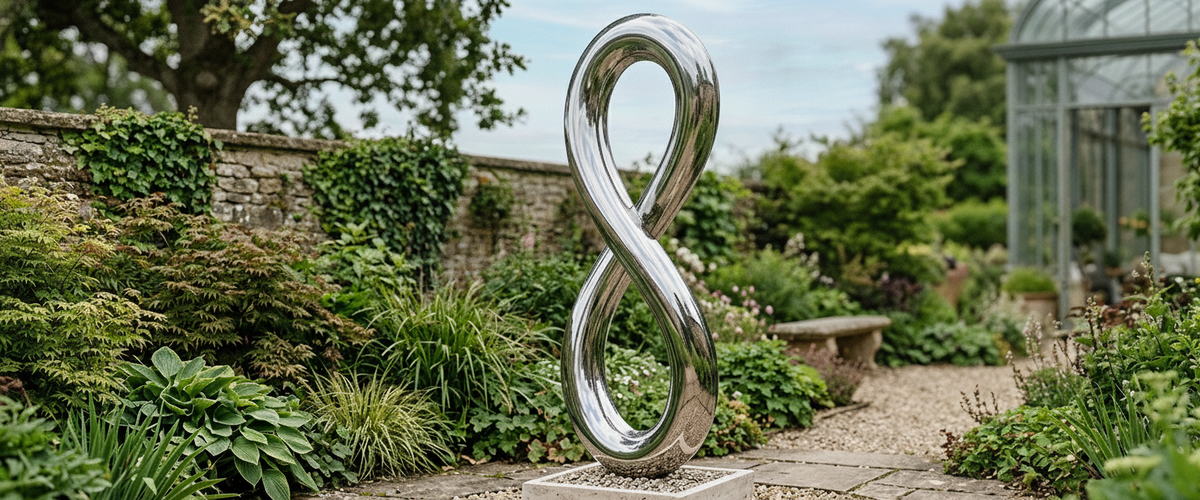

Squint at it until the detail disappears. That one move tells you more about an organic form sculpture than any product description will, and it takes about two seconds. A resolved curve holds its silhouette when you blur it, reading as a single continuous gesture. An unresolved one collapses into a lump with a few accidental dents. We run the squint test on every organic form sculpture maquette that crosses the studio before anything goes to fabrication, and it has killed more designs than any budget conversation ever has.

Key Takeaways
Blur the image first. If an organic form sculpture loses its outline when you squint, the shape was never properly worked.
Material dictates the curve. Ceramic, cast bronze and carved timber produce three unrelated families of shape.
Check for flat spots and seam lines. Mold-pulled pieces give themselves away on the inside of a curve.
Scale is not a slider. A design that charms at 12 inches (30 cm) often goes inert at 6 ft 6 in (2 m).
Test the bad angle. A good piece earns its keep from the view nobody photographed.
Why the Silhouette Is the Whole Argument
An organic form sculpture lives or dies on outline. Strip the surface finish away and you are left with edges, voids and the rhythm between them, which is exactly why the pierced and hollowed work of the mid-century modernists still reads from a hundred yards. The Henry Moore Foundation archive is a useful education here: the reclining forms were built so that the gaps carry as much weight as the mass.
The squint test in practice: the outline should still read as one continuous gesture.
When we assess a curve, we look for continuity of tension. Does the line accelerate and then release, or does it just meander? Run your eye along the top edge of any wave or wing form and you should be able to feel where it gathers speed before it turns. That acceleration is the difference between a designed wave and a decorative squiggle.

Ceramic, Cast Bronze and Carved Timber Give You Three Different Curves
Buyers tend to shop organic sculpture as a single look. It is not one look, because the making process draws the line for you.
Ceramic
A ceramic organic sculpture carries the hand. Coiled and thrown forms keep a faint asymmetry, and glaze pools in the hollows so the curve is described by color as much as by shape. The trade-off is scale and site: fired clay is brittle, shrinks in the kiln, and glaze can craze over decades. The Getty's conservation writing on ceramics care is worth reading before you commit a large ceramic piece to an exposed terrace.
Cast Bronze
Bronze lets an organic form sculpture go thin. Because the metal carries load, you can pull a form out into a cantilever that clay would never survive, then patinate it to hold a warm or near-black tone outdoors for generations. A cast wave form such as the Bronze Abstract Organic Wave Sculpture Brass - 91cm carries its crest out into open air at a section timber could not hold, and the top edge keeps its tension all the way through the turn. Casting also records every thumbprint from the clay original, which is why hand-modeled bronze reads softer than machine-formed steel.
Carved Timber and the Ethnicraft Look
Shoppers arriving from a search for an Ethnicraft natural organic sculpture are usually chasing a specific effect: solid teak or oak, sanded to a dry matte, the grain following the swell of the form. It is beautiful at tabletop size. Push carved timber past about 4 ft (1.2 m) outdoors and you inherit movement, checking and seasonal expansion, so for larger exterior commissions we usually steer clients toward metal that mimics the same softness.
Hand-Finished or Mold-Pulled? Look Inside the Curve
Photography flatters. A three-quarter hero shot hides the two places a lazy organic form sculpture always fails: the inside of a concave sweep and the point where two curves meet. Look for a faint ridge running the length of a bend, a slight dullness where filler was sanded, or a curve that suddenly goes straight for two inches before resuming.
On mirror-polished work, a seam ground flush is the only way the reflection stays unbroken.
On fabricated stainless work the tell is different. Formed steel panels are rolled, welded and then ground back, and a good workshop grinds and polishes across the seam so light travels uninterrupted. Choose a mirror finish like the one on the Molten Silver Organic Steel Sculpture at 155 cm (61 in) and any lapse shows instantly, because a reflective surface turns every flat spot into a visible kink in the reflected horizon. That unforgiving quality is exactly why we like polished steel for an organic form sculpture. It cannot lie.

The Scale Jump That Kills Them
This is the most expensive mistake in the category. A maquette at 12 inches (30 cm) is read as an object in the hand, so slight forms feel delicate and charming. Blow the same geometry up to 6 ft 6 in (2 m) and it goes inert: the wall thickness looks thin, the base looks apologetic, and the whole thing reads as a scaled photograph rather than a presence.
An organic form sculpture drawn for height behaves differently. Where a piece has to hold a long driveway or an open lawn, you want something designed for that distance from the start. The Molecular Silver Organic Steel Outdoor Sculpture at 226 cm (7 ft 5 in) uses clustered spheres and open voids so the mass stays legible against sky while the gaps keep it from turning into a monolith. When we enlarge a commission, we redraw rather than rescale: thicken sections, deepen the undercuts, and rebalance the footprint. A Napa client's courtyard piece went through three profile revisions between the tabletop model and the final 8 ft (2.4 m) build, and only the last one held its tension from the far end of the terrace.
Raking Indoor Light Versus Open Sky
Interior light is low and directional. It grazes across a curve and exposes surface quality, which suits matte and satin finishes; a hand-worked ruffled or pleated form gains depth in a hallway with side light because every fold throws its own shadow.
Open sky does the opposite. Diffuse overhead light flattens shallow modeling, which is why so many organic form sculptures that look commanding in a showroom go quiet in an open garden. Outdoors you want deeper undercuts, real voids, or a reflective finish that borrows contrast from the sky. Corten gives you a warm matte answer; polished stainless gives you a bright one. Browse the wider organic sculptures collection with that split in mind and the right candidates narrow fast.

Why a Good Organic Form Sculpture Needs a Bad Angle
Every piece has a hero view. The test of a genuine three-dimensional design is the awkward one: the view from the kitchen window, from the top of a staircase, from a car turning into the drive at an oblique angle. Ask for photographs from four sides plus above before you buy. A resolved form gives you a new composition from each position and never repeats itself. A relief-like design collapses to a thin profile the moment you step off axis, and clients notice that within a week of installation, not in the showroom.
Decisions We Lock Before a One-Off Goes to Fabrication
Viewing distance and primary sightline. Everything else follows from how far away the piece is normally seen.
Final height and footprint, with the profile redrawn for that size rather than uniformly enlarged.
Material and gauge, chosen against climate, coastal salt exposure and wind load.
Finish behavior, including how a polish, patina or coating will look in five and fifteen years.
Fixing method, whether that is a hidden plinth plate, a concrete footing or a pinned stone base.
Access and rigging, measured through gates, lifts and doorways before the first cut.
Maintenance expectations, agreed in writing so the owner knows what the surface needs annually.
Budget for a bespoke organic form sculpture depends on material, scale, structural engineering, finishing hours and installation, so the honest answer is a tailored quote rather than a headline figure. Giant Sculptures builds large-scale and bespoke work in bronze, stainless steel, Corten and stone for private gardens and commercial sites worldwide, and we are happy to review a site photograph and sightline before you commit to anything. If you are still comparing directions, the abstract sculptures collection is a good place to work out whether you want a soft biomorphic curve or something more geometric.
For wider placement ideas, Organic Sculpture: Why Some Curves Command a Room and Others Mumble is useful companion reading before finalising the setting and sightlines.