





































































































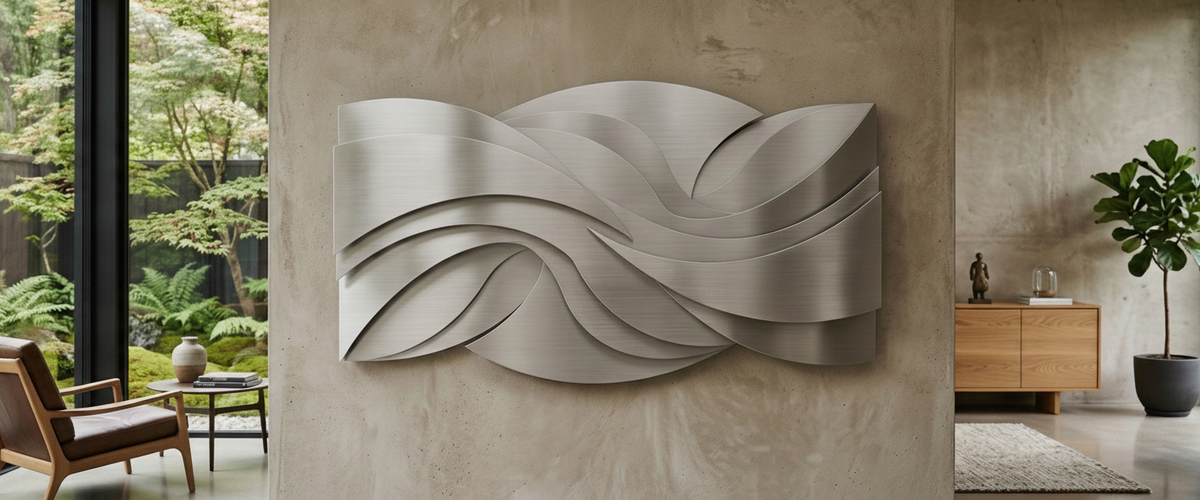

A mirror-polished panel looks magnificent under workshop lights and can turn into a bright gray smear by eleven in the morning. That is the single most expensive lesson buyers learn about 3D metal wall art, and it has nothing to do with the design. Relief work lives or dies on how the surface handles light, and the finish you pick decides whether a viewer reads every ripple and fold or just squints at a reflection of the window behind them.

Key Takeaways Before You Choose a Finish
Brushed steel is the detail-keeper. The directional grain scatters light, so shadow lines in the relief stay readable all day.
Mirror finish reflects the room opposite, not the sculpture. Audit that view before you commit.
Patinated and blackened surfaces are the most forgiving option on dark, textured or heavily patterned walls.
Sheet gauge matters more than finish. Thin panels ripple, and a mirror surface magnifies every wave.
Never judge a finish from a two-inch chip. Ask for a sample big enough to show grain direction and curvature.
Brushed Steel Holds Detail; Mirror Erases It by Lunchtime
Brushed stainless has a directional grain running across the surface. That grain diffuses incoming light, which means the raised sections of a relief still throw a soft shadow instead of blowing out into white glare. Stand in front of a brushed panel at three different times of day and the composition reads the same each time. The tone shifts; the drawing does not. That is why brushed 3D metal wall art still shows the same relief lines in an eight a.m. photograph and a six p.m. one, even as the color temperature changes.
Brushed grain diffuses daylight, so the shadow lines that describe the relief stay legible from morning to dusk.
Mirror polish behaves in the opposite way. It does not scatter light, it redirects it. Every curve becomes a lens pointed somewhere else in the room, so at certain angles the piece disappears into a bright field and the carefully modeled depth flattens out. Mirror work can be spectacular, but it needs indirect light, controlled sightlines and a client who genuinely wants a reflective object rather than a sculptural one. In a south-facing great room with unshaded glass, brushed wins almost every time.

Why a Patinated Panel Behaves Best on a Dark or Textured Wall
Put a bright metal relief on charcoal limewash or split-face stone and the two surfaces fight. The wall absorbs light, the metal throws it back, and the eye reads a floating cutout instead of an integrated piece. Patinated 3D metal wall art solves that, because the color sits inside the metal rather than on top of it, shifting from warm to deep as the surface undulates. Patina is a surface film formed as the metal reacts to air and applied chemistry, and it deepens with age; the Tate glossary on patina is a useful starting point if you want the technical background.
Dark-toned relief also gives you an escape route on busy walls. On textured plaster, a low-contrast layered panel like Panthra Shadow Black Acrylic Stripe 3D Wall Art holds together where a bright polished surface would fracture into highlights; the tonal range is compressed, so the form does the talking and the surface stays quiet. The same logic applies when we patinate bronze or blacken mild steel for a commission: reduce the contrast between wall and work, and the three-dimensional structure becomes the subject again.
Mirror Panels Borrow the Room Opposite Them
For wider placement ideas, Metal and Wood Wall Art: What a Sculptor Weighs Before Saying Yes is useful companion reading before finalising the setting and sightlines.
Before specifying any polished finish, go and stand where the sculpture will hang and turn around. Whatever is behind you is what the panel will show. We had a penthouse commission where a mirrored wave relief was destined for a hallway; the wall it faced held a utility door and a thermostat. We moved the piece eight feet down the corridor to face a stair void instead, and the entire brief changed for the better. Mirror-finished 3D metal wall art is collaborative. It needs something worth reflecting: a view, a stair, a fireplace, a good ceiling.
Sheet Gauge and Oil-Canning: The Question Nobody Asks
Oil-canning is the visible waviness in flat metal panels, and it is an inherent characteristic of formed sheet rather than a manufacturing defect, as the Metal Construction Association technical resources explain in a roofing and cladding context. The same physics governs wall art. Thin sheet stretched over a large area will ripple, and a mirror finish turns every ripple into a warped reflection you cannot unsee.
Heavier gauge, internal stiffeners and welded frame returns are what keep large 3D metal wall art genuinely flat. Brushed and patinated finishes hide a lot of minor movement; polished surfaces hide nothing. When a panel is heading past roughly 4 feet (1.2 m) in either direction, ask specifically about substrate thickness and back-bracing rather than accepting a general reassurance. Weight goes up, and so does the fixing spec, which is a conversation worth having before the piece is built rather than on delivery day.

3D Metal Wall Art for Living Room Walls: The Daily Reality
Living rooms are the hardest brief because people touch things. Mirror polish records fingerprints instantly and needs a microfiber cloth on hand. Brushed stainless is far more forgiving as long as you wipe with the grain, not across it. Blackened and patinated surfaces are the most relaxed of all; a coated bronze patina simply gets a dust and an occasional wax. Maintenance is what separates showroom-pretty from workable 3D metal wall art for living room use.
Patinated and blackened surfaces are the least demanding to live with in a room that gets daily use.
Then there is the ledge problem. Deep relief creates horizontal shelves that collect dust, and a piece with dozens of layered elements will need a soft brush every few weeks. Construction with open air between the layers, as in Aurelian Butterfly Display Acrylic 3D Wall Art, sheds dust far better than tight closed steps that trap it on every ledge. If the room sits above a busy street or a wood-burning stove, factor that in. Browse the wider 3D wall art collection with cleaning access in mind, not just composition.
Copper, Bronze and Blackened Steel Against Timber or Plaster
Metal color needs to argue slightly with the wall behind it, not match it. Warm walnut paneling and copper are close cousins, and hung together they can turn muddy; blackened steel or a cool graphite patina gives that timber something to push against. Cool gray plaster does the reverse, and it is where copper, bronze and warm brass finishes come alive. On a recent project with white-plaster walls and pale oak floors, we specified a bronze-toned relief because the room had no warm anchor at eye level. It fixed the whole elevation.
Where a warm timber wall needs a cool counterpoint and blackened steel would read too severe, a saturated cool panel such as Panthra Cobalt Blue Acrylic Stripe 3D Wall Art is closer to the right design language. Natural fiber wallpapers and grasscloth are their own case. Fine brushed grain competes with the weave, so a bolder relief with fewer, deeper planes usually reads better. You can see the range of surface treatments across our metal wall art collection, and if a client wants a specific patina depth, we develop it as a bespoke commission.

How to Ask a Studio for a Finish Sample Worth Judging
Samples are the cheapest insurance in the process. Before approving 3D metal wall art in any surface treatment, ask for the following:
Ask for at least 6 by 6 inches (150 by 150 mm). A thumbnail chip tells you the color and nothing about how the grain behaves.
Request a curved or folded sample if the piece has curved elements. Flat samples lie about how light rolls over a bend.
Specify grain direction on brushed finishes so the sample matches the panel orientation.
View it on the actual wall, taped in place, at morning, midday and lamp-lit evening.
Ask what the protective coating is and whether it changes the tone. Lacquered patina reads darker than raw patina.
Check touch-up and repair options for the finish before you buy, especially in high-traffic hallways.
Commissioning Larger Work
Scale changes the finish conversation entirely. A 2-foot (600 mm) panel forgives almost anything; a 10-foot (3 m) relief spanning a double-height wall will show every inconsistency in polish and every weld shadow. That is where engineering, hanging systems and finishing labor start driving the cost of a piece, which is why budgets for bespoke 3D metal wall art depend on material, size, depth of relief, structural backing and installation rather than any fixed rate. Send us the wall dimensions, a photo of the opposite view and the light conditions, and we will quote against the actual room. Our team at Giant Sculptures builds large-format work to order, and the finish is always the first decision we lock down, not the last.