





































































































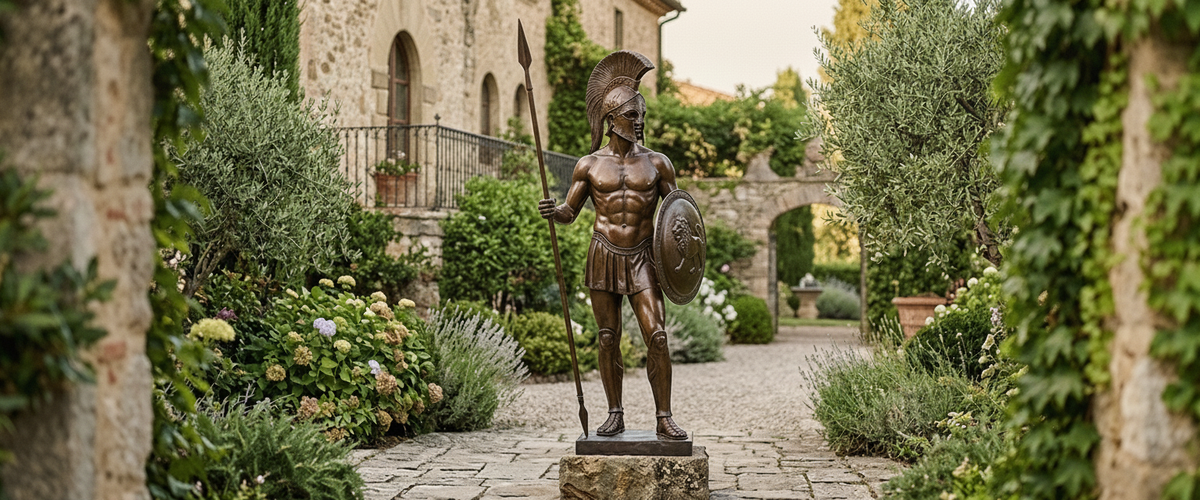

Stand in front of a good Greek athlete in marble and your eye keeps rechecking the proportions, as if hunting for the trick. There isn't one. The classical ideal of sculpture is a system rather than a style label: balanced weight through the hips, controlled anatomy, a calm face, and a figure built to be read from every angle instead of one flattering front. Buyers who ask us for "something classical" usually want something far more specific than they first realize, and the difference between a piece that holds a courtyard for fifty years and one that reads as costume drama comes down to decisions made before a single mold is built.

At a Glance
What it is: the classical ideal of sculpture is an approach to the human figure based on measured proportion, contrapposto weight shift, idealized anatomy and restrained emotion.
Who it suits: formal gardens, hotel lobbies, estate entrances, wineries, private collections and any site that wants permanence rather than trend.
Best materials: cast bronze for outdoor life and fine detail; carved marble or limestone for weight and light; stone composites only for sheltered interiors.
Scale rule of thumb: outdoor figures usually need to reach at least 6 ft (183 cm) before they stop looking like garden ornaments.
Budget: driven by size, material, modeling complexity, base engineering, finishing and installation, so a tailored quote beats any published guess.
What the Classical Ideal of Sculpture Actually Means
The classical ideal of sculpture grew out of fifth-century BCE Athens, when sculptors stopped making stiff frontal figures and started making bodies that stand the way people actually stand. One leg carries the weight, the opposite hip rises, the shoulders counter-rotate, and the whole figure settles into a quiet S-curve. That single move, contrapposto, is the engine of the entire tradition. Add canonical proportion systems, smoothed musculature that suggests an athlete at rest, and a face that refuses to shout, and you have the vocabulary that Rome copied, the Renaissance revived and neoclassical Europe standardized.
Two corrections worth carrying into a purchase. First, the classical ideal style of sculpture by the Greeks was never the pale white marble we picture; surviving pigment traces show these figures were painted, gilded and fitted with metal attachments, as the British Museum's Parthenon sculptures galleries make clear. Second, much of what we call Greek is Roman marble copied from lost Greek bronze. That matters commercially, because bronze was the original medium for many of these poses, and bronze is still the material that handles them best at scale.
Who is it for? Clients who want a piece to feel inevitable rather than fashionable. A classical figure at the head of an allee, a pair of lions flanking a drive, a bust in a paneled study: these read as settled the day they arrive. If your site is aggressively minimal glass and steel, a classical figure can still work, but it needs to be handled as a deliberate counterpoint, usually with a simpler base and a darker patina.
Materials, Finishes and the Honest Trade-Offs
Bronze is the default for a reason. Cast in a lost-wax foundry, it holds crisp anatomy, tolerates freeze-thaw cycles, survives coastal salt with sensible care, and can be patinated anywhere from near-black through chocolate brown to verdigris green. A patina is a controlled chemical finish, not paint, and it will keep moving unless it is protected. Our studio recommends a hot wax at installation and a maintenance wax roughly twice a year in exposed sites. The Smithsonian's Save Outdoor Sculpture survey work is a useful reminder of what skipped maintenance looks like after a couple of decades outdoors.
Marble gives you something bronze cannot: translucency. Light sinks a few millimeters into the surface and comes back softer, which is why classical drapery and skin read so convincingly in stone. The trade-offs are real. Marble is vulnerable to acid rain and pollution, it stains, and thin elements such as extended arms or spears need engineering support. In hard-freeze regions like Aspen or upstate New York we generally steer clients toward bronze outdoors and save marble for atriums, orangeries and covered loggias.
Finish choice does as much work as material. A high-polish bronze reads contemporary and reflective; a mid-brown patina with a lightly rubbed highlight on the raised anatomy reads traditional and shows the modeling. When you are pricing the classical ideal of sculpture in metal, ask to see finish samples on curved surfaces rather than flat plates, because a patina behaves differently across a shoulder than it does on a flat sample.

Scale: The Decision Most Buyers Get Wrong
Undersizing is the single most common mistake we see. A 4 ft (122 cm) figure that looked substantial in a studio photograph disappears against a 30 ft (9 m) hedge line or a double-height lobby wall. Outdoors, sky and planting swallow mass. A useful test: stand at the main viewing point, work out how much of the backdrop you want the piece to occupy from there, then mock it up on site with a cardboard cutout or a stack of boxes before you sign anything off.
For open ground, life-size and above is where the classical ideal of sculpture starts to hold its own. Where the sightline runs long, a figure on the order of the Life-Size Classical Greek Warrior Bronze Statue - 250cm reaches roughly 8 ft 2 in before its base, which is usually the right order of magnitude for a lawn terminus or a driveway island. Add a plinth and you gain both height and the visual formality of a proper pedestal.
Interiors flip the logic. In a study, hallway or reception desk zone, a bust does more than a small full figure ever will, because the head is where the classical tradition packs its detail. Where floor space is the constraint rather than budget, a console-height piece such as the Classical Female Bust Bronze Bust - 70cm puts the proportion language at eye level without asking the room to give up circulation. Browse more head-and-shoulder options in our bronze busts and heads collection if that is the direction your room wants.
Where to Place a Classical Sculpture for Real Impact
For wider placement ideas, Large Life Size Statues: How Scale and Placement Decide Whether a Piece Lands is useful companion reading before finalising the setting and sightlines.
Figures built on the classical ideal of sculpture were designed for axial landscapes, so they reward formal geometry. The placements that work share a pattern: the piece terminates a view, marks a threshold or anchors a symmetry.
End of an axis: the far point of a lawn, pool or gravel walk. The figure becomes the reason the axis exists.
Gate and entry pairs: matched pieces flanking a drive or steps. Where a standing figure would compete with the architecture, a seated animal pair such as the Large Classical Seated Lion Pair Bronze Sculpture - 130cm holds the threshold instead of fighting it, which is why they turn up so often on ranch entrances and winery approaches.
Water: reflection doubles the piece and lengthens the read. Pool ends, rills and formal ponds suit figures with movement in the silhouette.
Courtyards and light wells: raking side light across a torso is where idealized anatomy earns its keep. Avoid flat overhead light.
Lobbies and stair landings: a single figure on a half-landing gives arriving guests a reason to look up.
One practical note from a Hamptons project: the client set a bronze figure dead center on a lawn, and it looked stranded until we moved it 12 ft (3.7 m) closer to a hedge backdrop. Classical figures want something behind them. Dark yew, a stone wall, a clipped hornbeam screen; anything that stops the silhouette from dissolving into open sky.
Budget, Commissioning and Delivery
Budget for a commission in the classical ideal of sculpture is driven by scale, material, the complexity of the modeling, base and armature engineering, finishing time, crating and site installation. A seated figure with tight limbs prices differently from a striding figure with extended arms and a spear, even at the same height. Rather than guess at a band, ask for a tailored quote with the site conditions attached; we would rather price a real project than a hypothetical one.
A typical bespoke path in our studio runs like this. Reference gathering and a scale study, then a clay maquette for approval, then full-size modeling, mold making, casting, chasing and welding of sections, patina, wax, crating, freight and installation. Approving the maquette is the point where buyers should be most demanding. Check the head angle against the intended eye-line, because a figure modeled level and then set on a 3 ft (91 cm) plinth will read as staring past the viewer.
Delivery for monumental work is its own project. Anything above roughly 10 ft (305 cm) generally travels in sections, needs crane or telehandler access, and requires a foundation with a bolt pattern set before the piece arrives. At the 400 cm end of our monumental range, a survey of gate widths, turning circles and ground bearing capacity happens weeks before the truck is booked.

Buyer's Checklist Before You Commit
Mock up the height and footprint on site, at the actual viewing distance, in daylight and after dark.
Confirm the backdrop. Silhouette against sky is the fastest way to lose detail.
Choose material by climate first, taste second. Freeze-thaw and salt air rule out some stone options.
See patina or finish samples on curved metal, not flat plates.
Approve the maquette against the final eye-line, including plinth height.
Specify the base: material, drainage, bolt pattern and whether it is set in a footing.
Plan access early. Gate widths, overhead cables, soft ground and crane positions.
Agree a care routine in writing: wash schedule, wax frequency, who does it.
Ask about lighting. Two low-level uplights at 45 degrees usually beat one flood.
Keep the mold and model details on record for future repair or a matching pair.
How Giant Sculptures Handles Classical Commissions
Giant Sculptures works as a bespoke sculpture supplier specializing in large-scale, long-life pieces, and classical work sits at the center of that. We can supply directly from our classic sculptures range, scale an existing model up or down, or model something entirely new from your references. Where a client wants a matched pair, an extended arm re-posed, or a patina tuned to a specific stone facade, that is a modeling and finishing conversation, not an off-the-shelf one.
Most classical commissions we ship end up in bronze, which is why our bronze figures and statues collection is the best place to gauge pose, mass and finish before a call. Bring us the site photographs, the sightlines, the climate and the access constraints. The classical ideal of sculpture rewards buyers who plan the setting as carefully as the figure, and a piece specified properly will still be doing its job long after the planting around it has been replaced twice.