





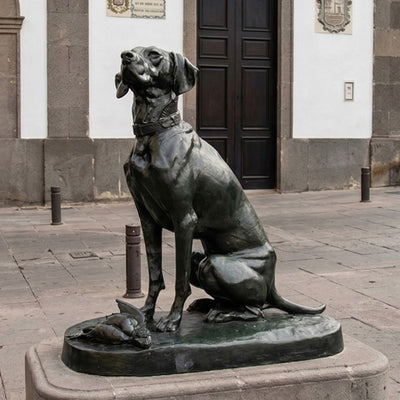






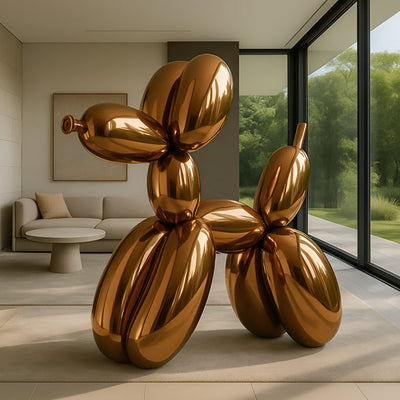














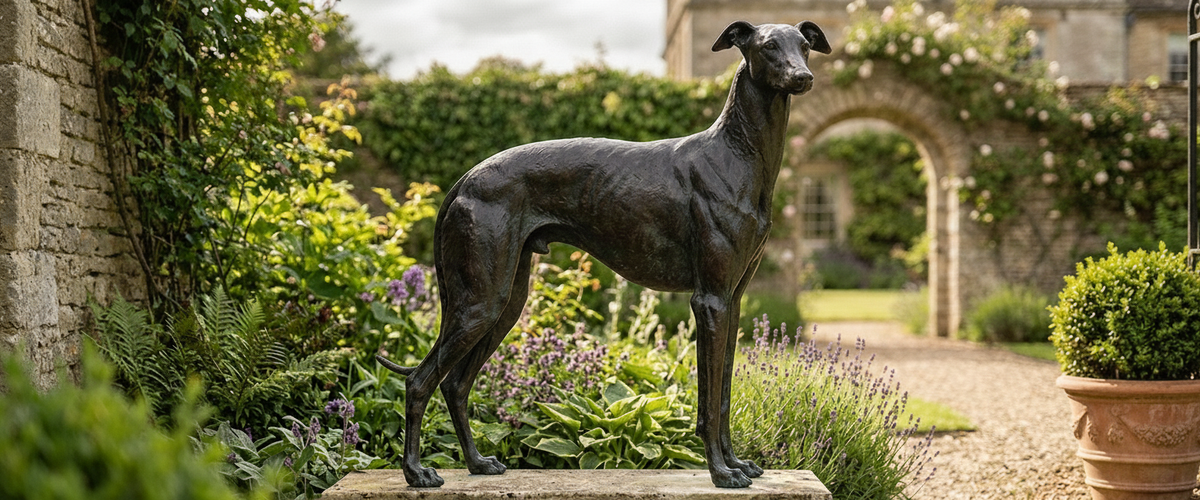

A greyhound is mostly outline. There is no thick coat, no heavy mane, no decorative flourish to distract the eye, so a bronze greyhound sculpture shows every decision made in the wax and every shortcut taken in the mould. Stand a good one next to a tired one and you do not need a trained eye to tell them apart. The good one has tension in the loin and a leg that looks like it could carry weight. The tired one looks like a dog-shaped balloon.

Key Takeaways Before You Buy
Pose sets the difficulty. Seated and recumbent hounds are forgiving; a coursing or standing bronze greyhound sculpture puts everything on the line work.
Check the ribs, haunch and hock tendon first. These are the details that go soft when a mould has been pulled too many times.
Patina changes the read. Dark chocolate tightens a lean form; green verdigris softens and ages it.
Ankles and base mass decide longevity outdoors. Thin-legged bronzes fail at the joint, not the body.
Greyhound bronze sculpture price tracks wall thickness, chasing hours and edition size far more than it tracks height.
Why a Bronze Greyhound Sculpture Forgives No Shortcut in the Mould
Most animal bronzes carry a margin for error. A lion has a mane, a bear has bulk, a horse has enough mass that a slightly blurred fetlock passes unnoticed. A sighthound has none of that. The whole appeal of the breed is the compressed chest, the deep tuck, the arched loin and the long spare limbs, which means the silhouette carries the entire sculpture.
In lost-wax casting, that outline survives only if the wax is chased properly before investment and the metal is chased again after the pour. The Metropolitan Museum of Art's account of bronze statuary technique sets out how many separate stages sit between the sculptor's model and the finished bronze, and each one is a chance to lose definition. Silicone moulds degrade with use. On a heavily reproduced hound, the twentieth pull looks noticeably duller than the second, and the loss always shows in the same places.
Standing, Seated or Coursing: The Three Poses That Survive Close Inspection
Seated is the safest and the most architectural. A seated hound reads as a guardian, sits square on a plinth and puts almost no bending load on the legs, which is why a classical seated pair at around 39 inches (100 cm) works so reliably on gateposts and at the head of steps. Where an entrance needs stillness rather than movement, a piece like the Classical Seated Greyhound Pair Bronze Sculpture - 100cm is the pose most buyers regret least, because it survives being seen from behind, from below and from thirty feet away.
A seated pair holds an entrance because it reads cleanly from the drive, from below and from behind.
Recumbent is the quietest option and suits terraces, pool surrounds and interior thresholds where a standing figure would feel like an obstacle. A reclining pair at roughly 24 inches (60 cm) sits low enough to read as furniture-scale company rather than statuary.
Standing and coursing poses are the hardest and the most rewarding. Weight has to look distributed, the head has to carry alertness, and a raised paw or extended stride must not look pinned in place. Where the setting needs a contemporary reading rather than classical weight, the Life-Size Contemporary Greyhound Bronze Sculpture - 100cm, pared back to essential planes, is closer to the right design language for a modern courtyard, but only if the line from occiput to tail tip has a single continuous rhythm. Ask for a profile photograph against a plain background before you commit. Any weakness in the outline shows immediately.

Ribs, Haunch and Tendon: The First Details to Go Soft
When we assess a hound in the studio we look at four places in order. The last two or three ribs, where they should break the surface without turning into corrugation. The point of the hip and the sweep of the haunch, which should have a hollow behind it, not a smooth pillow. The hock tendon, which on a real sighthound stands proud like a cable. And the skull, where the occipital bump and the shallow cheek separate a greyhound from a generic dog.
Ribs, haunch hollow and hock tendon are the first areas to blur when a mould is tired.
Softness in those areas is the reliable tell of a fatigued mould or rushed chasing. Run a hand along the flank. You should feel the transitions, not just see them. On a traditional single hound at 80 cm, roughly 31 inches high, that muscle definition is what carries the piece at close range on a hallway console or a garden pedestal.
Dark Chocolate Patina Against Verdigris on a Lean Form
Patina is chemistry, not paint, and it changes how much of the anatomy you actually see. A dark chocolate brown with a light rub on the high points is the traditional choice for a reason: it deepens the shadow in the tuck and under the ribs, making a lean form read leaner. Green verdigris does the opposite. It scatters light, softens the outline and makes the hound feel older and more settled, which suits a walled garden or a weathered stone terrace better than a glass-fronted modern build.
Outdoors, the patina on a bronze greyhound sculpture keeps moving. Rain, salt air and pollutants all shift the surface over time, and the Smithsonian Museum Conservation Institute's guidance on caring for outdoor bronze sculpture makes the case for regular washing and a maintained wax coat rather than occasional heavy intervention. Twice a year, warm water and a soft brush, dry it, then a thin coat of microcrystalline wax buffed by hand. Coastal sites need it more often. We shipped a pair to a Napa driveway where irrigation spray was hitting one hound and not the other; within two seasons the difference in surface was obvious, and it took a full re-wax to bring them back into agreement.
Ankle Joints and Base Weight: Where Thin-Legged Bronzes Actually Fail
Bodies rarely fail. Ankles do. On a standing hound, the entire mass funnels into pasterns barely thicker than a wrist, and a lawnmower knock, a leaning teenager or a Texas storm gust finds that weak point. Good foundry practice runs a stainless steel armature or threaded rod up through each supporting leg and into the body, then anchors it into the base plate rather than just into the plinth surface.
Ask three questions before you buy any standing bronze greyhound sculpture on slim legs: what is the internal armature made of, how does the piece fix down, and what is the base weight? Stainless internal fixings avoid the galvanic issues you get when mild steel corrodes inside a bronze and swells. For freestanding lawn placement, a bronze needs either a substantial concealed footing or a stone plinth with cast-in anchor bolts. With a standing pair such as the Life-Size Traditional Pair of Greyhounds Bronze Sculpture - 90cm at around 35 inches tall, that fixing detail matters more than the height, because a pair is usually placed where people walk past within arm's reach.

Pairs on Gateposts, Singles on Lawns, and the Sightline That Makes It Work
Greyhounds are one of the few subjects that genuinely improve in pairs. Symmetry suits them, and two hounds facing slightly inward frame an entrance in a way one never can. Standard placements that keep working: matched pairs on gate piers, flanking a stone stair, or bookending a pool terrace. Keep the piers wide enough that the base is not overhanging, and set the heads at or just below eye level from the approach path.
A single hound needs a different logic. It should sit on a sightline, not in the middle of open lawn. The end of a hedge walk, the turn of a gravel drive, the point where a Hamptons lawn drops to a lower terrace: all places where the eye is already traveling. Face the hound along the line of movement rather than square to the house, and the piece stops looking like an ornament placed on grass. For interiors, a recumbent or seated hound at hearth height beside a fireplace holds a room without crowding it. The wider bronze animal sculptures range is a useful way to see how different poses behave at different heights.
What Greyhound Bronze Sculpture Price Is Actually Telling You
Height is the least useful thing to compare when you are pricing a bronze greyhound sculpture. Two hounds of the same size can differ enormously in cost, and the difference sits in four places: wall thickness of the casting, hours spent chasing the surface, whether the patina was applied hot by hand or sprayed cold, and edition size. A thicker wall means more bronze and more weight but far better resistance to knocks. Long chasing hours mean crisp ribs and clean seams. A small numbered edition means a fresher mould and better definition. Large open editions spread the tooling cost thin, and the surface usually shows it.
Because those variables move independently, we quote per commission rather than publishing a band. Budget depends on scale, alloy, complexity of pose, internal engineering, base and plinth specification, finishing and installation. If someone quotes a headline figure without asking where the piece is going, they are guessing.
A Ten-Point Check Before You Commit
Ask for a clean profile shot against a plain background.
Zoom in on the last three ribs and the hock tendon.
Check the skull shape reads as a sighthound, not a generic hound.
Confirm bronze alloy, not brass or coated composite.
Ask the wall thickness and approximate weight in pounds (and kilograms).
Confirm the internal armature material and how it ties into the base.
Ask how the patina was applied and how to maintain it.
Confirm fixing method: bolt-down plate, dowel, or concealed footing.
Ask the edition size or whether the mould is newly made.
Check the plinth height against the viewing distance before ordering.

Commissioning a Bronze Greyhound Sculpture at Your Own Scale
Catalog sizes solve most situations, but not all. Gate piers are rarely standard, and a hound sized for a 39 inch (100 cm) pier looks undersized on a 5 foot (1.5 m) one. A bespoke commission lets you set the height, adjust the head turn so the pair look at each other correctly across your specific gate width, and match the patina to existing stone or metalwork on site. Giant Sculptures works from your photographs, elevations and sightlines, and larger-than-life scaling is usually the single change that makes an entrance feel resolved.
If you want the pose to reference a specific dog, whether a retired racer or a family whippet, send photographs from four angles plus a shot of the animal standing naturally. The head is where owners spot a likeness or fail to, so that is where the sculptor spends the time. Start with the bronze garden statues collection to fix a direction, then talk to us about scale.
For wider placement ideas, Pounds Before Inches: Buying a Life Size Bronze Statue Without Surprises is useful companion reading before finalising the setting and sightlines.