





































































































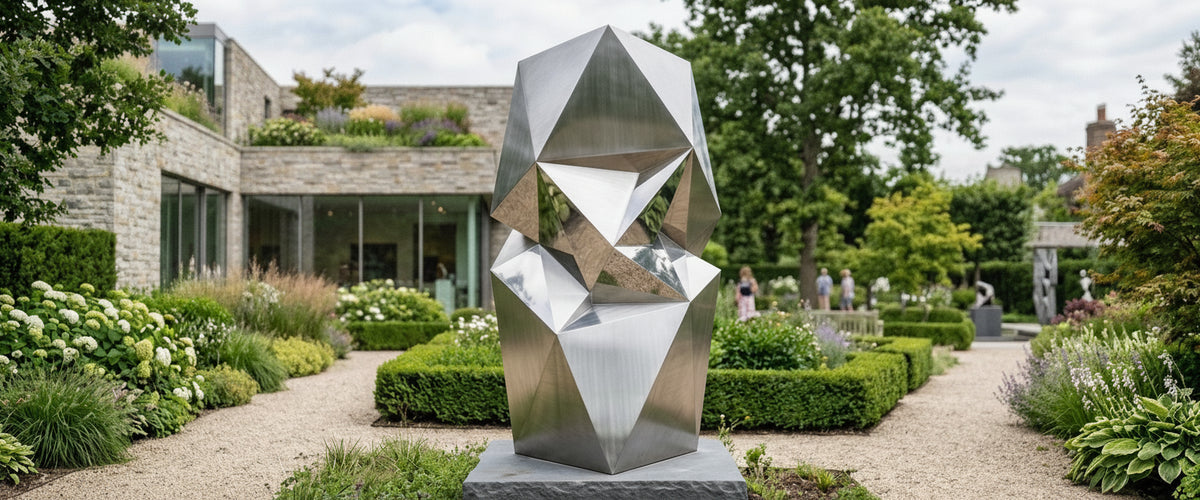

A geometric metal sculpture can look effortless on a screen and completely wrong on a wall. The faceted planes that read as sharp and confident in a render can flatten out under real light, or throw hard shadows that fight the piece instead of flattering it. The best geometric metal work solves those problems before anyone cuts a single panel, and that is the part buyers rarely see.
We build a lot of these at Giant Sculptures, both wall pieces and freestanding forms, and the finished object is only the last five percent of the story. What follows is how the decisions actually get made with the best geometric metal pieces, and what to press us (or any studio) on before you sign off.

Key Takeaways
- The best geometric metal pieces are engineered for a specific viewing distance and light source, not designed in the abstract.
- Material choice (bronze, stainless steel, Corten) drives finish, weight, cost, and how the surface ages.
- Scale is the most common buyer mistake: a form that sings at 10 ft can look thin or clumsy at 30.
- A serious studio works maquette to sample to fabrication to install, and shares each stage.
- Budget depends on material, scale, complexity, engineering, and finishing. Ask for a tailored quote rather than a headline number.

What Sculptors Actually Weigh Before Taking on a Geometric Metal Commission
The first questions are dull, and they matter enormously. Where does the piece live? What is the primary viewing distance? Is it lit by daylight that moves through the day, or fixed gallery light, or nothing after dark? A faceted form is a machine for catching and breaking light. If we do not know how the light behaves, the best geometric metal design in the world is still a guess.
Then comes orientation. A panel reads completely differently when its planes tilt toward a low western sun than when it faces flat north light. This is the heart of good geometric sculpture decor: matching the object to the room rather than the other way round. Where a wall needs a reflective circular piece that plays with light rather than fires it straight back into the room, something like the Orbitra Bronze Reflective Circular 3D Wall Art earns its place through facet depth as much as finish. We had a piece close in spirit that a client wanted opposite a west-facing window. At certain hours it turned into a glare bomb. The fix was not a new sculpture; it was rotating the mounting and adjusting the facet depth so the reflections raked across the surface instead of firing straight back at the room.
We also think hard about the wall or the ground the piece has to work against. Angular metalwork wants a plain backdrop. Put even the best geometric metal form on a busy stone wall or a fussy patterned interior and the eye cannot separate the object from the noise behind it. Good studios will tell you this before you buy, not after.

Craft Decisions That Change the Final Result (and the Price)
Material is the biggest lever behind the best geometric metal outcomes. Each metal has a personality, and choosing well is more than a taste question.
Stainless steel gives you crisp edges, a cool modern read, and finishes that range from mirror-bright to soft brushed satin. It is the natural home for sharp geometric sculpture home decor, and it holds up outdoors with minimal fuss. Where the setting needs quiet clarity of edge rather than warmth, the Contemplative Silver Geometric Steel Sculpture at 130cm shows how far that stainless language can carry on its own.
Bronze brings warmth and depth. A patinated bronze facet catches light differently from steel; it glows rather than flashes. Bronze also carries centuries of proven outdoor durability, which is why so much public sculpture is cast in it. The Getty's conservation notes on outdoor bronze are a good primer on how patina and protective coatings actually behave over time (Getty Conservation Institute).
Corten (weathering steel) gives you that rust-orange skin and heavy, grounded presence. It suits large garden work and reads beautifully against greenery. It is not for every setting; the surface stains what sits beneath it in the first year or two, so the best geometric metal choice here depends on the ground it stands over.
Finish is the second lever. Mirror polish shows every weld and every fingerprint, so it demands more fabrication hours. Brushed and bead-blasted finishes hide more and age more gracefully. A gold or brass-toned surface changes the whole temperature of a room, warm and a little theatrical rather than cool and architectural; the Dynamo Gold Geometric Steel Sculpture at 104cm is the clearest example of how that shift reads across a space.
Then there is internal structure. Faceted forms are hollow more often than not, and the hidden armature decides whether the piece survives a decade of thermal movement and, if outdoors, wind load. That engineering is invisible in the price but very present in it, and it separates the best geometric metal builds from the ones that fail early.

Why Some Pieces Read Right at 10 ft and Wrong at 30
This is the mistake I see most. A buyer falls for a maquette or a small piece on a plinth, then scales it up for a driveway or a double-height lobby and the magic drains out of it.
Facet density is the reason. A form with lots of small planes looks intricate and jewel-like up close, but from across a lawn those facets blur into a single gray mass. A form built from fewer, bolder planes can look blunt on a desk yet commanding at 30 ft (roughly 9 m). The best geometric metal answer depends entirely on how far away most people will stand.
Edge weight matters too. Thin edges that look elegant at arm's length disappear at distance; the piece looks flimsy. For a monumental figure like the Monumental Contemporary Geometric Sprinting Figure Bronze Sculpture - 260cm at 260cm (about 8.5 ft), the faceting has to carry across a courtyard, so the planes are deliberately larger and the silhouette does most of the work.
Ask any studio to show you the best geometric metal piece at your actual viewing distance, either as a scaled render placed in your space or a physical sample. If they cannot, that is worth noting.
Studio Process: Maquette, Sample, Fabrication, Install
A proper commission for the best geometric metal work runs in stages, and each stage exists to catch a problem before it becomes expensive.
- Maquette. A scale model, physical or digital, that lets you judge proportion and silhouette in three dimensions. Screens flatten geometry; a maquette does not.
- Material sample. A small finished panel in your chosen metal and finish. This is where you approve the exact patina, polish, or weathered tone under your own light. Colors and reflectivity shift between studio and site.
- Fabrication. Cutting, forming, welding, and finishing the full piece. For metalwork this is where structural standards matter; the American Institute of Steel Construction publishes the engineering benchmarks that serious fabricators build to (AISC).
- Install. Delivery, rigging, mounting, and final adjustment on site. Large pieces are heavy and awkward, and the mounting detail is as important as the sculpture. A wall piece that is beautifully made but poorly anchored is a liability.
We share each stage deliberately, because the best geometric metal commissions are the ones you can check as they grow. A commission that jumps straight from a quote to a finished object, with nothing to approve in between, is a commission you are trusting on faith.
Honest Red Flags to Ask About Before You Commit
Buyers rarely know what to probe, so here is a short list that separates a considered maker of the best geometric metal work from a drop-shipper.
- "What is the internal structure?" If the answer is vague, the engineering may be too.
- "How does this finish age outdoors?" A good studio will tell you honestly, including the awkward parts, like Corten staining or mirror polish showing water spotting.
- "Can I see a material sample before full fabrication?" Reluctance here is a warning.
- "How is it fixed to the wall or ground, and who signs off the load?" For anything large, mounting is a safety question, not a detail.
- "What does aftercare actually involve?" Every metal needs some attention; a maker who claims zero maintenance is overselling.
- "Is the price broken down by material, scale, and finishing?" A single flat number with no breakdown makes it hard to compare like for like.
On price itself: the best geometric metal work spans a huge range, from a compact wall piece to a monumental courtyard figure. The cost is driven by material, scale, structural complexity, finishing hours, and installation. Rather than trust a headline figure, ask for a tailored quote against your actual space and brief.
Choosing the Right Piece for Your Space
For interiors, wall-mounted work is the easiest entry point. The best geometric metal wall sculptures for home decor add depth without eating floor space, so a reflective circular piece over a console or above a fireplace earns its keep. You can browse the range in our Metal Wall Art collection. For a hallway or stair wall where scale is tight, a smaller faceted form or a slatted metal accent keeps things sculptural without crowding.
For gardens and larger interiors, freestanding forms earn their keep. A single confident piece on a lawn or in an entrance atrium does more than several small ones scattered about. Our Geometric Sculptures and wider Metal Sculptures collections are a good place to gauge how scale and material change the mood, and how geometric sculpture home decor behaves at different sizes.
Whatever you land on, the principle holds: the best geometric metal sculpture is the one engineered for your light, your viewing distance, and your setting, not the one that looked best on someone else's wall. If you have a space in mind, that is exactly the conversation our studio likes to start with.
For wider placement ideas, Art Deco Geometric Sculpture: What Sculptors Weigh Before They Cut Metal is useful companion reading before finalising the setting and sightlines.