





































































































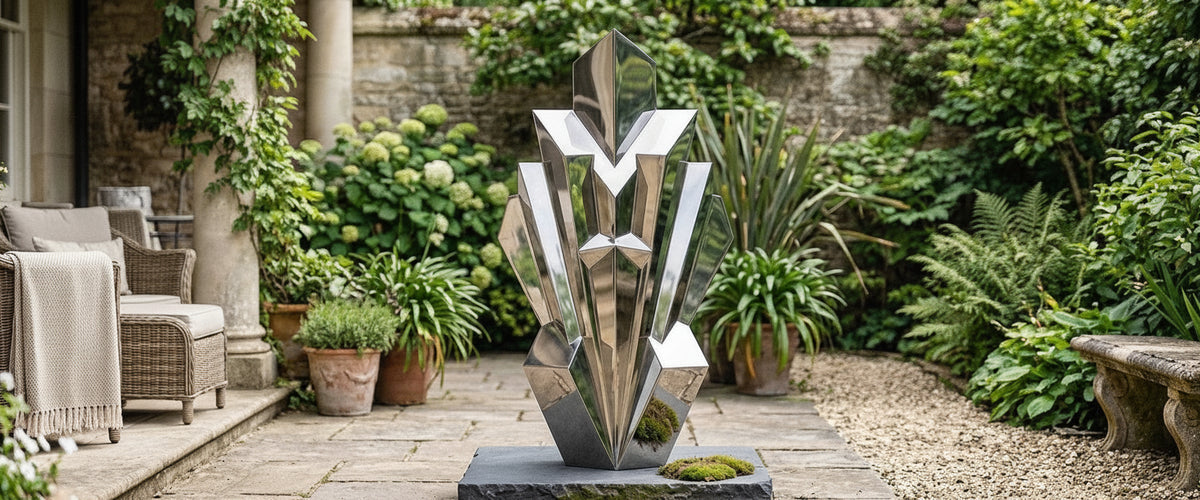

A clean art deco geometric form is one of the hardest things to get right, precisely because it looks like it should be easy. Straight edges, sharp facets, confident angles: there is nowhere to hide. A curve can absorb a fabrication error. A crisp geometric plane broadcasts every millimeter of drift. That gap between how simple an art deco geometric piece looks and how exacting it is to build is where most buyer disappointment starts, and it is where a good studio earns its fee.
Looking for the full range in this category? Browse our Geometric Sculptures collection for every available finish, size, and configuration.
We build a lot of art deco geometric work at Giant Sculptures, from tabletop pieces to garden-scale statements, and the conversations that go well tend to cover the same ground early. So here is the honest version of what happens on our side before we quote, cut, or install anything.
Crisp facets leave nowhere to hide fabrication drift.

Art Deco Geometric Sculpture at a Glance
Material sets the mood. Polished stainless reads modern and reflective; gold-finished steel leans decorative and warm; Corten and stone feel grounded and architectural.
Scale changes the design. An art deco geometric piece engineered for 10 ft (3 m) rarely works when blown up to 30 ft (9 m) without reworking facet size and internal structure.
Finish is a long-term decision. Gold and mirror finishes look sharp on day one and demand a maintenance plan outdoors.
Bespoke is the norm here. Most of our art deco geometric commissions start with a maquette and a material sample, not an off-the-shelf spec.
Budget is quote-driven. It depends on material, size, faceting complexity, engineering, finishing, and installation, so ask for a tailored estimate rather than a headline number.

What Sculptors Actually Think About Before Taking on an Art Deco Geometric Commission
The first thing we assess is not style, it is intent. Where will the piece live, who sees it, and from how far away? A faceted deco form destined for a vineyard entrance behaves very differently from one going into a city lobby. Outdoor pieces face weather, sightlines from a moving car, and years of UV. Interior pieces get read up close, under controlled light, where a sloppy weld seam becomes the only thing anyone notices.
Then we look at the geometry itself. Art deco leans on symmetry, stepped forms, sunburst rhythms, and confident repetition. Those visual signatures only sing if the underlying facets are proportioned with discipline. When we take on a geometric sculpture art project, we are effectively agreeing to hold tight tolerances across every joint, because the eye tracks a straight edge for a long way and catches any wobble instantly.
We also flag the honest constraints up front on any art deco geometric build. Some faceted forms want a hollow fabricated shell for weight and cost; others need internal bracing you will never see but absolutely need for wind load. Getting that conversation out of the way early is what separates a piece that survives a decade outdoors from one that starts oil-canning in its first winter.

Craft Decisions That Change the Final Result (and the Price)
Every faceted deco piece carries a handful of decisions that quietly drive both the look and the cost. Buyers who understand these ask sharper questions and get better outcomes from an art deco geometric commission.
Material and Finish
Polished stainless steel is our workhorse for faceted modern forms; it holds a crisp edge and takes a mirror or brushed finish cleanly. Where a setting wants sharp planes and reflective steel that shift with changing daylight, something like the Edge Geometric Steel Outdoor Sculpture is close to the right design language. For a warmer, more decorative art deco geometric gold sculpture, we apply gold-toned finishes over steel, which flatters interior lighting but wants more care outdoors. At a domestic scale, on a console or plinth, a smaller gold piece such as the Orbit Gold Geometric Steel Sculpture shows how that warmth reads in a room rather than a landscape.
Gold finishes read warm indoors but need a care plan outside.
Facet Size and Count
More facets is not automatically better. Dense faceting reads as texture from a distance and can muddy a bold art deco geometric silhouette. Larger, cleaner planes hold their geometry across a room or a lawn. We often reduce facet count as scale grows so the form stays legible.
Solid, Hollow, or Wireframe
A wireframe treatment keeps a large form light and lets the landscape show through the geometry, which is why a piece like the Deer Gold Geometric Wireframe Outdoor Sculpture suits an open garden setting where a solid mass would feel heavy. A solid or shelled form reads as mass and shadow instead. That single choice affects weight, wind load, shipping, and price more than almost anything else.
Weld and Seam Strategy
On a mirror-polished piece, seam placement is a design decision. We plan welds to fall on natural edges so the eye never lands on them. This is slow, skilled work, and it is a large part of why two superficially similar art deco geometric pieces can carry very different quotes.

Why Some Art Deco Geometric Pieces Read Right at 10 ft and Wrong at 30
Scale is where good geometric abstract art sculptures either earn their keep or fall apart. A design resolved at 10 ft (3 m) does not simply enlarge to 30 ft (9 m). The proportions that felt taut at eye level can look heavy and clumsy when a facet becomes the size of a car door.
Three things shift as you go up. Facet edges that read as fine lines up close become dominant structural bands at scale, so we usually enlarge and simplify. Reflections change too; a mirror finish that flattered a foyer can throw hard glare across a plaza, so brushed or satin finishes often win outdoors. And structure stops being invisible. At garden scale, wind and self-weight dictate internal steel that never existed in the maquette, which is why our larger geometric animal forms, like the Bull Geometric Steel Outdoor Sculpture, are engineered from the inside out, not just scaled up from a small model.
The lesson we repeat to clients buying an art deco geometric piece: design it for the distance it will be viewed from. A lobby sculpture read at 8 ft wants fine detail. A landscape marker seen from a driveway 120 ft away wants bold, simple geometry that resolves at speed.

Studio Process: Maquette, Sample, Fabrication, Install
Our commissioning path for any art deco geometric project is deliberately staged so buyers see and approve the piece before it becomes irreversible steel.
Maquette. We build a scaled model to lock proportion, facet rhythm, and stance. This is the cheapest moment to change your mind, and the most valuable.
Material sample. We prepare a finish sample, whether mirror stainless, brushed steel, or a gold tone, so you judge color and reflectivity in your own light rather than on a screen.
Fabrication. Cutting, forming, welding, and finishing happen in sequence, with internal structure engineered for the final site. Facet accuracy and seam placement are checked throughout.
Install. We plan lifting, foundations, and fixings before the piece leaves the studio. For a large outdoor form, the base and anchoring often need as much thought as the sculpture itself.
We once shipped a faceted stainless piece to a coastal property where salt air was the real enemy. Because we specified marine-grade stainless and sealed fixings at the sample stage, not after, the client avoided the staining that catches out buyers who treat finish as an afterthought. For why alloy choice and coatings matter so much for longevity, the Metropolitan Museum of Art's conservation and scientific research is a useful primer.

Honest Red Flags Buyers Should Ask About Before They Commit
A confident supplier will welcome these questions on any art deco geometric commission. Hesitation is the warning.
"Can I see a maquette and a finish sample?" If the answer is no, you are approving geometry and color blind.
"How is it structured internally for wind and weight?" For anything outdoors or above human scale, vague answers here are a real risk.
"Where do the welds and seams fall, and how are they finished?" On a polished faceted form, this is the difference between crisp and cheap.
"What alloy or coating protects it outdoors, and what maintenance does it need?" Gold and mirror finishes especially need a care plan.
"Who handles delivery, install, and foundations?" A beautiful piece is worthless leaning against a wall because nobody planned the lift.
For interior projects where you want the deco geometry without freestanding mass, a wall piece can be the smarter move. The Ecliptica Fragmented Geometric Gold Frame Wall Art brings the fractured, symmetrical art deco geometric language to a hallway or stair wall, while the Prisma Orange Geometric Panel 3D Wall Art shows how color and dimensional facets can carry a room without a plinth. Both sit naturally within our wider geometric art range if you want to compare treatments before committing to a commission.
The short version: an art deco geometric build rewards planning and punishes shortcuts. Decide the viewing distance, choose the material and finish for real conditions, insist on a maquette, and ask hard structural questions. Do that, and you end up with a piece that looks as sharp in year ten as it did on install day.
For wider placement ideas, Inspirational Wall Art for the Office: What Sculptors Weigh Before They Start is useful companion reading before finalizing the setting and sightlines.