





































































































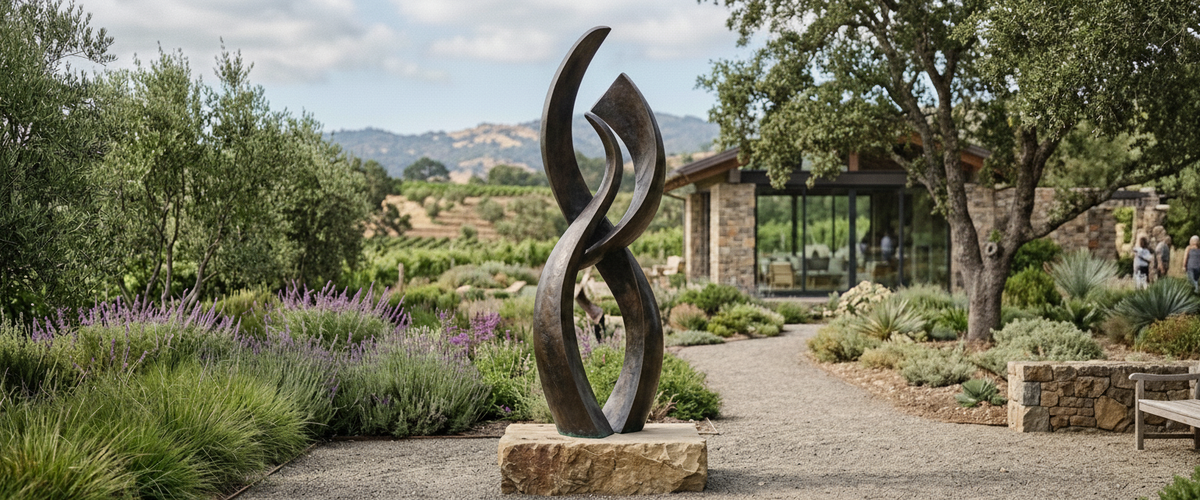

Most large modern sculptures are chosen at arm's reach on a screen, then lived with from 165 feet (50 m) away. That gap is where the expensive mistakes hide. A form that photographs beautifully in a studio, with raking light picking out every tool mark, can flatten into an anonymous blob when it sits at the far end of a forecourt on a gray Tuesday. The work of buying well is mostly the work of testing a piece at the distances your site actually offers.

Key Takeaways
At roughly 165 feet (50 m), only outline, mass and negative space survive. Surface detail is gone.
Large modern sculptures for public spaces have to pay out in three viewing bands: far, middle and arm's reach.
Judge the three-quarter view before the front elevation; almost nobody approaches a sculpture head-on.
Plinth height controls viewing speed and eye line, and it compensates for sloped or vehicular approaches.
Satin stainless, Corten and bronze behave very differently under midday sun on an open forecourt.
For much of the year, a public site sees the piece after dark, so lighting is a design decision, not an accessory.
The Long View: What Survives at 165 Feet
Drop a photograph of any sculpture into grayscale, shrink it to thumbnail size, and squint. What is left is what your visitors will see from the entrance gate. Patina variation disappears first, then weld seams and chisel texture, then the subtle modeling that makes a piece feel alive up close. Outline remains. So does the rhythm of solid against void, and the way the form breaks a hedge line, a roof line or an open sky.
This is why so many large modern sculptures that work at 4 feet fail at 60. A gentle S-curve reads as a vertical smudge. Two masses separated by a narrow gap merge into one lump. The pieces that hold their ground at distance tend to have an unambiguous gesture: a clear lean, a deep bite of negative space, or a stance wide enough to register against a building's grid.
From the gate, outline and negative space are all that survive, which is why the silhouette test comes first.
Parking Lot, Approach Path, Arm's Reach
Think of three distinct viewing bands and ask what the sculpture pays you at each one. In the far band you get silhouette. In the middle band, somewhere around 40 to 60 feet (12 to 18 m), proportion and gesture arrive; you start to read whether the piece is striding, resting, coiling or falling. In the close band, within about 10 feet (3 m), the surface finally speaks: patina depth, casting quality, the grain of brushed steel, the crispness of an edge.
A commercial piece that only performs in one band is a half-purchase; the large modern sculptures worth their invoice pay out in all three. Our studio pushes clients to sketch the actual route people take, including the door they come out of and the angle the delivery trucks swing through, then mark the three bands on the plan. It takes twenty minutes and it settles arguments about scale that would otherwise run for weeks.
Turning the Corner: Why the Three-Quarter View Matters Most
Almost no one meets a sculpture head-on. They come around a wall, up a curving drive, or diagonally across a lawn. The front elevation is a drawing convention, not a human experience. Ask for images or renders at 45 degrees from both sides, and if you are commissioning, ask what happens in the turn between them. The best large modern sculptures do their most interesting work in that turn.
Multi-mass compositions handle this best, because the gap between elements opens and closes as you walk. A piece on the scale of the Monumental Modern Abstract Duo Bronze Sculpture - 260cm is really several sculptures depending on where you stand: two separate figures from one side, a single interlocked mass from another. That behavior is worth paying for on a site where people circulate rather than stop.

Plinth Height as a Speed Control
A plinth does more than lift bronze out of the splash zone. It sets the eye line, and the eye line sets the mood. Floor-level placement invites people to walk right up and circle slowly. Waist-height pedestals suit gardens and courtyards where the viewer is already ambling. Chest-height and above turns a piece formal and distant, which is exactly right beside a tall facade and exactly wrong in an intimate terrace.
Sloped and vehicular approaches change the math. If your drive rises toward the piece, viewers look down on it and the top plane becomes the main event. If they arrive by car, large modern sculptures compete with parked vehicles, so a standing form in the range of the Large Modern Abstract Anthropomorphic Figure Bronze Sculpture - 220cm needs its head and shoulders clear of roof height. At 220cm the form manages that on a low plinth, and raising it further only pushes the eye line past comfortable reading. Mock it up with stakes and tape before anything is cast.
Stainless, Corten and Cast Resin Across a Busy Forecourt at Midday
Material choice is a distance decision as much as a taste decision. Mirror-polished stainless at noon dissolves into reflected sky and paving; the form can vanish precisely when the site is busiest. Satin or linished finishes hold their edges and read as a consistent light-toned mass, which is why finish selection deserves as much attention as alloy grade. The Nickel Institute's architectural guidance is a useful starting point on grade and finish for exposed exterior work.
Corten silhouettes against pale architecture, satin stainless holds its edges at noon, bronze rewards the close band.
Corten does the opposite. It reads as a dark, solid, matte mass that silhouettes cleanly against pale buildings, and it keeps working on overcast days. The trade-off is run-off: early-stage weathering carries oxide onto adjacent paving, so it belongs above gravel, planting or dark stone rather than limestone steps. Highway agencies have documented this staining on uncoated weathering steel in detail, and the FHWA guidance on uncoated weathering steel is worth a skim before you specify it near a white entrance canopy.
Cast resin belongs in the conversation only briefly. It can look convincing in a controlled interior, but on a public forecourt it faces UV, thermal cycling and the occasional shopping cart. For large modern sculptures for public spaces, we steer almost every client toward bronze, stainless or Corten, because the fifteen-year view matters more than the first-week photograph.
Night Lighting and the Silhouette Half the Year Sees
From late fall through early spring, a good portion of a site's foot traffic happens after dark, and large modern sculptures spend much of that season as pure outline. Uplighting from below exaggerates everything: undercuts become caves, a mild lean becomes a lurch. Test it crudely first, with a flashlight on the maquette in a dark room, then properly with a lighting designer who will think about glare cutoff for people at eye level, not only about how the piece looks in a render. Ground-recessed fittings need a drainage strategy, and a wash from two sides usually beats a single dramatic spot.
Two Commissions Where the Site Plan Set the Final Scale
For wider placement ideas, Tap It, Weigh It, Light It: How to Judge a Modern Large Resin Statue is useful companion reading before finalising the setting and sightlines.
A winery forecourt taught us this the hard way. The maquette looked resolved on the studio bench, but the approach was a long drive with rising vineyard rows behind the placement point. Against that striped backdrop the form lost its edge, so the final piece grew and its stance widened until it could hold its own against the rows. The client had signed off on the maquette; the site plan overruled it.
The reverse happened on a medical campus courtyard. Most viewing came from third-floor windows and a covered walkway, not from ground level. Final height came down, the plinth went up, and the top surfaces were reworked to be the strongest part of the composition. Both projects ended well, and both make the same point: large modern sculptures rarely fail because of the model. They fail because nobody read the survey drawings first.

Buyer Checklist for Large Modern Sculptures
Run the grayscale thumbnail test; if the silhouette is unclear, the site will make it worse.
Mark three viewing bands on the site plan and confirm the piece pays at each.
Request three-quarter views from both sides, plus the rear.
Stake out plinth height on site before any casting or fabrication starts.
Check sightlines from upper windows, the vehicle approach and the disabled-access route.
Match material and finish to paving color, run-off risk and midday glare.
Plan lighting, drainage and cable routes at design stage, not after installation.
Confirm crane access, foundation depth and the anchoring detail with your engineer.
Agree on a cleaning and inspection cadence, and who owns it.
Commissioning at the Right Scale
If nothing in the existing contemporary and modern sculptures range fits the sightlines, a bespoke commission is usually a scale question rather than a design question. Send us the site plan, photographs from each approach, and a note on what the piece needs to do: anchor a roundabout, close a vista, or reward a slow walk. Budget for large modern sculptures follows material, scale, structural engineering, finishing and installation access, so we quote each project individually rather than working from a list. Where a monumental commission still needs internal approval, a smaller cast such as the Large Modern Abstract Bull Bronze Sculpture - 120cm can stand in as a scale study, letting a committee judge form and patina in the flesh before anyone signs off on full height.
Get the distance question right and the rest tends to follow. Large modern sculptures earn their keep when they read clearly from the gate, reward the walk in, and still have something to say at arm's reach on the thousandth viewing. You can browse more forms in our abstract sculptures range while you work out which distances your site really has.