





































































































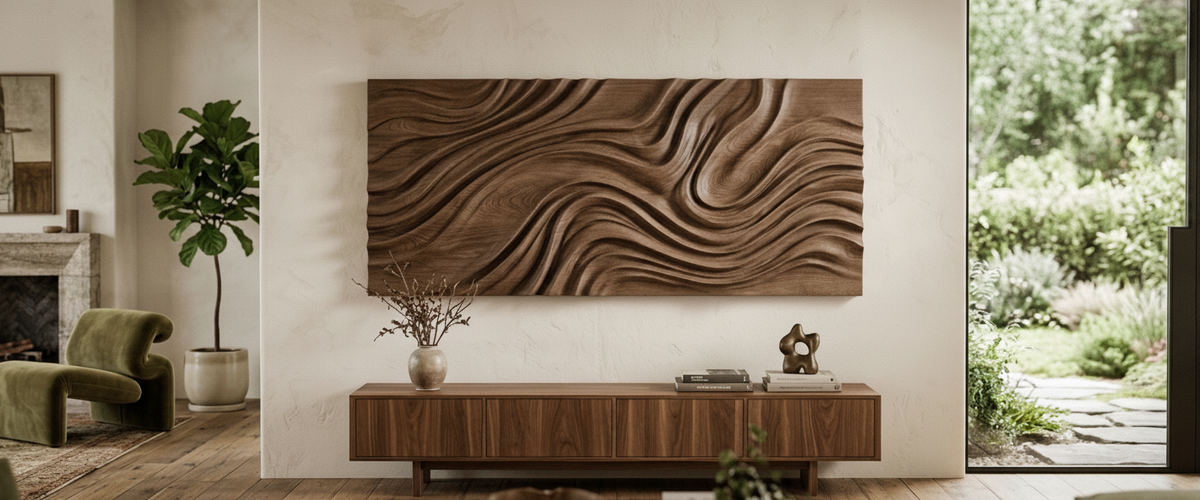

Textured fabric wall art photographs beautifully on day one. Twelve feet (3.6 m) of woven relief across a stairwell, shadows raking sideways across the pile, a hard architectural room suddenly softened. The trouble usually shows up around month fourteen, when the top corners of a stretched panel start to droop and that crisp shadow line goes slack. We field these calls regularly: a designer in Dallas with a sagging wool panel above a media wall, a Napa client whose linen piece has gone two shades lighter on the window side. The material was never wrong. The expectations were.

Key Takeaways Before You Buy
Stretched fabric moves. Fiber relaxes, gravity wins, and corners sag first. Plan on re-stretching, not permanence.
Fiber choice sets the aging curve. Wool recovers pile, linen goes limp, jute yellows.
Light is the real enemy. A south-facing window will fade a textured panel long before dust does.
Ridges collect, surfaces do not. Dust and cooking odor settle in the valleys of the texture.
Carved wood and engineered metal give you the shadow play of textured fabric wall art with a service life measured in decades, which is why most of our large-format texture commissions end up in those materials.
Month One to Year Two: How a Stretched Fabric Panel Starts to Sag
A stretched textile panel is a system under tension: fiber pulled over a timber or aluminum subframe and stapled or clipped at the back. Fiber under sustained load creeps. Wool creeps slowly, cotton canvas moderately, loose-weave linen quickly. Humidity swings accelerate all of it, because the weave takes on moisture, expands, then dries and does not fully return.
Fourteen months in, the staple line at the top corner gives first and the shadow goes slack.
What you notice is not a dramatic failure. It is a soft belly in the center of a large panel and two tired corners at the top, where the staple line carries the most shear. On a panel under 3 feet (0.9 m) wide, you may never see it. On a 7 or 8 foot (2.1 to 2.4 m) statement piece, the sag reads from across the room because the light no longer hits the texture at a consistent angle. Big panels punish small weaknesses, and textured fabric wall art at scale is where that lesson gets expensive.
Wool Holds Pile, Linen Goes Limp, Jute Yellows
Three fibers, three completely different ten-year outcomes for textured fabric wall art.
Wool
Wool is the resilient one. The crimp in the fiber lets a crushed pile spring back, which is exactly why it dominates hand-tufted work and high-traffic carpet. Wool still felts if it gets damp and rubbed, and it is the fiber moths want most, so a wool panel in a lightly used guest wing needs actual monitoring.
Linen and Cotton
Linen has almost no elastic recovery. Press a fold into it and the fold stays. Over time a linen panel loses its taut, papery quality and starts to read as slack cloth rather than deliberate relief. Cotton behaves similarly but yellows faster in sunlight.
Jute, Sisal and Hemp
Bast fibers bring gorgeous coarse texture and the shortest honeymoon. Residual lignin in jute oxidizes under light and air, so the color drifts toward brassy yellow, then brittle tan. Fine textile collections are typically held at low light levels for this reason; the Smithsonian's conservation guidance on light damage to organic materials is worth reading before you hang natural fiber opposite glass.

The Radiator Wall and the South Window: Two Spots That Bleach Fiber Fastest
Above a radiator or a floor register, a textured panel sits in a rising column of dry, warm air for months at a time. The fiber dries unevenly, the backing board can cup, and the lower edge collects a gray line of airborne dust carried up by convection. Directly opposite a big west or south window, ultraviolet and visible light do the fading, and they do it selectively: undyed wool warms, plant-dyed and low-lightfastness pigments shift, and the exposed half of the panel drifts away from the shaded half.
This is the placement conversation we have most often. If the wall you love is a sun wall, texture is still the right instinct but textured fabric wall art is the wrong specification; the material needs to change. On a wall that takes direct afternoon light, a sealed carved timber relief such as Barwick Charcoal Flow Abstract 3D Carving Wall Art gives you the same raking shadow line as a woven panel, with none of the fade gradient that splits a textile down the middle after two summers.
Steam, Kitchens and the Smell a Textured Panel Quietly Collects
Open-plan kitchens are the quiet killer for textured fabric wall art. Aerosolized cooking oil travels further than most people expect, lands in the pile, oxidizes, and turns sticky. Once that film exists, dust bonds to it and the panel starts to hold odor rather than release it. Steam from an adjacent bathroom or a laundry room does something different but equally unhelpful: repeated wetting and drying cycles, which speed up sag and can wick tannins from a timber subframe through to the face.
For kitchen and dining walls, we steer buyers toward wood or metal relief every time. A finished carved panel wipes down. A brushed or patinated metal piece from our metal wall art range can be degreased outright without any risk to a pile.
Dust Settles in the Ridges, Not on the Surface
Textured fabric wall art does not get dusty the way a flat canvas does. The high points stay reasonably clean while the valleys silt up, which slowly kills the contrast that made you buy the piece.
Dust silts into the valleys of a weave, flattening the contrast that sold the piece.
Vacuum through a screen. Stretch fine nylon mesh over the nozzle, use low suction, and work in the direction of the weave. Never use a beater head.
Brush with a soft natural bristle down the ridges, not across them, so you lift dust without crushing the pile.
Skip the steam cleaner. Moisture plus tension equals a permanent belly in the panel.
Spot-test any solvent on a hidden back edge, and do it before you need it.
Rotate exposure annually if the design allows, so fading stays even.
Hang on standoffs. A half-inch (12 mm) air gap behind the panel reduces trapped humidity and the gray shadow line that forms along a tight edge.
Re-Stretching, Re-Backing and Knowing When a Panel Is Genuinely Finished
A sagging panel is often fixable. A good upholsterer or framer can strip the staple line, re-tension the textile over the same subframe, and add a rigid backing board to stop future flex. Expect to lose a small amount of face dimension at the edges each time, since you need fresh fabric to grip.
The panel is genuinely finished when the fiber itself has failed: brittle jute that cracks when flexed, a sun-bleached gradient that no cleaning will even out, moth grazing across a wool field, or oxidized cooking film that has gone tacky. At that point you are not restoring texture, you are replacing it.
Choosing Textured Wall Art That Outlives the Room
Run your wall through these five questions before you commit to textured fabric wall art or any other relief piece:
Light: does direct sun reach the wall at any hour? If yes, choose carved timber, stone or metal.
Air: is there a register, radiator, kitchen or wet room within about 10 feet (3 m)? Same answer.
Scale: anything past roughly 6 feet (1.8 m) on the long side needs engineered support, whichever material you pick.
Handling: will people brush past it in a corridor or a hospitality space? Pile crushes; carved relief does not.
Horizon: five years or thirty? Fabric suits the first. Bronze, Corten, stainless and carved timber suit the second.
If texture is what you actually want, and it usually is, browse our 3D wall art for pieces built around relief and shadow rather than surface pattern. Where the room was always heading toward the warmth of wool, a mocha-toned carving such as Barwick Mocha Tangle Abstract 3D Carving Wall Art reads as soft as a woven panel from six feet away, then holds crisp edges up close for far longer.

Commissioning Texture at Scale
Most of the large texture briefs that reach our studio start as fabric ideas and end as engineered relief. A hospitality client in Scottsdale came to us wanting a woven panel above a lobby fireplace; the heat plume made that a two-year piece at best, so we developed a multi-section carved sequence instead, hung on a concealed rail with an air gap behind. Sculptural depth intact, maintenance close to nil.
Long spans usually want rhythm rather than a single dominant motif, and a quieter carved field like Barwick Mocha Flow Abstract 3D Carving Wall Art is the kind of pattern language that repeats across three or four panels without becoming busy. Scaled-up custom versions follow the same logic, sized to the wall rather than trimmed to fit it.
Giant Sculptures works this way on bespoke commissions: material chosen for the wall's real conditions, structure sized for the span, finish specified for the room's traffic and light. Budget depends on material, scale, complexity, engineering, installation and finishing, so the sensible next step is a tailored quote rather than a guess. Send us the wall dimensions, orientation, and a photograph at the time of day the light is worst, and we will tell you honestly whether textured fabric wall art belongs there or whether something more permanent will serve you better.
For wider placement ideas, Abstract Metal Wall Art That Actually Reads From Across the Room is useful companion reading before finalising the setting and sightlines.