









































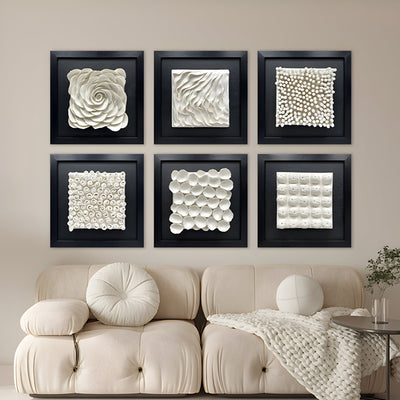
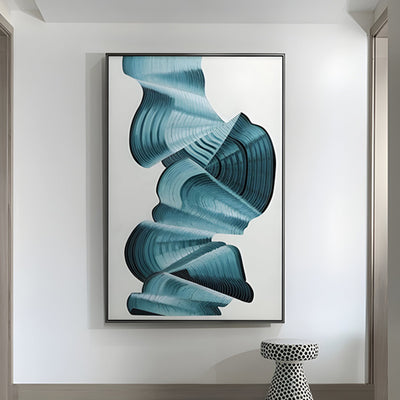
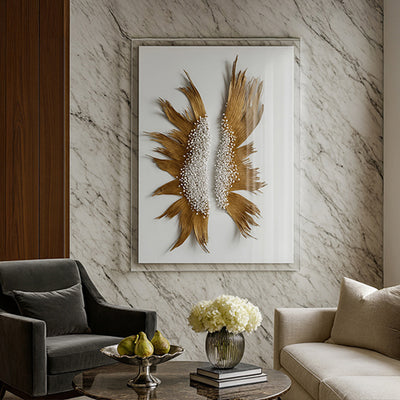
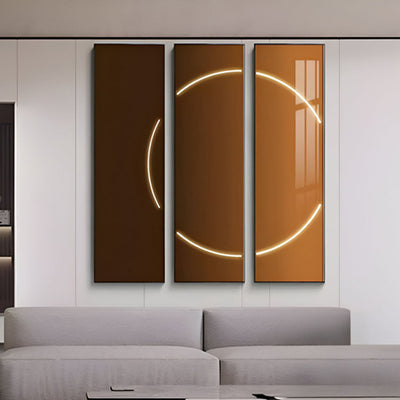
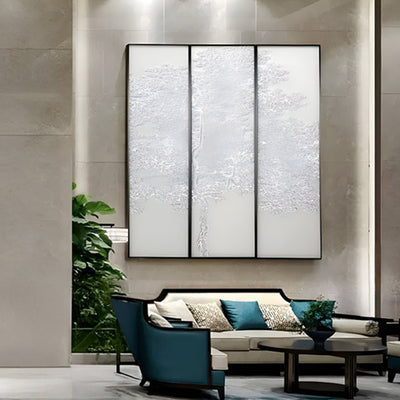
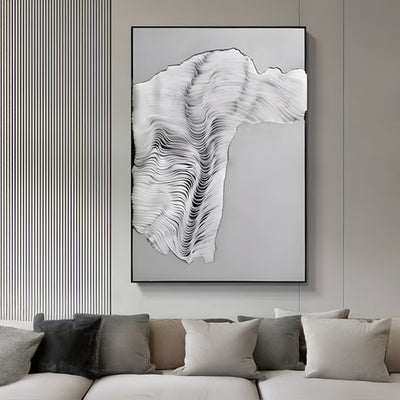
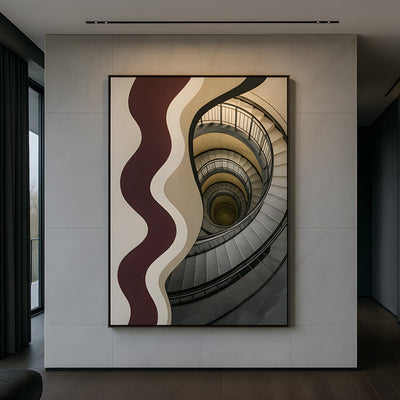
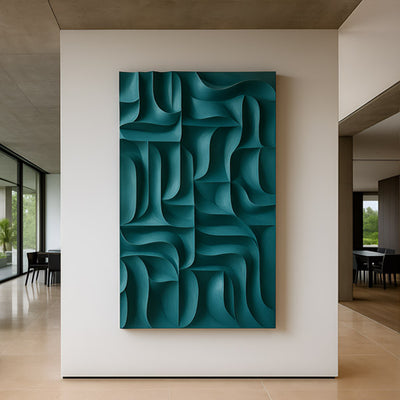
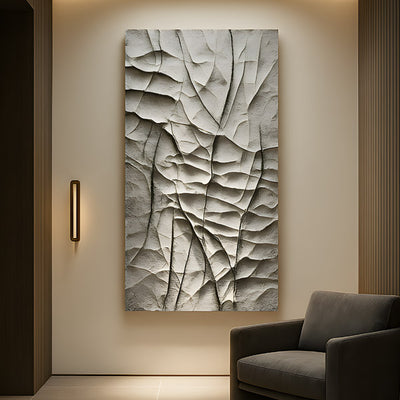
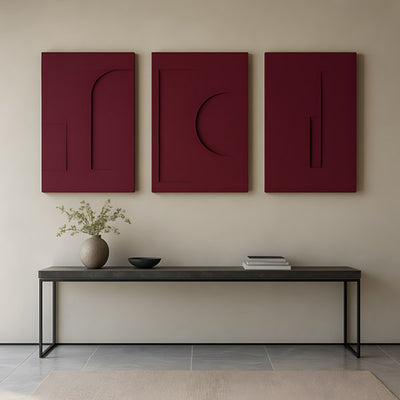
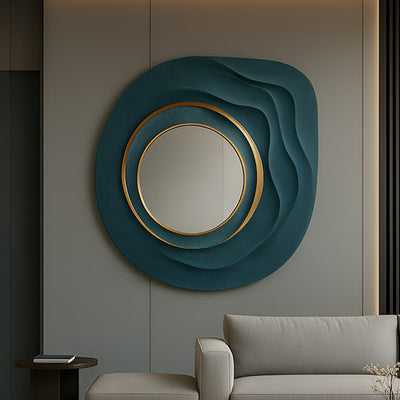
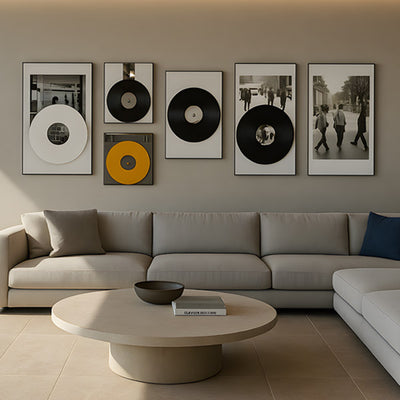
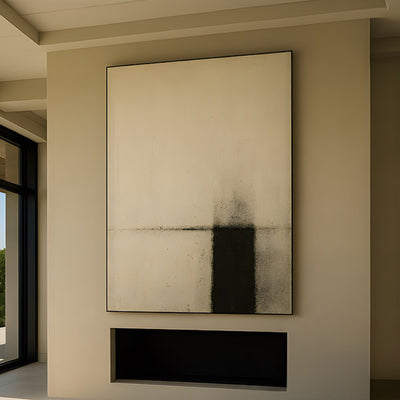
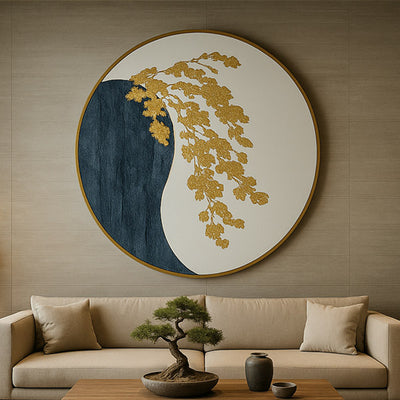
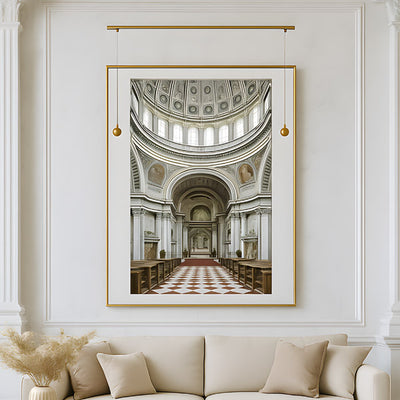
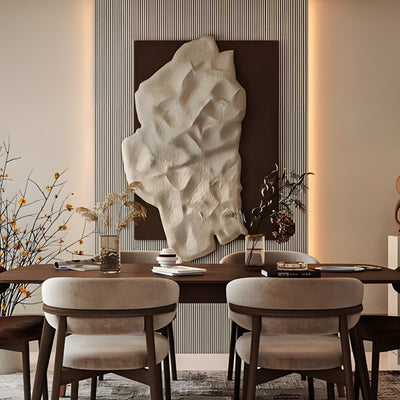
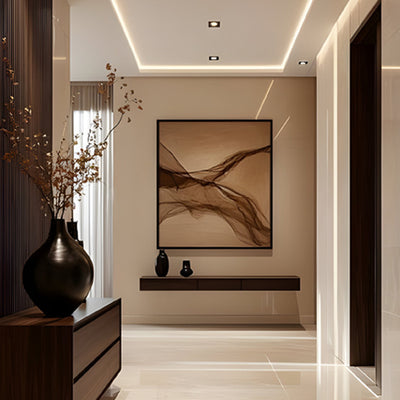
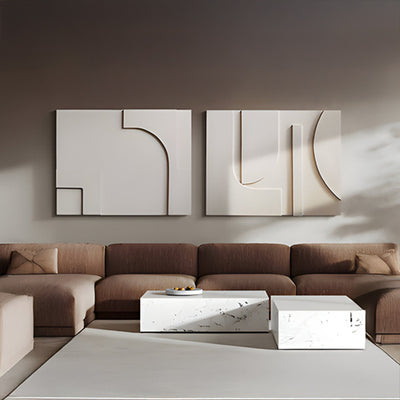
















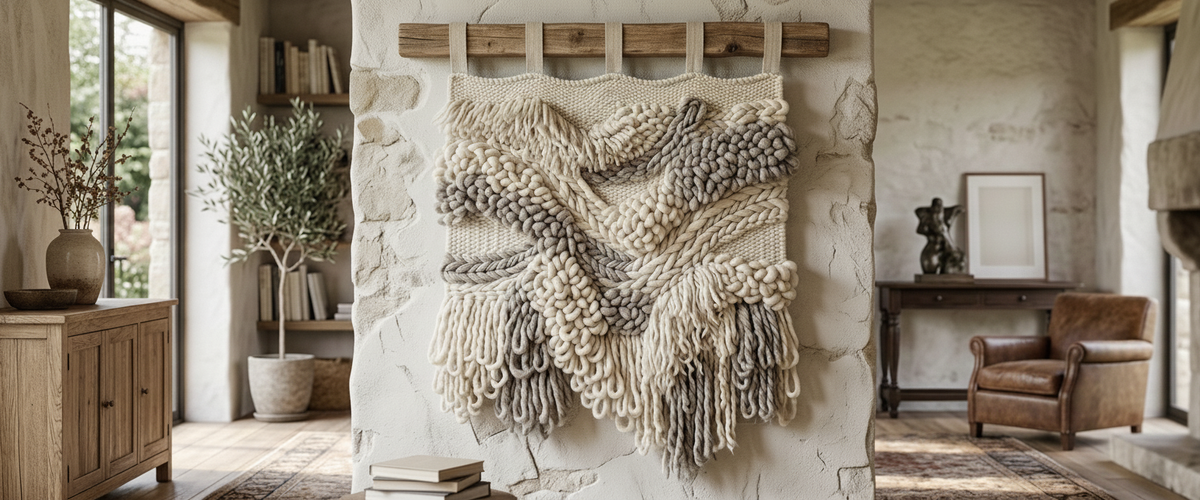

A glass-walled living room with polished concrete floors photographs beautifully and sounds awful. Footsteps clap. Conversation picks up a hard metallic edge. Textile art is the least fussy fix we know for that problem, because one properly sized woven panel absorbs the slap, softens the room, and gives the eye somewhere to rest without introducing a single new color into a carefully controlled scheme.

Key Takeaways Before You Buy
Acoustics are the hidden benefit. Loose-hung fiber with an air gap behind it does more for a hard room than glazed, framed textile art.
Texture reads as warmth even in an all-gray, all-stone palette. You do not need color to soften a space.
Wool and linen age well in daylight. Silk does not. Match the fiber to the wall's light exposure, not to the mood board.
Presentation changes everything. The same weaving framed, stretched or hung loose gives you three completely different room presences.
Upkeep is real but light. Dust, moths and drape relaxation are the three things nobody raises at the point of sale.
Commission cost is quoted, not listed. Fiber, scale, weave complexity, finishing and hanging hardware all move the number, so ask for a tailored quote rather than guessing from a size chart.
The Acoustic Shift: How One Woven Panel Calms a Hard Room
We shipped a large undyed wool panel to a Hudson Valley barn conversion where the owners had already tried rugs and heavy drapery. The room still rang. The panel went on the long masonry wall opposite the glazing, hung from a batten with roughly an inch of air behind it, and the change was audible from the doorway. Porous fiber traps mid and high frequencies, and the air gap behind a loose-hung piece lets the weave work on both faces.
A dense wool panel hung with an air gap behind it, opposite the glazing in a hard-surfaced room.
That detail matters commercially. A dense, deep-pile textile wall art piece hung with a gap will always outperform the same weaving sealed behind glass, because glazing simply bounces sound back into the room. If acoustic performance is part of why you are buying, say so at the commission stage. It changes the weave density, the backing choice and the mounting method.
Warmth Without Color: Why Fiber Reads Soft in a Neutral Palette
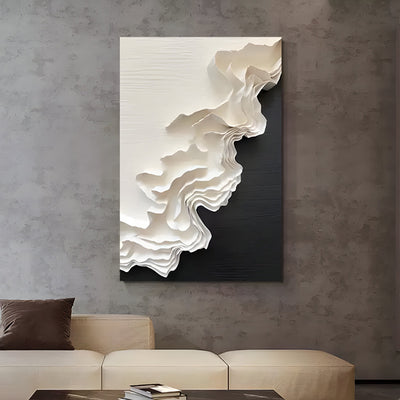
Designers working in stone, plaster and blackened steel often assume warmth has to come from a color injection. It does not. A looped or high-relief weave in undyed cream, oatmeal or natural gray creates thousands of tiny shadows across its surface, and those shadows shift through the day as light rakes across the wall. Weavers at a textile arts center test their samples under angled light for exactly this reason: the shadow is the color.
This is why textile art earns its place in minimalist interiors where a painting would feel like a statement and a mirror would feel cold. It adds tactile information, not visual noise.

Wool, Linen, Jute and Silk: How Each Fiber Handles Daylight
Fiber choice is the single decision most buyers get wrong, usually because they picked from a swatch in a showroom with no windows.
Wool. The most forgiving option. It springs back, resists soiling, holds dyes well and takes a deep sculptural weave. Its one weakness is pests, covered below.
Linen. Strong, crisp and cool in tone. It creases and it will relax over time, which suits a stretched or framed presentation better than a heavy drape.
Jute and hemp. Coarse, architectural, excellent for scale. They shed a little in the first months and grow brittle under sustained direct sun, so keep them off south-facing glass.
Silk. The most beautiful and the most fragile. It is highly light-sensitive and will fade and weaken faster than any other common fiber. The Smithsonian's Museum Conservation Institute is blunt about cumulative light damage to textiles being irreversible, and that applies to a hallway just as much as a gallery.
Our default advice for a bright American interior, whether it is a Napa tasting room or a Manhattan loft, is wool or a wool-linen blend on any wall that gets more than a couple of hours of direct sun.
Framed, Stretched or Hung Loose: Same Weaving, Three Room Presences
Take one woven piece, present it three ways, and you get three different objects.
Float mounting inside a shadow box protects the edges and gives a weaving gallery discipline.
Framed textile art reads as fine art. A float mount inside a deep shadow box gives the work gallery discipline, protects the edges and suits corridors, dining rooms and anywhere the piece will be brushed past. It flattens the surface slightly, so choose a weave with strong graphic structure rather than one that relies on drape.
Stretched over a concealed frame gives you taut, architectural presence. This is the option that sits most comfortably alongside contemporary metalwork, because the edges are clean and the piece holds a rectangle.
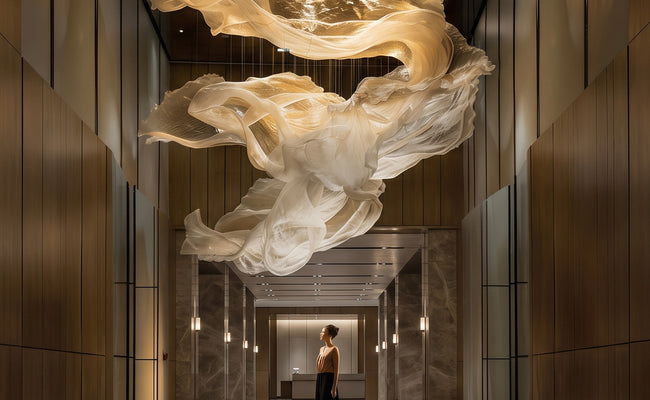
Hung loose from a rod or timber batten is where the textile arts tradition really lives. The lower edge moves when a door opens. Some designers call this living textiles art, and the description is fair: the surface never looks the same twice. It is the best choice for double-height walls and the best choice acoustically.
Pairing Textile Art With Metal or Stone So Neither One Goes Quiet
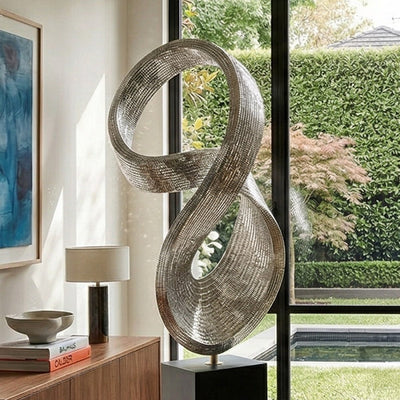
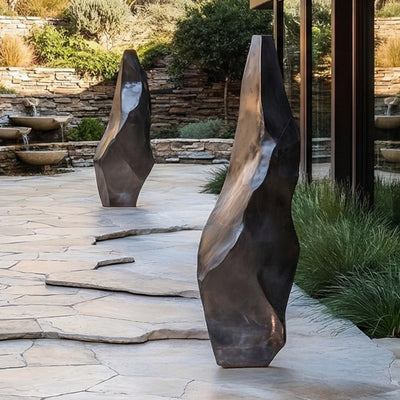
The pairing mistake we see most often is putting a matte, low-contrast weaving directly behind a large sculpture. The metal wins and the textile becomes wallpaper. Give each piece its own sight line instead. A patinated bronze figure on a plinth reads as warm brown mass against a cool linen ground, and the two hold each other well across a room. Mirror-polished work behaves differently: a stainless steel sculpture will pick up and repeat the weave in its reflections, which is a gift if you plan for it and a mess if you do not.
Stone is the easiest partner. Marble and limestone share the same matte light behavior as natural fiber, so a carved piece and a woven panel in the same room feel like they came from the same decision rather than two different shopping trips.
Dust, Moths and Drape: The Upkeep Nobody Mentions
Fiber needs less attention than people fear, but it needs the right attention.
Vacuum every few months through a screen or with a soft brush attachment on low suction, working with the weave direction.
Inspect the back and the lower hem for moth activity twice a year. Wool casings and grazed patches are the giveaway, and the American Institute for Conservation covers domestic textile pest checks clearly.
Rotate or reposition the piece annually if the wall gets uneven light. Fading is always worst at one edge first.
Never wet-clean a sculptural weaving yourself. Spot issues go to a textile conservator.
Allow drape to settle. A newly unrolled linen or wool panel can take a few days on the wall before the folds relax out.
Keep it off exterior walls prone to condensation, and out of unventilated bathrooms.

Sizing a Textile Art Commission to Your Wall
Three practical questions decide the specification, and answering them early saves a round of revisions.
How much wall are you filling? Aim for roughly two thirds of the usable wall width for a single hero piece, and keep the lower edge clear of furniture backs and radiators.
How is it hanging? A batten or French cleat spreads load across studs and keeps a heavy panel flat. A single decorative rod looks lovely and concentrates weight at two points, which is fine for lighter work and risky for dense wool at scale.
How much does it weigh? Dense wool at architectural scale can run well past 40 pounds (18 kg) before hardware. Confirm the fixing surface is masonry or framing, not plasterboard alone.
Add drape allowance to any loose-hung commission: a sleeve or hem eats into the finished drop, and a panel specified to the exact wall measurement will end up shorter than the drawing suggested. Our studio always works from a finished visible dimension and builds the sleeve on top of it.
Browse the textile art collection to see how weave scale behaves at different sizes, then talk to us about a commission. Fiber, scale, weave complexity, finishing and the hanging system all move the price, so we quote per project rather than publish a bracket. Giant Sculptures builds large-format work to last, whether that is woven, cast or fabricated, and we would rather specify a woven wall piece correctly the first time than replace it in five years.
For wider placement ideas, Wall Sculptures for the Living Room: A Buyer's Guide to Scale, Material, and Placement is useful companion reading before finalising the setting and sightlines.