






































































































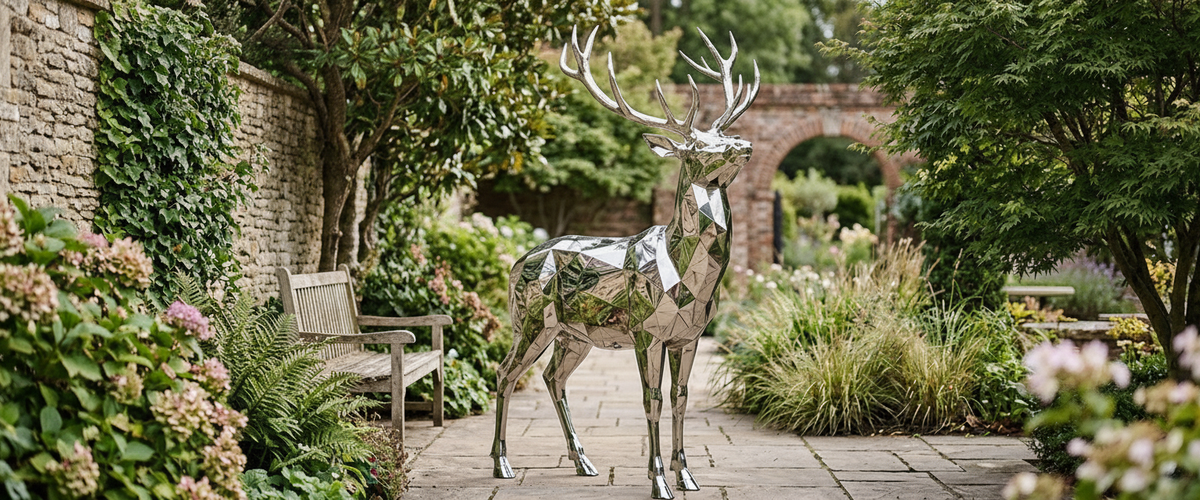

Polish a bear to a mirror finish, set it on a lawn, and the bear disappears. In its place you get a warped picture of sky, hedge and your own reflection wrapped around a lump. That is the first lesson of buying a stainless steel animal sculpture: the material has opinions about anatomy, and some animals win the argument while others lose it badly.

At a Glance
Mirror steel suits angular, bony or spiky subjects. Soft, round bodies tend to read as blobs.
Antlers, manes, feathers and claws break reflections into a readable outline.
Faceted, low-poly finishes rescue heavy animals such as bears, bulls and rhinos.
Slender legs and necks concentrate stress at the welds, so fabrication quality matters most there.
Grade 316 is the safer choice for coastal, poolside or thin-section outdoor pieces.
Mirror Steel Rewards Sharp Anatomy
A polished surface shows whatever surrounds it, so the sculpture's own shape has to fight for attention. Hard edges win that fight. A shoulder blade riding up under taut skin, a ridge of spine, the sharp break between flank and belly: each creates a crisp line where one reflection stops and another begins. Your eye reads those lines as form.
This is why big cats are such reliable subjects in steel. A pose built on tension, with a lowered head, raised shoulders and a back that dips and climbs, gives the polish something to follow. Even at tabletop scale, around 20 inches (50 cm), a stalking cat such as the Gold Prowling Panther with Sphere Chain Stainless Steel Sculpture - 50cm lets the anatomy carry the reflection instead of drowning in it. A sleeping cat in the same finish would look like a polished pebble.
A lowered head and raised shoulders give mirror steel clear lines to follow.
Antlers, Manes and Talons Give the Reflection Something to Hold
Extremities do a lot of work in a reflective stainless steel animal sculpture. A stag's antlers, a lion's mane or an eagle's spread primaries cut the surrounding view into small, separate fragments. Instead of one large, smeared reflection, you get dozens of bright edges that trace the silhouette against a garden or a sky.
When you compare pieces across our stainless steel sculptures, look at the outline before the finish. If you can recognize the animal from its shadow alone, it will hold up in mirror steel. If the shadow could be a boulder, the polish will make it worse.

Low-Poly Facets Forgive Heavy Subjects
So what about the bear, the bull, the hippo? Clients love them, and they deserve a place in a garden. The answer is faceting. Breaking the body into flat planes gives every surface its own angle to the light, so the form reads through a pattern of brighter and darker panels rather than one continuous smear.
The difference shows most outdoors. A smooth-polished bear can photograph beautifully under controlled lighting, then look shapeless on a lawn on an overcast afternoon. A faceted version of the same animal reads clearly from across the yard in almost any light. If you want a bear or bull as a stainless steel animal sculpture, facets are the honest fix rather than a style trend.
Thin Legs and Long Necks: Where Cheap Fabrication Cracks First
Stainless sculpture is usually fabricated from cut and formed sheet, welded together and then polished. On any stainless steel animal sculpture, the welds are where quality shows. On a squat animal, loads spread across broad joints. On a deer, a heron or a crane, the entire weight and every gust of wind funnel through narrow legs and a long neck, and the weld at the ankle or the base of the skull takes the strain.
A leaping pose raises the stakes further. At console scale, roughly 18 inches (45 cm), a mid-air cat like the Gold Polished Leaping Panther with Amber Sphere Stainless Steel Sculpture - 45cm can balance a full body on minimal contact points without much engineering. Scale that idea up to a life-size outdoor piece and you need internal armatures, full-penetration welds and proper treatment of heat tint, or the joint will be the first place to stain, weep or crack.
Mid-air poses rest on a few small contact points, so weld quality matters.
201, 304 or 316: Choosing the Right Grade for a Stainless Steel Animal Sculpture
Not all stainless steel is equal. Grade 201 swaps much of the nickel for manganese and is cheaper, but its corrosion resistance is noticeably weaker. Grade 304 is the standard austenitic workhorse and suits most indoor work and sheltered inland gardens. Grade 316 adds molybdenum, which improves resistance to chlorides from sea air, pool water and road salt, as the Nickel Institute explains in its guidance on stainless grades.
A slender raptor needs a better grade than a squat bear, because thin sections and many welds give corrosion more places to start. A 304 heron set a short walk from the sea or a brackish pond can show brown tea staining around its leg joints within a few seasons, which is why we specify 316 for waterside pieces. Indoors the priorities flip. For a sculptural bird piece kept inside, such as the Brown Loop with Two Green Birds Stainless Steel Sculpture - 80cm at around 31 inches (80 cm), grade is far less critical than finish quality. The World Stainless Association publishes useful background on matching grades to environments.

Buyer Checklist Before You Order
Check the silhouette. Can you name the animal from its outline alone?
Match finish to body type. Mirror polish for lean, angular animals; facets for heavy, round ones.
Ask about weld locations. Where do legs, necks and tails join, and are those joints reinforced?
Confirm the grade in writing. Specify 316 for coastal, poolside or exposed sites.
Plan the base and fixings. Tall, slender pieces need anchoring designed for wind load.
Budget for scale. Cost depends on material, size, complexity, engineering, installation and finishing, so request a tailored quote.
When an Awkward Subject Is Worth a Commission
Catalog pieces are designed around subjects and poses that already work in steel. If your heart is set on something harder, such as a curled-up fox, a life-size flamingo on one leg or a family pet with a soft coat, a commissioned stainless steel animal sculpture is usually the better route. At Giant Sculptures we can adjust the facet density, thicken a vulnerable joint, choose 316 from the start and design the base around your actual site rather than a generic plinth.
Sometimes the right answer is a different material. A rounded, gentle animal can look better in patinated bronze, so compare our bronze animal sculptures with the wider animal sculptures collection before you commit. Choose the animal first, then the metal, and the sculpture will still read clearly in twenty years.
For wider placement ideas, Inside a Large Stainless Steel Sculpture: Why the Frame Matters More Than the Mirror is useful companion reading before finalising the setting and sightlines.