












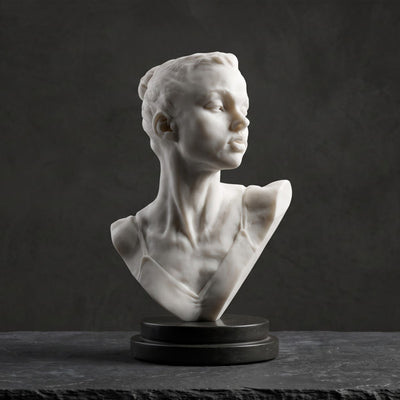





































Browse any marble bust sculpture sale and you will find three very different objects wearing the same label. One was carved from a single block of stone by someone with a claw chisel and a lot of patience. One was poured into a mould from crushed marble and resin. The third is plain resin with veining painted on. Prices tell you a little, photos tell you less, and the listing copy tells you almost nothing. Here is how we check a bust before it leaves our studio, and how you can check one before it arrives at yours.

At a Glance: Five Checks Before You Buy
Ask for the weight. Real marble is dense. A seller who cannot give you a crated weight is a warning sign.
Turn it around. Tool marks on the back and socle mean carving. A fine ridge line means a mould.
Shine a light on the cheek. White marble glows a few millimeters deep. Composite stays flat, and resin glows evenly like plastic.
Study the eyes and hairline. Deep undercuts and crisp drill work are hard to cast.
Read the price against the labor. Hand carving takes weeks, and that has to show up somewhere.
Carved Stone, Marble Dust Composite or Resin: What a "Marble Bust" Can Mean
For wider placement ideas, Your Classical Marble Bust Sculpture Deserves a Better Plinth is useful companion reading before finalising the setting and sightlines.
Genuine marble is a metamorphic rock made of recrystallized calcite or dolomite, as the Encyclopaedia Britannica explains. A carved bust starts as a quarried block and is reduced by hand and machine until the face appears. Nothing is added.
Marble dust composite (often sold as "bonded," "cast" or "cultured" marble) is powdered stone mixed with a polymer binder and poured into a mould. It can look convincing on a shelf, and it has a place in decor. It is still a casting, and it will never age, weather or take a polish the way stone does. Plain resin is the same idea with no stone in it at all. Ask any seller, us included, to confirm in writing which of the three you are buying.

The Weight Test: Why Genuine Marble Always Surprises You
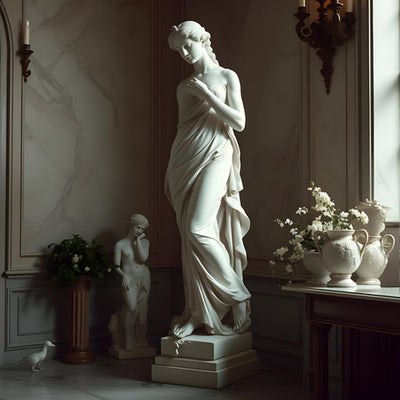
Marble weighs roughly 168 pounds per cubic foot (about 2,700 kg per cubic meter). Cast resins typically come in at less than half that, and most resin busts are hollow, so the real gap is far wider. A carved head-and-shoulders bust at life scale is at least a two-person lift. A larger piece such as the Classical Female Marble Bust Sculpture, 75cm (about 30 in) needs a plan for the doorway, the stairs and the plinth before it needs a spot on the console.
A useful tell at any marble bust sculpture sale comes from shipping. Solid stone travels crated on a pallet by freight. If a large "marble" bust is offered with standard parcel delivery, the physics does not add up.
Tool Marks Versus Mould Seams: What the Back and Socle Reveal
Carvers finish the face first and the back last. Historically many busts were made for niches, so the rear of the head was left rougher, and plenty of workshops still leave visible claw or rasp texture there. The underside of the socle (the small pedestal the bust sits on) is another honest spot: carved stone shows chisel or saw marks, while a casting shows a flat poured base, sometimes with pinhole air bubbles.
Rough claw and rasp texture on the back of the head points to hand carving.
Moulds leave seams. Look behind the ears and across the tops of the shoulders for a hairline ridge that runs in a suspiciously straight path. The classic giveaway is a "Carrara" bust with a seam running neatly from ear to ear over the crown. That may be a good composite. It is not marble.

Hold a Torch to the Cheek: The Check Resin Can't Fake
Fine white marble is slightly translucent because light passes between its calcite crystals before scattering back. In a dim room, press a phone flashlight against the edge of the cheek, the nose or an earlobe. Real stone glows softly a few millimeters in. Composite stays dead flat, and pure resin tends to glow evenly like plastic, with no depth.
Pale marble glows a few millimeters deep under a torch; composite stays flat.
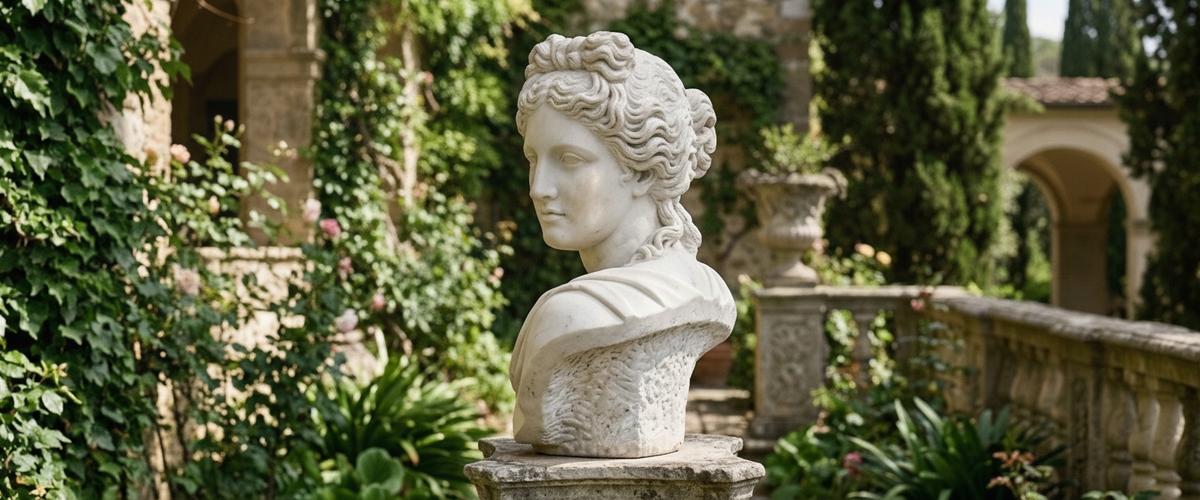
This works best on pale stone. On a smooth white classical face like the Aphrodite Marble Bust Sculpture, 65cm, the glow at the nose and cheek should be easy to see. Gray and heavily veined marbles are less translucent, so a weak glow on dark stone is not proof of a fake.
Eyes and Hairline Show the Carver's Hand Before the Face Does
A smooth face reproduces well in a mould. Hair and eyes are harder. Look for drilled channels between curls, locks that lift away from the head with shadow behind them, and incised pupils with a crisp edge. Moulds dislike undercuts, so casters soften them or skip them entirely.
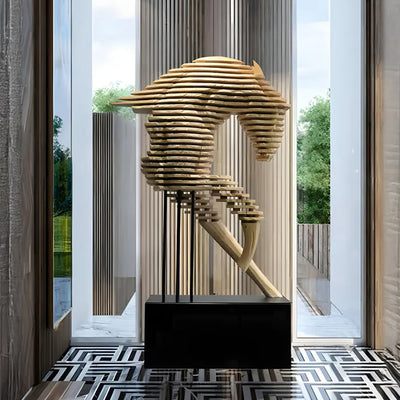
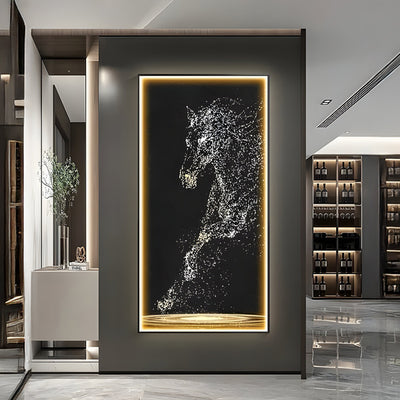
The same principle scales up. When you are weighing a monumental animal form such as the Horse Head Bust with Flowing Mane Marble, 180cm, ask for close-ups of the mane: the strands should separate deeply and independently, the kind of cutting a mould cannot reproduce.
When a Marble Bust Sculpture Sale Price Is Too Low for Real Stone
The cost of a carved bust is built from the block, the carving hours, hand finishing, crating and freight. None of those shrinks much in a sale. If a marble bust sculpture sale runs permanently at a steep discount, the likeliest explanation is composite. A genuine reduction on real stone does happen (display pieces, end-of-line models), but the seller should still be able to name the stone, show the back and give a crated weight.
For bespoke work, budget depends on material, scale, complexity, engineering, installation and finishing, so we always recommend requesting a tailored quote rather than working from a headline number.

Buyer Checklist for Any Marble Bust Sculpture for Sale
Get the material named in writing: Carrara, Statuario, a named gray marble, or composite.
Ask for the net and crated weight.
Request photos of the back of the head and underside of the socle.
Check behind the ears and across the shoulders for seams.
Do the torch test on pale stone.
Zoom in on hair, eyes and undercuts.
Confirm freight, crating and whether your floor or plinth can take the load.
For an antique or high-value piece, get an opinion from a conservator through the American Institute for Conservation.
Whether you are shopping our studio or someone else's marble bust sculpture sale, run that list first. If you want to compare carved options side by side, start with our Marble Busts & Torsos collection, or widen the search across Bust & Torso Sculptures in other materials. For a garden in a freeze-thaw climate, such as Aspen, bronze busts often make more sense outdoors. And if none of the stock pieces fits your room, Giant Sculptures carves bespoke busts to commission, from portrait heads to monumental animal forms in our wider marble sculpture range.