




















































































A torso hides nothing. Take away the head, the arms and most of the legs, and every decision the carver made about stone, surface and stance sits exposed at eye level. That is why one marble female torso sculpture looks quietly inevitable while another reads like a leftover offcut on a box. The gap between the two rarely comes down to how much was spent. It comes down to vein direction across the ribs, where the cut lands, and how the finish behaves under the light already in the room.

Key Takeaways
Vein direction matters more than vein drama. On a marble female torso sculpture, veins running with the implied muscle read as anatomy; veins crossing the ribcage read as cracks.
Statuario, Carrara and Bianco P are not interchangeable. Each treats a soft transition (rib to flank, breast to sternum) differently.
Honed beats polished in warm domestic light. At around 2700K, a honed surface holds warmth; polished throws a hotspot.
The termination sets the mood. A shoulder-and-thigh cut implies a whole standing figure. A hip cut behaves more like a bust.
Know whether you are buying solid stone or marble-dust composite. The tells sit at the base and any join.
Turn it off-axis. Roughly fifteen degrees away from the main sight line gives a static torso movement.
Vein Direction Across the Ribs
Veining is geology, not decoration. It records how the original bed formed, and it runs through the block in a direction the carver either works with or fights. In our studio the block gets chalk arrows on it before roughing out for exactly this reason. Ideally the figure is oriented so the vein rises diagonally from the flank toward the sternum, echoing the pull of the obliques, or runs close to vertical down the center line. Get that right and the stone appears to describe muscle the carver never actually cut.
Horizontal veining across the ribcage is the failure mode. The eye reads a strong lateral gray line on a torso as damage, a repair, or worse. It is the most common reason a buyer looks at a marble female torso sculpture in person and says something feels off without being able to name it. Ask for photographs of the actual piece rather than a studio sample, and look specifically at the ribs and lower abdomen.

Statuario, Carrara and Bianco P Handle a Soft Transition Three Ways
Choosing the stone for a marble female torso sculpture is really a decision about how the soft transitions will behave. Statuario is the brightest of the three, with sparse and confident gray veining and real translucency near the surface. It flatters carving with genuine anatomical detail, because light penetrates a millimeter or two before scattering and gives the modeling depth. It punishes lazy work for the same reason.
Bianco Carrara is the classical default: a soft, feathery gray clouding that forgives. Where a breast meets the sternum or a hip rolls into the thigh, Carrara's diffuse figure blurs the transition slightly and reads as softness rather than indecision. The Greek originals were cut from Parian and Pentelic marble, but the Roman versions that shaped our idea of the fragment torso came largely out of Luna, the quarries we now call Carrara, and the Metropolitan Museum of Art collection is worth studying for how those transitions were originally modeled.
Bianco P is whiter still, with a fine even grain and almost no figure at all. Choose it when you want pure form and nothing else, which suits pared-back contemporary carving and rooms with a lot of texture elsewhere. Across the pieces in our marble busts and torsos range you can see how much the same pose shifts in character with the stone underneath it.
Honed Skin Reads Warmer at 2700K
Polished marble reflects light specularly. It mirrors whatever lamp is nearest, cools the surface tone, and exaggerates every small ripple in the modeling. Honed marble scatters light instead, keeps that faint subsurface glow, and behaves much more like skin. Under warm residential lighting around 2700K, a honed marble female torso sculpture takes on the warmth of the room; a polished one bounces a bright spot back at you and loses its form in the glare. The Natural Stone Institute publishes clear guidance on how these finishes differ in behavior and in care requirements.
Polished has its place. In a gallery-style space with cooler 3500K to 4000K light and matte plaster walls, a polished surface gives you crisp contrast and a sharper silhouette. Just decide the finish after you know the lighting, not before.

Where the Cut Falls at Shoulder, Hip and Thigh
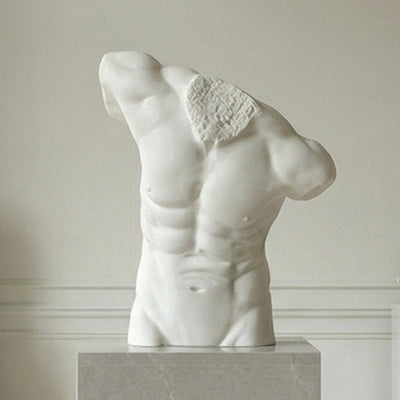
Each termination makes a different promise. A cut high at the shoulder combined with a break at mid-thigh implies a complete standing figure whose remainder has simply gone missing; it carries the most narrative weight and needs air around it. At 130cm (about 51 inches), Female V2 Marble Torso Sculpture - 130cm works that way, reading as floor-standing architecture in a double-height entry or at the end of a long gallery hall.
Terminate at the hip and the piece behaves more like a bust: compact, contained, happy on a console or a library shelf. In a hallway, a library or a small reception room rather than a double-height space, a hip-cut piece around 80cm such as Female Marble Torso Sculpture, 80cm (roughly 31 inches) is the easier fit. A cut that runs below the pelvis into the thigh gives you the strongest read of weight shift, because the viewer can see which leg was carrying.
Solid Block or Marble-Dust Composite
For wider placement ideas, No Head, No Arms: How to Buy an Abstract Female Torso Sculpture That Holds a Room is useful companion reading before finalising the setting and sightlines.
Composite has legitimate uses, but you should know which one you are buying. The tells hide at the base and at any join. Turn the piece and look at the underside: a poured composite often shows a flat mold face, a faint parting seam, and a uniform color with no crystal sparkle. Solid stone shows saw marks or a dressed face, and a chipped edge glitters because you are looking at crystalline calcite. Composite chips crumble into granular, resin-bound dust instead.
Two other checks. Solid marble feels noticeably cold and stays cold; resin-bound material warms to the hand within seconds. And if two units of the same model have identical veining in identical places, that pattern was molded, not quarried. Every marble female torso sculpture commissioned through Giant Sculptures is cut from solid block, which also governs weight, mounting and how the base needs to bear load.
The Fifteen-Degree Turn That Gives a Static Torso Movement
Mount a marble female torso sculpture square to the wall and it looks like inventory. Rotate it roughly fifteen degrees off the primary sight line so one shoulder leads and the opposite hip recedes, and the body starts to twist even though nothing below the thigh exists. We shipped a torso to a designer outside St. Helena who had it dead square in a hallway for a month and could not work out why it felt inert. Turning it fifteen degrees toward the window put a raking shadow under the ribs and the whole piece woke up.
Plinth height follows the cut. For a hip-terminated piece, aim to bring the sternum near standing eye level. For a taller floor-standing torso, drop the plinth so the viewer looks slightly up the ribcage rather than down into it. Paired compositions want mirrored angles rather than matching ones; with something like the Male & Female Marble Torso Sculpture Set - 100cm (about 39 inches each), three to four feet (0.9 to 1.2 m) of separation lets each figure keep its own shadow.

Buyer's Checklist
Request photographs of the specific piece, shot from three sides, with the ribs clearly visible.
Confirm the vein direction relative to the figure's center line.
Name your marble: Statuario, Bianco Carrara or Bianco P, and ask why it suits the carving.
Match finish to lighting temperature before you commit to honed or polished.
Ask whether the stone is solid block or composite, in writing.
Check the base bearing area against the load capacity of your plinth, floor or console.
Plan the fifteen-degree rotation into the plinth footprint, not after delivery.
Ask about sealing, indoor versus sheltered outdoor siting, and long-term cleaning.
Commissioning a Bespoke Marble Female Torso Sculpture
Bespoke work starts with the block. Vein matching for a pair, an unusual scale, a specific termination or a particular degree of surface softness all depend on what the quarry can supply, so the conversation runs backward from availability to design. Budget for a marble female torso sculpture is driven by material, scale, carving complexity, mounting engineering, finishing and crated freight, which is why we quote each commission individually rather than publishing a figure. If you want to compare approaches first, the wider marble sculptures collection shows how the same stone behaves across figures, fragments and abstract forms.