





































































































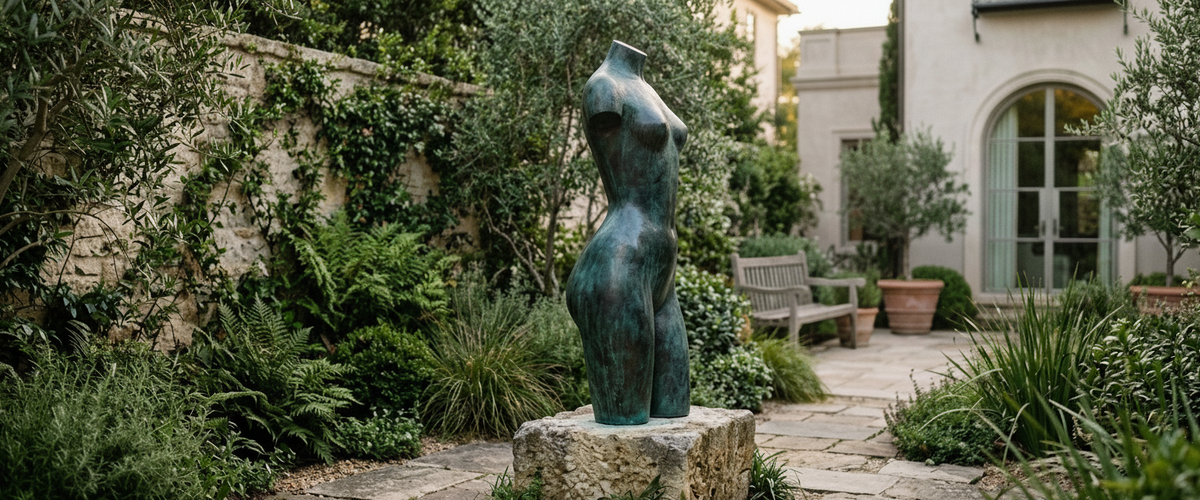

Strip a figure of its head and arms and you take away every easy cue a viewer leans on. An abstract female torso sculpture has no face to read, no hand pointing anywhere, no narrative to fall back on. What remains is contour: the hip line, the turn of the ribcage, the way a cut edge meets open air. Get that right and the piece anchors an entrance hall or a pool terrace for thirty years. Get it wrong and you have bought a shop mannequin on a nice plinth.

At a Glance
The hip line is the whole design. In any abstract female torso sculpture, if the weight shift does not read from twelve feet away, no finish will rescue it.
The crop matters as much as the form. Where the piece ends at the shoulder, thigh and neck decides whether it looks considered or amputated.
Material sets the temper. Bronze softens, marble cools, cast stone blunts. Same subject, three different tempers.
Surface is judged at arm's length. Polished, tooled and sandblasted all read differently up close and almost identically from across a lawn.
Plinth height changes the meaning. Chest height reads intimate. Knee height reads architectural.
Budget follows material, scale, engineering and finish. Ask for a tailored quote rather than guessing from a photograph.
No Head, No Arms, No Alibi
The torso has been a complete sculptural statement since antiquity, and the modern tradition made it deliberate rather than accidental. Rodin famously presented headless, armless figures such as The Walking Man as finished works, not damaged ones. That is the standard a contemporary piece is measured against.
The diagonal from high hip to dropped shoulder is what keeps a cropped form alive.
Practically, this means the pelvis does the acting. Look at any strong abstract female torso sculpture and you will find one clear diagonal running from the high hip to the dropped shoulder line. That diagonal is what makes the form look alive instead of embalmed. Walk around a candidate piece and check the profile from the side and the three-quarter rear, not just the front. Weak pieces have a good front elevation and a flat, unresolved back, because the back was treated as a surface rather than as sculpture. In our studio, the back view sends more maquettes into revision than anything else.

The Crop That Separates a Torso from a Mannequin
Two decisions define the crop on an abstract female torso sculpture: where the form stops at the top and where it stops at the bottom. A neck cut straight across at the collarbone tends to look industrial. A cut angled higher on one side, following the trapezius, keeps the implied movement going past the edge. At the bottom, ending mid-thigh usually reads better than ending at the hip joint, because the thigh gives the eye somewhere to travel before the form resolves into the base.
Elongation is the other lever. Stretching the neck and torso beyond natural proportion pushes a piece from figurative toward pure form, which is why elongated crops sit so comfortably in minimal interiors: the exaggeration signals intent rather than accident. Set one beside a naturally proportioned piece in the same room and you will see instantly which language the space wants.
Bronze, Marble and Cast Stone Each Simplify the Body Differently
Bronze is the most forgiving material for a simplified abstract female torso sculpture. Casting holds a knife-sharp edge alongside a soft belly plane, and patina gives the maker a second pass at tuning warmth. A cast piece such as the Modern Abstract Female Figure Bronze Sculpture - 100cm (about 3 ft 3 in) is a fair test of what the alloy does well: the transitions stay fluid rather than faceted, even where the form is heavily reduced. Outdoors, bronze develops its own protective surface over years, though it still wants periodic washing and waxing, which the American Institute for Conservation sets out clearly for owners of exterior work.
Marble goes the other way. Carving is subtractive and unforgiving, so marble torsos tend toward broader, calmer planes and a cooler emotional register. In bright Southern California sun a white marble torso can bleach out at midday and come alive again at five o'clock. Cast stone sits between the two: heavier in feel, blunter in detail, and well suited to a garden where you want mass rather than refinement. Browse the marble busts and torsos alongside the bronze abstract sculptures and the difference in temperament is obvious within a minute.

Polished, Tooled or Sandblasted
Tooled and satin surfaces suit pieces people touch; polish suits pieces they only look at.
Surface finish is the detail buyers judge too early and too far away. From across a garden, a mirror polish and a fine sandblast read almost the same. At arm's length they are completely different objects. Polished bronze reflects the room and can make a torso look jewel-like on a hall console. Tooled surfaces, where chisel or rasp marks are left visible, keep the maker's hand in view and hide fingerprints on work that gets handled. Sandblasted and matte finishes absorb light, which flatters heavy curves and suits hot climates where glare is a real problem.
One practical note from commissions we have shipped: clients who touch sculpture (and most do) are happier with a tooled or satin surface. Polished patina in a busy Manhattan lobby needs a maintenance rhythm most building managers will not keep.
Plinth Height Sets the Relationship
Put the crop line at roughly chest height and the piece becomes conversational, almost companionable. Drop the plinth so the torso sits at knee height and the same sculpture turns architectural, something you look down across rather than meet. A Napa terrace commission we worked on landed on a low limestone block for exactly that reason: the owners wanted the vineyard view uninterrupted and the sculpture to sit into the landscape, not stand in front of it.
For indoor pedestal placement, a cropped form in the 50 to 60 cm range such as the Cawsand Brown Torso Sculpture - 50–60cm holds a sideboard or a niche where a full-height figure would crowd the room, and its lighter cast body means the shelf or console does not need reinforcing. Keep the plinth footprint slightly narrower than the widest point of the hips; a base wider than the form always looks like packaging.
Rake the Light Across the Form
Frontal downlights are the most common installation mistake we see. A light dropped straight down in front of an abstract female torso sculpture fills every hollow and kills the shadow that describes the spine and the waist. Raking light from one side at a shallow angle does the opposite: it rides across the muscle planes and pulls the form forward. Outdoors, aim for one primary raking source plus a weak fill on the shadow side, and mount fixtures so they are not glaring into seating areas.
Scaling an Abstract Female Torso Sculpture to the Room
Fragments come with a scale trap. A cropped form at three feet can read as a tabletop object in a double-height space, no matter how good the carving is. The fix is not always more height; often it is more mass or a taller plinth. Where a space genuinely needs presence, a monumental work such as the Monumental Modern Seated Figure with Hollow Torso Bronze Sculpture - 220cm (about 7 ft 3 in) gives the void itself enough size to become the subject, which a small torso in the same atrium never manages.
As a working rule for interiors, allow the sculpture to occupy about a third of the wall height behind it. In gardens, judge against the nearest mature planting rather than the house. Costs on any bespoke abstract female torso sculpture depend on material, finish, scale, internal engineering, base design and installation access, so send us site photographs and rough ceiling or sightline heights and we will quote against the real conditions.

Buyer's Checklist
Ask for photographs of the rear and both three-quarter views before committing.
Confirm the crop lines at neck and thigh; request a sketch overlay if you are commissioning.
Decide on surface finish by touch, not from a catalog photo.
Check the fixing method: doweled, bolted or free-standing, and what the plinth needs underneath.
For exterior placement, confirm drainage at the base so water cannot pool against the foot.
Plan lighting angles before the plinth is poured, not after.
Ask what maintenance the finish needs annually, and who does it.
Start with the bust and torso sculptures to see how different crops behave, then talk to us about scaling or reworking a form for your site. Giant Sculptures builds bespoke work in bronze, marble, stainless steel and stone, and the torso is one of the forms where a small change in proportion makes the largest difference.
For wider placement ideas, Abstract Gold Face Sculpture: How to Read the Finish Before You Buy is useful companion reading before finalising the setting and sightlines.