





































































































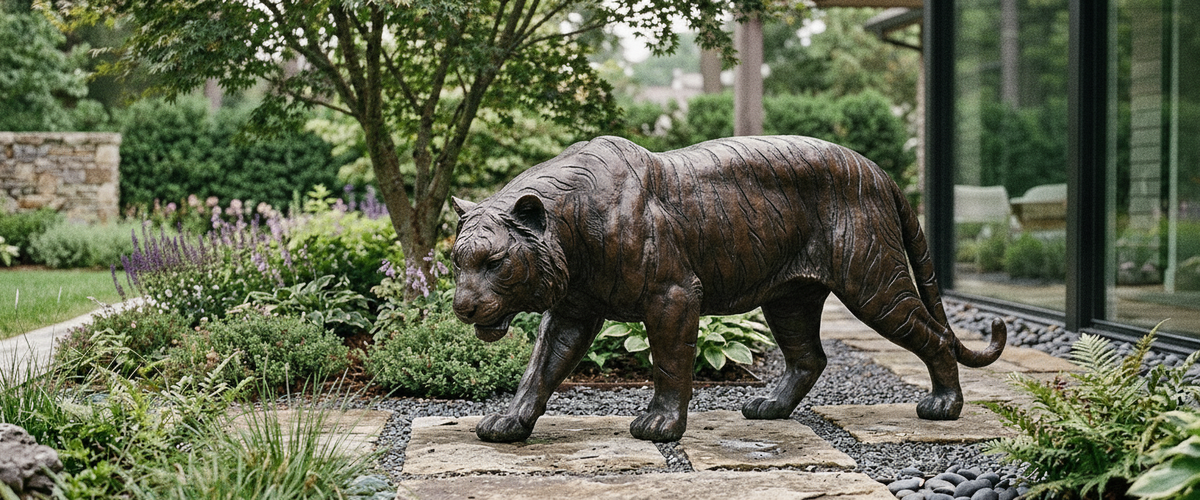

A tiger with its head down and its shoulders loaded reads as a threat from 40 feet (12 m) away. The same animal seated, chin lifted, reads as a guardian. That single difference in posture decides how a bronze tiger sculpture behaves in a space, and it matters far more than height, patina or price. Buyers usually start by asking how big the piece should be. The better first question is what the animal is doing, and where the viewer will be standing when they see it.

At a Glance: What Actually Drives the Decision
Six things decide whether a bronze tiger sculpture works on site, and height is not the first of them.
Stance sets the mood. Prowling reads as tension, seated reads as authority, yawning or roaring reads as spectacle.
Viewing angle follows stance. Prowlers need profile sightlines; open-mouthed poses need a frontal approach.
Wall reliefs live or die on depth. Too shallow and the muzzle flattens into a mask.
Casting method shows in the stripes. Lost-wax carries chased fur detail straight into metal; fabricated work earns its surface from welding, grinding and chasing.
Patina is a planting decision. Dark brown, verdigris and warm ochre each behave differently against green, gray stone or gravel.
Budget depends on scale, alloy, complexity, engineering, finishing and installation. Ask for a tailored quote rather than assuming a bracket.
Three Postures, Three Completely Different Rooms
A stalking bronze tiger sculpture belongs where it can travel. Set one along a lawn edge, a pool terrace or the low side of a sloping garden and the body language does the work: weight forward, spine long, tail counterbalancing. Where the site offers that run of open ground, a piece on the scale of the Life-Size Traditional Stalking Tiger Bronze Sculpture - 150cm, roughly 5 ft (150 cm) nose to tail, has room to read properly. Push the same pose into a corner and it looks confused rather than predatory.

A prowling bronze tiger sculpture needs a run of open ground and a profile sightline.
A seated bronze tiger sculpture is architectural. Seated figures hold thresholds, gateposts, stair heads and courtyard entrances, and they tolerate tight placement because the silhouette is compact and vertical. Pairs work here in a way they never do with prowlers, which is why seated figures tend to end up flanking an approach rather than sitting alone in open lawn. The classic arrangement is also the simplest: a gravel forecourt, a stone gate, one cat on each side.
Fighting or interlocked groups are the loudest option and the hardest to place. A composition on the scale of the Large Contemporary Fighting Tigers Bronze Sculpture, reaching about 7 ft 2 in (220 cm), needs 360-degree circulation, because the drama sits in the negative space between the bodies. Hotel lobbies, resort arrival courts and large private gardens handle this well. A suburban side yard does not.
Why a Yawning Tiger Bronze Needs a Frontal Approach
An open jaw is a frontal event. The teeth, tongue and pulled-back lips only resolve when the viewer stands more or less in line with the muzzle, which is why a yawning tiger bronze sculpture wants to sit at the end of a path, at the head of a courtyard or facing a doorway. Place the same bronze tiger sculpture in profile against a hedge and you lose the whole point of the pose; the head becomes a lumpy outline. Roaring variants behave the same way. Monumental open-mouthed work also asks for eye-level thinking: on a plinth above about 4 ft (1.2 m), the viewer starts looking at the underside of the jaw rather than into it.
Prowlers are the inverse. Their strength is the long line from nose to tail, so give them a wall, a hedge or a water edge to run along and let people read them side-on before they ever see the face.
Chinese Bronze Tiger Sculpture Traditions and What the Stance Signaled
The Chinese bronze tiger sculpture has a much older brief than garden decoration. In early bronze culture the tiger appears as a guardian and a symbol of martial power, used on ritual vessels, tomb furnishings and military tallies rather than as freestanding ornament. Crouched, compact forms with heavy shoulders signaled protection at a boundary; a low, tense body was a warning aimed outward, not a decorative flourish. Collections of early Chinese bronzes at institutions such as the Cleveland Museum of Art show how consistently the animal was tied to threshold and authority.
That history is useful when you buy. If you want a bronze tiger sculpture that guards, follow the tradition and go compact, low and paired. If you want narrative and movement, look to the naturalistic Western animalier tradition instead, where the walking and stalking studies came from close observation of live animals.

Bronze Tiger Wall Sculpture: Getting the Relief Depth Right
A bronze tiger wall sculpture is the most commonly botched format in this subject. The head is the whole composition, and heads have depth: brow ridge, cheek ruff, muzzle projection. Ask for enough relief that the muzzle and brow throw real shadow, then position the piece so daylight or a downlight crosses the face rather than hitting it flat-on. Half-round and high-relief treatments hold up on brick, plaster and stone. Very shallow versions flatten into a plaque, and no patina saves them. Get the depth right and a wall-mounted bronze tiger sculpture holds a courtyard as firmly as a freestanding one.
Cross-lighting a high-relief head keeps the brow and muzzle throwing shadow.
TIG Welding Bronze Sculpture Versus Lost-Wax Casting
Fur and stripe detail is where fabrication method becomes visible. Lost-wax casting carries the sculptor's modeling directly into metal, so chased coat texture, whisker pads and the fine break of stripes over a shoulder blade survive into the finished bronze. Fabricated and TIG-welded work builds form from sheet and plate, then relies on weld bead, grinding and chasing for surface. A fabricated bronze tiger sculpture suits stylized, faceted or planar treatments extremely well, and it is the right route when a client wants a contemporary reading rather than a naturalistic one.
TIG welding a bronze sculpture is skilled work. Silicon bronze is the usual fabricator's choice because it welds cleanly and takes patina consistently across weld and parent metal, and copper-alloy welding practice is covered in American Welding Society standards. In our studio the tell is always the same: on cast pieces we chase stripes into the wax; on fabricated pieces we plan the seams so they run with the anatomy, never across a cheekbone.
Patina: Dark Brown, Verdigris or Warm Ochre
Dark brown patina is the safe, confident choice for a bronze tiger sculpture set against green planting and pale stone, and it keeps stripe relief legible at distance. Verdigris cools the whole piece and works beautifully against gray granite, weathered timber or a coastal palette, though it can disappear into heavy foliage. Warm ochre and lighter chestnut tones read closest to real tiger coat color and sing in gravel, decomposed granite or desert planting. Water changes the calculation again: a piece such as the Life-Size Traditional Walking Tiger Bronze Fountain, at around 5 ft 11 in (180 cm), will develop mineral streaking wherever water runs, so pick a patina that ages gracefully with it rather than fighting the staining.

Checklist Before You Commission
Confirm the primary viewing angle and distance before choosing a stance.
Check circulation space; groups and prowlers need approach room, seated pairs do not.
Set plinth height from eye level, not from a catalog default.
Specify base fixing and, for larger work, ask about foundation or pad requirements.
Decide cast versus fabricated based on how naturalistic you want the coat to read.
Match patina to planting, hardscape color and any water feature.
Plan access: gate widths, crane or forklift reach, ground protection.
Agree a simple care routine, usually rinsing, drying and periodic waxing for outdoor bronze.
Giant Sculptures works on both sides of this decision: existing pieces from our bronze tiger statues range and bespoke commissions where a bronze tiger sculpture is built around one site's stance, scale and patina. If you are still comparing subjects, the wider bronze animal sculptures collection is a useful way to test how much drama a garden or lobby can actually carry. Send us the site photographs, the sightlines and the finish you have in mind, and we will quote it properly.
For wider placement ideas, Bronze Framed Wall Art: How to Buy a Piece That Earns Its Wall is useful companion reading before finalising the setting and sightlines.