





































































































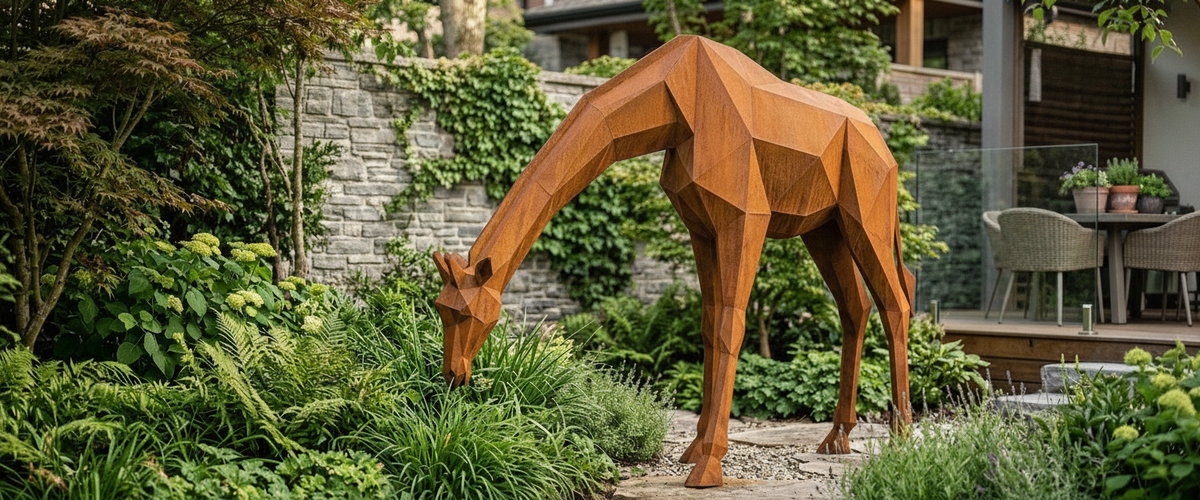

Most outdoor giraffe sculptures do not fail at the hooves. They fail at the neck. A metal giraffe statue outdoor is, structurally speaking, a flag on a pole: a broad head and jaw held at the far end of a slender column, catching every gust that crosses an open lawn. Every pound of wind pressure on that head gets multiplied by the length of the neck and dumped into one weld at the shoulder. Get that joint right and the metal giraffe statue outdoor will outlive the planting around it. Get it wrong and you will notice a lean by the third winter.

At a Glance: What Separates a Ten-Year Piece from a Two-Year One
Neck joint design matters more than surface finish. Ask whether the armature runs continuously from hoof to skull.
Sheet gauge tells you the intent. Decorative garden-center figures use thin skin over a token frame; fabricated builds use structural steel behind the panels.
Continuous seam welds beat tack welds smoothed over with filler. Inspect the belly and inner thigh, not the show side.
Corten, stainless and powder coat age very differently at the same joint. Choose for your climate, not for the photo.
Lower legs and hooves are where water sits, so drainage detailing decides the corrosion timeline.
Anchoring a metal giraffe statue outdoor that is deliberately top-heavy needs a real ballast pad or ground screws, not four spikes in turf.
Why Wind Load Concentrates at the Neck
Picture a 13 ft (4 m) metal giraffe statue outdoor on an exposed rise or at the head of a ranch driveway. The legs carry weight, which is easy. The neck carries bending, which is not. Wind hitting the head and upper neck creates a turning force at the shoulder, and that force grows with height. Two figures of identical height can behave completely differently depending on whether the head is tipped down toward a browsing pose or held high and square into the prevailing wind.
When we quote a tall metal giraffe statue outdoor for an open site, the first question from our fabricators is not about finish. It is about how the neck attaches. The strongest builds run an internal steel spine unbroken from the hoof plates through the body and into the skull, with the panels hung off that spine. Weaker builds treat the neck as a separate tube socketed into the shoulder and sealed with weld metal on the outside only. That second approach looks identical on day one. It behaves very differently in a February gale.
The shoulder joint carries the bending load, which is why a continuous spine beats a socketed neck tube.
Sheet Gauge and Internal Armature: Garden-Center Giraffe Against Fabricated Build
Tap the flank. A thin decorative shell rings hollow and flexes under a palm; a fabricated body feels dead and solid. Thin sheet is not automatically wrong at small scale, but it stops being viable the moment a metal giraffe statue outdoor gets tall, because the skin starts doing structural work it was never designed for. Panel edges then work loose around fixings, and the movement opens hairline gaps that hold water.
Faceted geometric builds handle this well because each plane stiffens the next, which is why they read as sharp and contemporary while staying rigid. At approachable scale, a panel build such as the Giraffe Geometric Steel Outdoor Sculpture, 181cm, roughly 6 ft (1.8 m), carries its own stiffness in the facets rather than relying on a token internal frame. That is the construction logic worth understanding before you commit to a monumental metal giraffe statue outdoor. The wider metal sculptures range shows the same thinking applied to other subjects.

Continuous Seam Welds Against Tack and Fill
This is the inspection most buyers skip, and on a metal giraffe statue outdoor it is the one that decides the ten-year outcome. Take a flashlight, crouch, and look at the underside of the belly, the inside of the legs and the back of the jaw. Show surfaces are always ground and blended. Hidden surfaces tell you the truth. You want continuous seams with consistent bead width. What you do not want is a row of tack welds with body filler smoothed between them, which is common on imported decorative work and which cracks along the filler line once thermal movement starts. Weld quality is a defined discipline with published standards behind it, and reputable fabricators are happy to describe their process; the American Welding Society is a useful reference if you want to understand what you are looking at.
Corten, Stainless and Powder Coat: Three Ten-Year Stories at the Same Joint
Corten weathering steel builds a stable oxide skin that slows further corrosion, but it needs genuine wet and dry cycling to do it. Sit a Corten giraffe under dense tree cover with irrigation misting the legs every morning and the patina never stabilizes properly; it stays actively wet and keeps shedding. The Federal Highway Administration has published extensively on where weathering steel performs and where it does not, and the same site logic applies to any metal giraffe statue outdoor.
Stainless steel is the low-drama option for a metal giraffe statue outdoor on coastal plots and pool surrounds, provided the grade suits salt exposure and the welds are passivated rather than left raw. Powder coat gives you color control, and it is excellent until something chips the film at a leg edge; from there corrosion travels underneath the coating out of sight. Bronze sits in its own category, aging through patina rather than failing, so where the brief is a hundred-year answer rather than a ten-year one, a cast figure like the Life-Size Standing Giraffe Bronze Sculpture, 400cm, around 13 ft (4 m), takes coating repair and repainting off the maintenance list for good.
Hooves and Lower Legs: Where the Trouble Starts First
Water does not attack the neck. It attacks the last four inches of each leg. Rain runs down the body, collects at the hoof plate, and sits in the joint where the leg meets its base flange. Add mulch banked against the metal or a sprinkler head aimed at ankle height and you have created a permanent damp collar. We have opened up legs on older imported giraffe figures and found standing water inside the tube, held there because nobody drilled a weep hole at the lowest point.
Weep holes at the lowest point and a hoof sitting proud of the soil line do more for longevity than any coating.
So ask three things of any outdoor metal giraffe statue: are there drainage holes at the base of each leg, is the internal cavity sealed or ventilated, and does the hoof sit proud of the finished surface rather than buried in soil? A small stainless spacer under each foot solves more corrosion problems than any coating.
Ballast Pads, Ground Screws and Paved Plots
A giraffe is deliberately top-heavy, so anchoring a metal giraffe statue outdoor is not optional. On lawn, a poured concrete pad below grade with cast-in bolts gives the cleanest result; the pad disappears under turf and the figure looks like it grew there. Ground screws work well on sloped or rocky ground where excavation is awkward, and they can be removed later. On paved terraces, the piece can bolt through into the slab structure, but confirm the substrate before anyone drills. Where the ground fights you, a low-slung pose is the easier specification: something like the Life-Size Resting Baby Giraffe Bronze Sculpture, 120cm, about 4 ft (1.2 m), keeps its mass close to the ground and needs far less groundwork, which makes it a practical way to layer a scene around one tall anchor figure.

Buying a Metal Giraffe Statue Outdoor: Questions Worth Asking
Does the internal armature run continuously through the neck, or is the neck a bolted or socketed add-on?
What is the sheet gauge, and what grade of steel or bronze is behind it?
Are seams continuously welded, and can I see photos of the underside before crating?
What prevailing wind exposure has this metal giraffe statue outdoor been engineered for?
Are there weep holes at every low point, and how are the hoof plates detailed?
What anchoring method is supplied, and does it suit turf, gravel or paving?
If the finish is powder coat, can matching touch-up material be supplied with the piece?
Price moves with scale, material, fabrication complexity, structural engineering and installation, so a headline figure for a metal giraffe statue outdoor tells you very little. Get a quote written against your actual site instead. Giant Sculptures builds bespoke commissions to site conditions, which is where the neck detailing, ballast design and finish choice get decided together rather than in isolation.
The Year-Five Check That Keeps the Neck Honest and the Legs Plumb
Sight down each front leg of the metal giraffe statue outdoor with a level. A lean that develops over five years usually means the pad is settling, not that the metal has moved.
Check the shoulder and jaw seams for hairline cracking in the finish, which is often the first sign of flex at the joint.
Clear debris and soil from around each hoof, then confirm the weep holes are still open.
Wash down with clean water and a soft brush. For stainless, rinse salt and irrigation mineral deposits before they etch.
Touch up any powder coat chips down to bare metal immediately; five minutes now saves a repaint later.
Re-torque anchor bolts and inspect the pad edge for cracking or frost heave.
Work through that list at year five, then every few years after, and a well-built giraffe outdoor garden statue simply keeps standing, quietly getting better looking as the patina settles. Skip it and the fault on a metal giraffe statue outdoor will show up exactly where physics said it would: at the neck.
For wider placement ideas around a metal giraffe statue outdoor, Metal Bird Sculptures for the Garden: The Rod Gauge Nobody Checks is useful companion reading before finalizing the setting and sightlines.