






































































































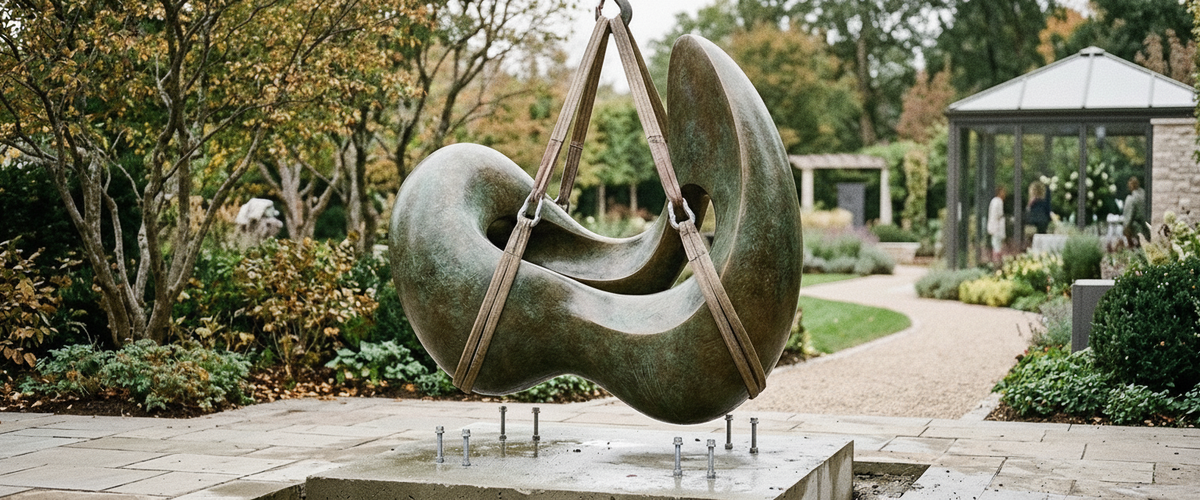

Clients rarely lose sleep over the price of the bronze. The shock is page two of the quote, and this article explains what drives it: the real cost split behind a large sculpture installation, material by material. On a big piece, installation can run from a small fraction of the material price to roughly as much as the sculpture itself, and your choice of bronze, stone, Corten, stainless or resin decides which end you land on. Material sets the weight. Weight sets the footing and the crane. Then come the concrete pad, the lift plan and, in some cities, a permit to close a lane while a tall figure swings over a hedge. That is why every Giant Sculptures quote prices the material, the installation, the engineering and the lift together.

At a Glance
Material sets the weight, and weight sets the foundation, the lifting gear and the access plan.
Bronze and stone cost the most to put in the ground. Corten and stainless move the spend into base plates and anchor engineering.
Lightweight resin and fiberglass are easy to place but need serious anchoring against wind.
A site survey before you finalize the design prevents the most expensive surprises on a large sculpture installation.
Lock the material early. Book the install crew once the foundation drawings are signed.
Why the Material Quote Is Only the First Line
Once a sculpture passes a few hundred pounds or stands taller than a person, an engineer treats it as a small structure. It needs a foundation sized to its weight, a fixing that resists overturning, and a way to get from the truck to its final spot. None of that appears on a foundry invoice. When buyers compare material and installation for large sculpture costs, the numbers only line up if you measure total cost in place, followed by total cost over twenty years of ownership. Budget depends on material, scale, complexity, engineering, installation and finishing, which is why we price every large sculpture installation as one tailored quote.
Bronze and Stone: Weight That Pays for Footings and Cranes
Cast bronze is dense, roughly 550 pounds per cubic foot (about 8,800 kg per cubic meter), though monumental figures are cast hollow. Stone works the other way. A carved granite or marble piece is solid all the way through, so a stone figure often outweighs a hollow bronze of the same silhouette. Either way, the biggest line in a bronze or stone large sculpture installation quote is a reinforced concrete footing that sits below the frost line. That line runs much deeper in Aspen than in Austin.
Weight also decides the crane. Anything beyond what a team can move on rollers needs a lift plan and a certified operator, and US jobsites fall under the OSHA cranes and derricks rules. In Manhattan or San Francisco, the crane brings a street permit and sometimes a traffic plan. One large sculpture installation in the Hamptons taught us to ask about septic systems on the first call: the only crane position that could reach the lawn sat over the leach field, so the piece went in with a smaller tracked crane in two separate lifts.
Corten and Stainless Steel: Lighter Lifts, Heavier Anchors
Fabricated metal is built from plate and sheet around an internal frame, so it weighs far less per foot of height than cast or carved work. On a large sculpture installation budget, the savings tend to come back as engineering. Tall, slender Corten or stainless forms catch wind like a sail. That means thick base plates, chemical or cast-in anchors, and usually a structural engineer's stamp on the drawings.
Each metal adds its own detail. Corten weeps rust-colored runoff for its first seasons, so plan a gravel apron or drainage channel before it stains a pale limestone terrace. Stainless needs fixings that will not set up galvanic corrosion against cheaper carbon-steel anchors. Many of the mirror-polished forms in our stainless steel sculptures collection appear to rise straight out of the lawn, and that clean look depends on a concealed base plate; that hidden plate is where the large sculpture installation money goes.

Fiberglass and Resin: Easy to Set Down, Hard to Keep Upright
Resin and fiberglass look like the bargain on a delivery truck. Two people can carry a sizable piece, and no crane is required. The trouble starts in a storm. A light, tall form has little self-weight to resist overturning, so it needs ground screws, a bolted plinth or a concrete pad, sized against local design wind speeds. You can check those for any US address on the ASCE Hazard Tool. On the Gulf Coast or in coastal Florida, those numbers are sobering. Add UV fading and periodic refinishing, and the lifetime cost of a lightweight large sculpture installation can exceed that of metal or stone. That is why we steer permanent outdoor commissions toward bronze, stainless, Corten and stone.
Access, Ground and Power: The Site Survey Lines That Move a Quote
For wider placement ideas, How to Ship a Large Sculpture Without Losing It at the Garden Gate is useful companion reading before finalizing the setting and sightlines for your large sculpture installation.
The survey is where large sculpture installation budgets swing most. We ask for photos of every gate, the narrowest point on the route, the slope, and whether a soft lawn will need ground-protection mats. In the US, call 811 before anyone digs so buried utilities are marked. Look up too, because overhead power lines can rule out a crane position entirely. On a Napa vineyard project, the access track could not carry a full-size crane, which changed both the lifting method and the delivery vehicle.
Plan for power at the same time. If you want uplighting, run the conduit while the footing is open; trenching back through a finished garden costs far more. Scale changes the whole calculation. For a border or courtyard where the route runs through a garden gate, a hand-carried piece such as the Butterfly Egg & Fern Garden Wrought Iron Installation - 88cm, at 88cm (about 35 inches), can be walked in and fixed to a modest footing with no lift plan at all. Once a piece outgrows two pairs of hands, a large sculpture installation becomes a project of its own.

Phasing Large Sculpture Installation Spend
Sequence matters as much as the totals. Commission the site survey first, then lock the material and design, because switching from Corten to bronze halfway through changes the foundation. Foundation drawings can be prepared while the piece is in fabrication. Pour the footing well before delivery, since concrete typically needs about four weeks to reach design strength. Book the install crew only when the shipping date is firm. Keep a contingency in the budget for site discoveries; buried rubble is common in older Texas and California gardens.
Buyer Checklist Before You Sign Off
Weight: the finished piece plus its base, confirmed in writing.
Route: the narrowest gate, the steepest slope and any overhead lines.
Ground: soil type, frost depth, utilities and drainage.
Wind: exposure level and who signs off the anchor design.
Responsibility: who pours the footing, who supplies the anchors and who carries insurance during the lift.
Power: lighting conduit laid with the foundation.
Long-term care: the maintenance cost of your chosen material over decades, beyond the first year.
Send us site photos and a rough idea of scale, and Giant Sculptures will return a tailored large sculpture installation quote that covers the material, footings and lift in one figure.