


















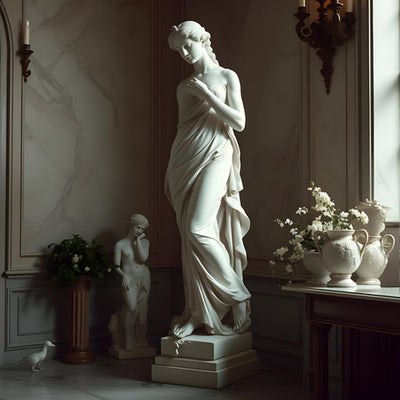





























Buy the god before you have measured the site and you will spend the next decade apologizing for it. Marble statues of Greek gods carry a problem that ordinary garden sculpture does not: every figure arrives with a role, a stance and a set of attributes that demand a particular kind of space. Among large-format marble statues, Greek gods are the least forgiving of a badly chosen spot. Zeus resents being tucked beside a hedge. Apollo looks wrong pinned flat to a wall. Get the pairing right and the carving reads as architecture. Get it wrong and a serious piece of stone reads as a lawn ornament.

At a Glance
Zeus wants a hall, an atrium or a long axial approach. He is a frontal, authoritative figure and needs distance to be read.
Athena suits an enclosed courtyard, where the spear and shield have walls to answer to.
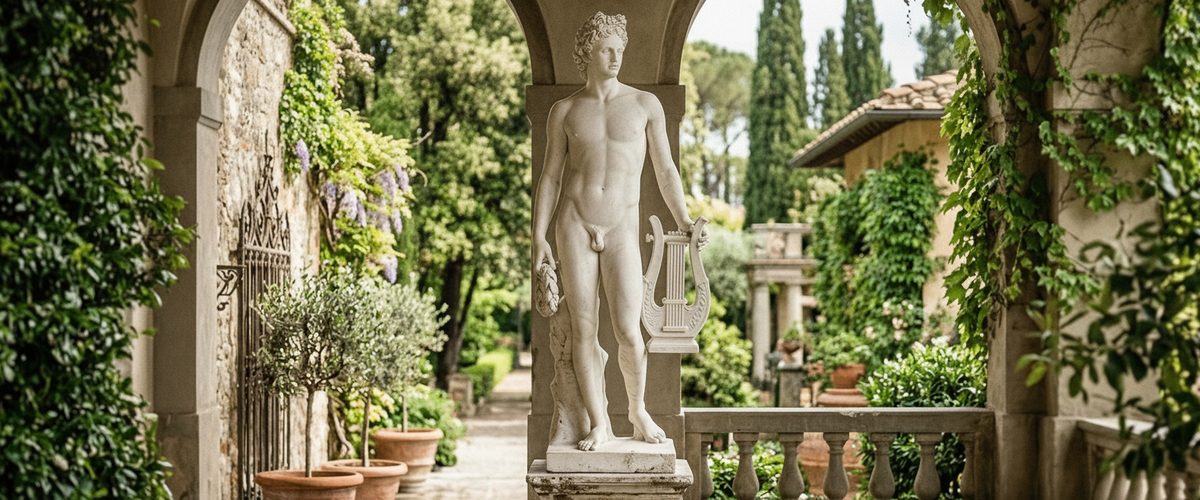
Apollo works best as a garden end-stop, closing a sightline at the far end of a lawn or allee.
Attributes need clearance. A trident, lyre or raised arm fails the moment it crowds a wall.
Thin extremities are the first casualty on exposed, freeze-prone sites. Ask how they were carved and fixed.
Plinth height decides whether marble statues of Greek gods command a space or merely decorate it.
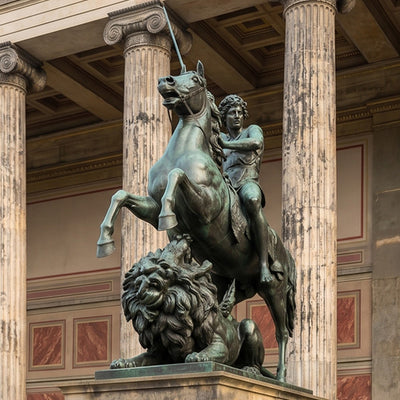
Frontal, authoritative and built to be read from a distance: Zeus holding a double-height hall.
How to Match Marble Statues of Greek Gods to the Space
Scale is only half the calculation. The other half is posture. Zeus is usually carved frontal, weight settled, arm extended or raised with a thunderbolt; that composition wants a viewing distance of at least two and a half times the figure's height. In a double-height entrance hall, an orangery or a covered loggia, he holds the room. Drop the same carving into a narrow side yard and the extended arm becomes a hazard rather than a gesture.
Athena is a courtyard figure. She is vertical, armored and self-contained, and of all the marble statues of Greek gods she gains the most from enclosure; walls give the spear a vertical line to rhyme with. We shipped a full-figure Athena to a Napa Valley courtyard where the client had four blank stucco planes and a gravel square. She anchored it instantly, because the geometry of the space matched the geometry of the pose.
Apollo is the garden piece. Lyre in hand, weight on one leg, the contrapposto only resolves when you approach from a distance and slightly off-axis. He belongs at the end of a lawn, a hedge corridor or a pool axis. Poseidon and Artemis follow similar logic: Poseidon near water or on a raised terrace, Artemis on the move, best sited where a path bends so the stride reads as travel. Where a water axis needs a secondary marker rather than a second deity, a gray marble piece such as the Arching Dolphin Grey Marble Statue - 180cm at 180cm holds the line without competing with the god for attention. The Greek and Roman statues collection is the place to compare marble statues of Greek gods side by side before you commit to one deity.

Attributes Need Airspace
The single most common siting mistake we see with marble statues of Greek gods is treating an attribute as decoration rather than volume. A trident adds roughly a foot (30 cm) of reach beyond the hand. A raised thunderbolt pushes the silhouette upward and sideways. Athena's shield projects forward at hip level, which matters on a path where people pass within arm's reach. The British Museum collection records are a useful reference for which attributes belong to which deity.
Before you order, chalk the full footprint on the ground, including attribute reach, and walk around it. If a lyre arm sits within 18 inches (45 cm) of a wall, the shadow will flatten the carving and the piece will look crammed. Frontal gods can go closer to a backdrop. Figures with outstretched limbs need to stand free. That one habit has saved more Greek god marble statues from a bad spot than any rendering ever has.
Thin Extremities Are the Weak Point Outdoors
Marble is calcite. It is strong in compression and unforgiving in thin section, and it is chemically vulnerable to acidic rain and runoff, as the Natural Stone Institute notes in its guidance on stone selection and care. On an exposed coastal site in the Hamptons, or anywhere with hard freeze-thaw cycling like Aspen or the Colorado Front Range, the parts of marble statues of Greek gods that fail first are fingers, spear shafts, lyre strings, ribbon drapery and the narrow ankle where the leg meets the base.
So ask two questions of anyone selling you marble statues of Greek gods. First, is the attribute carved from the same block, or doweled in? Doweled elements are normal in figurative marble, but the pin should be stainless steel or titanium, never ferrous. Rusting iron pins split stone from the inside out and that is the quiet killer of century-old garden statuary. Second, is there a supporting element, a tree stump, drapery fall or strut, taking load off the free leg? Classical carvers used these for structural reasons, not aesthetic ones.
Statuary Marble or Marble Composite?
For wider placement ideas, Why a Turning Torso Marble Sculpture Needs a Bigger Block Than You Think is useful companion reading before finalizing the setting and sightlines.
Judge this by where the figure stands, not by budget instinct. Of all our marble statues, Greek gods attract the most questions about stone grade, because faces, hands and drapery carry the whole piece. Solid statuary marble, hand-carved, is the right call for a figure that will be touched, lit closely, or read at short range: an entrance hall, a courtyard, a pool terrace. It ages honestly, takes a hand polish, and can be re-dressed decades later by a conservator.
Marble dust composite, cast rather than carved, earns its place on distant sightlines, on roofs and balconies with strict load limits, and anywhere a crane cannot reach. It carries detail well and weighs far less. What it will not do is reward close inspection in raking light, and it cannot be recarved. A useful rule from the studio: if the viewer will ever be within 10 feet (3 m), carve it. Beyond that, cast is defensible. The same test applies to marble statues of Greek gods whatever the deity. Browse the marble sculptures range to see how the two read at different distances.

Bust, Half Figure or Full Figure: How Much Space Each Needs
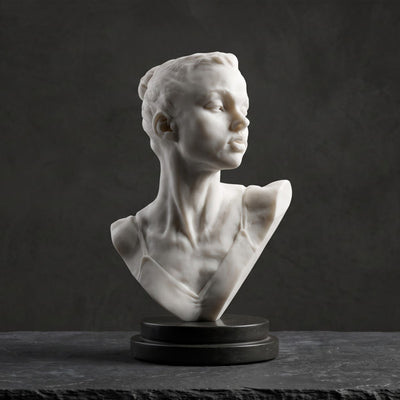
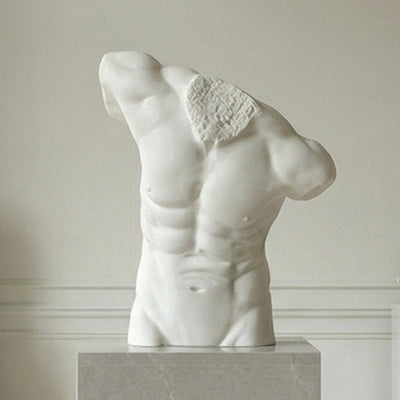
Buyers routinely underestimate the footprint of full-size marble statues of Greek gods. A full-figure god at around 7 feet (2.1 m) plus plinth typically needs a clear circle 10 to 12 feet (3 to 3.7 m) across to be walked around comfortably. A half figure on a pedestal cuts that roughly in half while keeping the head at adult eye level. A bust on a column takes almost no floor area and is the only sensible option in a hallway under 6 feet (1.8 m) wide; our marble busts and torsos work hard in exactly those constrained interiors.
Weight is the other constraint. Solid marble at this scale runs to thousands of pounds, which means foundation pads, access routes and lifting plans. That conversation should happen before you fall in love with a piece, not after.
Plinth Height Sets the Gaze Line
Apollo closing a sightline, set high enough that the pose still commands the lawn.
This is the detail that separates a god from a garden feature, and it is the cheapest upgrade available on marble statues of Greek gods. Raise a deity so the eyes sit above the viewer's own and the figure gains authority immediately. Set the same carving on a low pad and the viewer looks down at it, which drains the pose of every ounce of command.
As a working guide, put a standing god's eyes 12 to 24 inches (30 to 60 cm) above average adult eye level for an authoritative read, and roughly level for an intimate one. Plinth design matters too. A classical Greek key band on the base ties a figure to its period without fuss, which is why the Winged Lion on a Greek Key Plinth Marble Statue - 220cm at roughly 7 feet 3 inches (220 cm) sits so comfortably as a gate marker alongside Greek god marble statues: the plinth does the period work, and the whole composition already clears the viewer's eye line.
Commissioning a Group Without Three Different Whites
Order three gods separately over two years and you will almost certainly end up with three different whites. Marble statues of Greek gods bought piecemeal rarely match, because marble varies by quarry, by bed and by block. Warm cream, cool blue-white and gray-veined stone sitting in one courtyard looks like an accident, because it is one.
If you want a group of Greek god marble statues, commission it as a group. At Giant Sculptures we block-match at the quarry stage so figures in a set share tone and vein character, and we keep finish consistent across the run, whether that is a honed matte or a fine polish. The same discipline applies when you deliberately mix stone: a gray marble accent such as the Alighting Eagle Grey Marble Garden Statue - 220cm, Zeus's own bird, works because the contrast is intentional and repeated across the scheme, not random.

Buyer's Checklist
Chalk the footprint on site, attributes included, and walk it before ordering any of the marble statues of Greek gods on your shortlist.
Confirm viewing distance: under 10 feet (3 m) argues for carved statuary marble.
Ask whether attributes are carved integral or doweled, and in which metal.
Check the free leg and ankle section for structural support on exposed sites.
Set plinth height by gaze line, not by guesswork.
Confirm foundation, access route and lifting requirements early.
Block-match any group at the quarry stage, and agree one finish spec across the set.
Agree a seasonal care routine: rinse with clean water, no acidic cleaners, no pressure washing.
Among marble statues, Greek gods reward planning more than most sculpture, because the figures were designed for specific architectural conditions two and a half thousand years ago and those conditions have not changed. Tell us the site, the sightlines and the climate, and we will tell you which god belongs there and how tall he should stand. Budget for marble statues of Greek gods depends on scale, stone selection, carving complexity, engineering and installation, so the honest answer is always a tailored quote rather than a number pulled from the air.